
NEMT Claims Process: Navigating Claims Smoothly
NEMT providers lose thousands of dollars annually to claim denials that could have been prevented. The difference between a smooth reimbursement and a rejected claim often comes down to documentation, eligibility verification, and timing.
We at Saberlines Insurance Services have seen firsthand how small mistakes derail the entire NEMT claims process. This guide walks you through exactly what you need to do to get paid faster and avoid the most common pitfalls.
Understanding the NEMT Claims Process
What Makes a Claim Valid
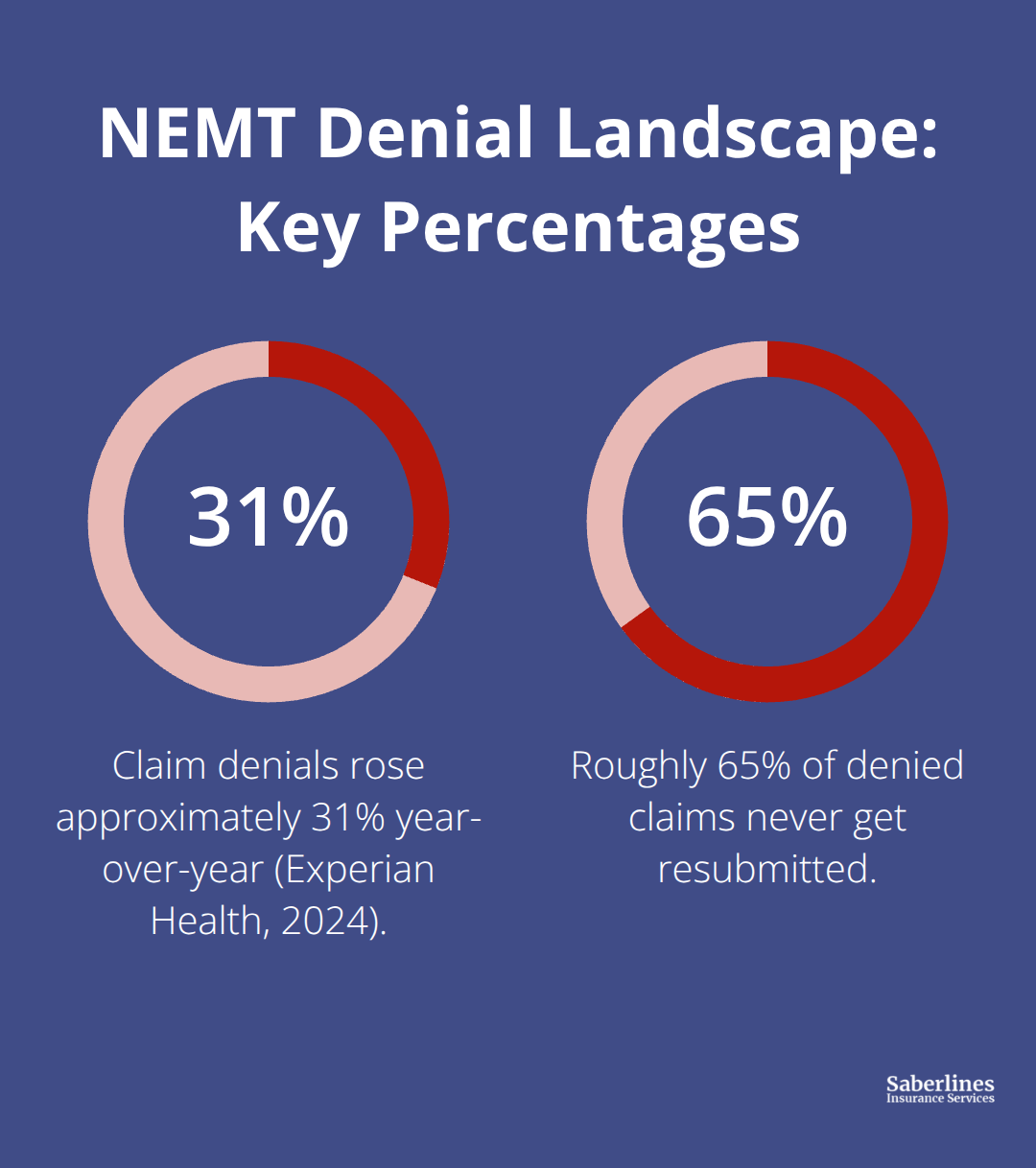
A valid NEMT claim requires five critical elements working in perfect alignment: active patient eligibility on the date of service, accurate billing codes matched to the actual trip type, complete trip documentation with GPS-verified mileage and timestamps, proper prior authorization when required, and submission within the payer’s timely filing window. Experian Health’s 2024 State of Claims survey reports that claim denials rose approximately 31% year-over-year, and roughly 65% of denied claims never get resubmitted, meaning providers abandon thousands in legitimate revenue. Nationally, 10 to 20 percent of NEMT claims face denial on first submission, with smaller fleets frequently exceeding 20 percent denial rates.
What separates successful providers from struggling ones is not trip volume but process discipline. Reworking a single denied claim costs between $25 and $125 in staff time, yet many trips reimburse only $30 to $50, making even one preventable denial a significant financial wound.
Why Claims Fail: Five Root Causes
Denials stem from five distinct categories. Eligibility errors occur when Medicaid coverage changes and plan transitions happen without your knowledge. Missing or incorrect prior authorization numbers cause automatic rejections. Documentation gaps emerge because payers require GPS locations and electronic trip logs rather than paper records. Coding and modifier mistakes-including outdated mileage codes-create mismatches between what you bill and what payers expect. Submission chaos from fragmented payer portals (ModivCare, MTM, Access2Care operate independently) means different formats, timelines, and denial codes apply to each broker. Understanding which root cause affects your operation most frequently allows you to target fixes where they matter most.
Submission Windows and Electronic Requirements
Medicaid brokers dominate NEMT volume, and each operates on different submission deadlines and denial codes. Submitting claims within 24 to 48 hours after service completion significantly reduces payment delays, yet many providers wait days or weeks, pushing claims past timely filing windows that range from 30 to 90 days for brokers and 90 to 365 days for direct Medicaid. Electronic submission using the EDI 837P format is no longer optional; payers reject paper claims or delay them indefinitely. After submission, claims move through acknowledgement via 999 transactions, evaluation where payers verify member eligibility and service records against billing codes, and finally adjudication where errors are flagged or claims are approved. Tracking claims at 14-day intervals after submission catches processing delays early, allowing you to correct issues before they become denials.
Cash Flow Impact and Active Monitoring
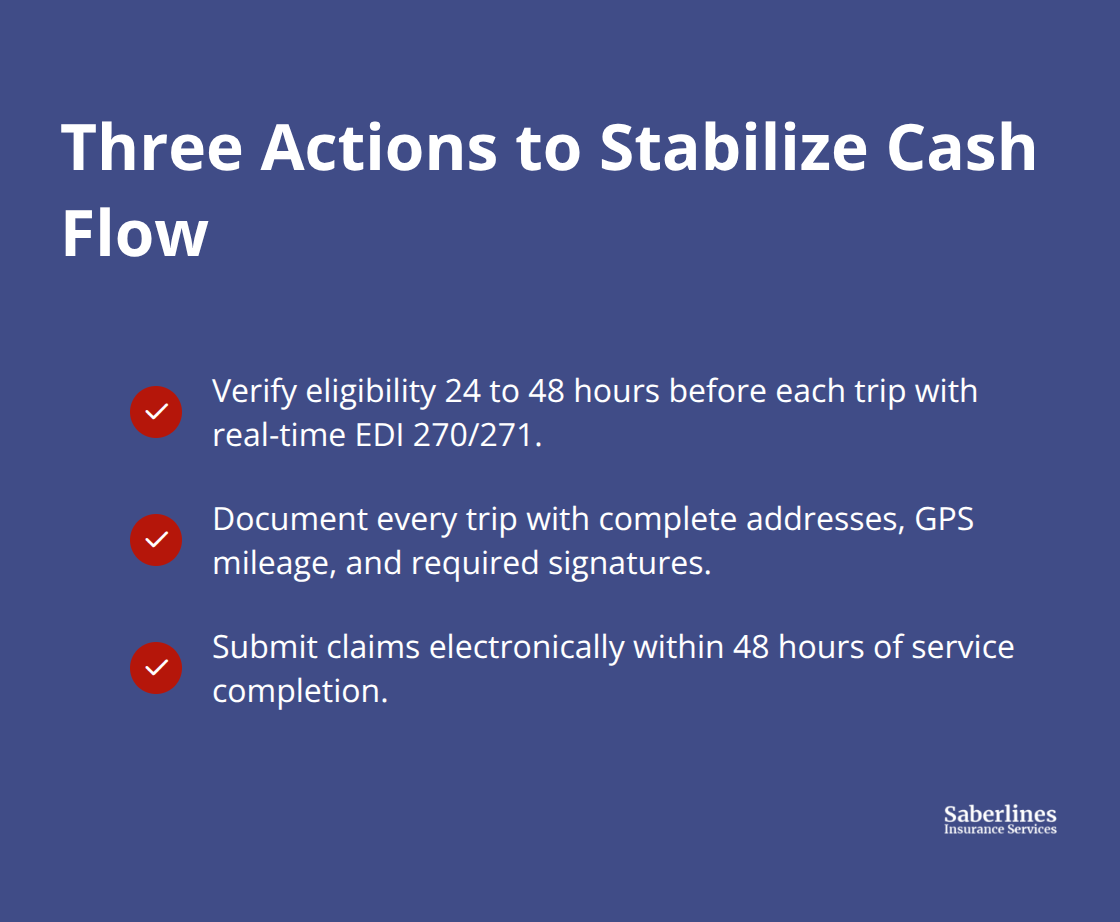
Payment arrives 60 to 120 days after approval in many cases, creating severe cash flow strain when denials occur. The practical path forward requires three actions: verify eligibility 24 to 48 hours before each trip using real-time EDI 270/271 checks, document every trip with complete pickup and drop-off addresses, driver and patient signatures, and GPS mileage, and submit electronically within 48 hours.
Active monitoring of claim status rather than passive waiting prevents surprises and catches errors while they remain fixable. The next section covers the specific documentation and evidence you must maintain to support every claim you submit.
Documentation and Evidence Requirements
The Five Fields That Make or Break Your Claim
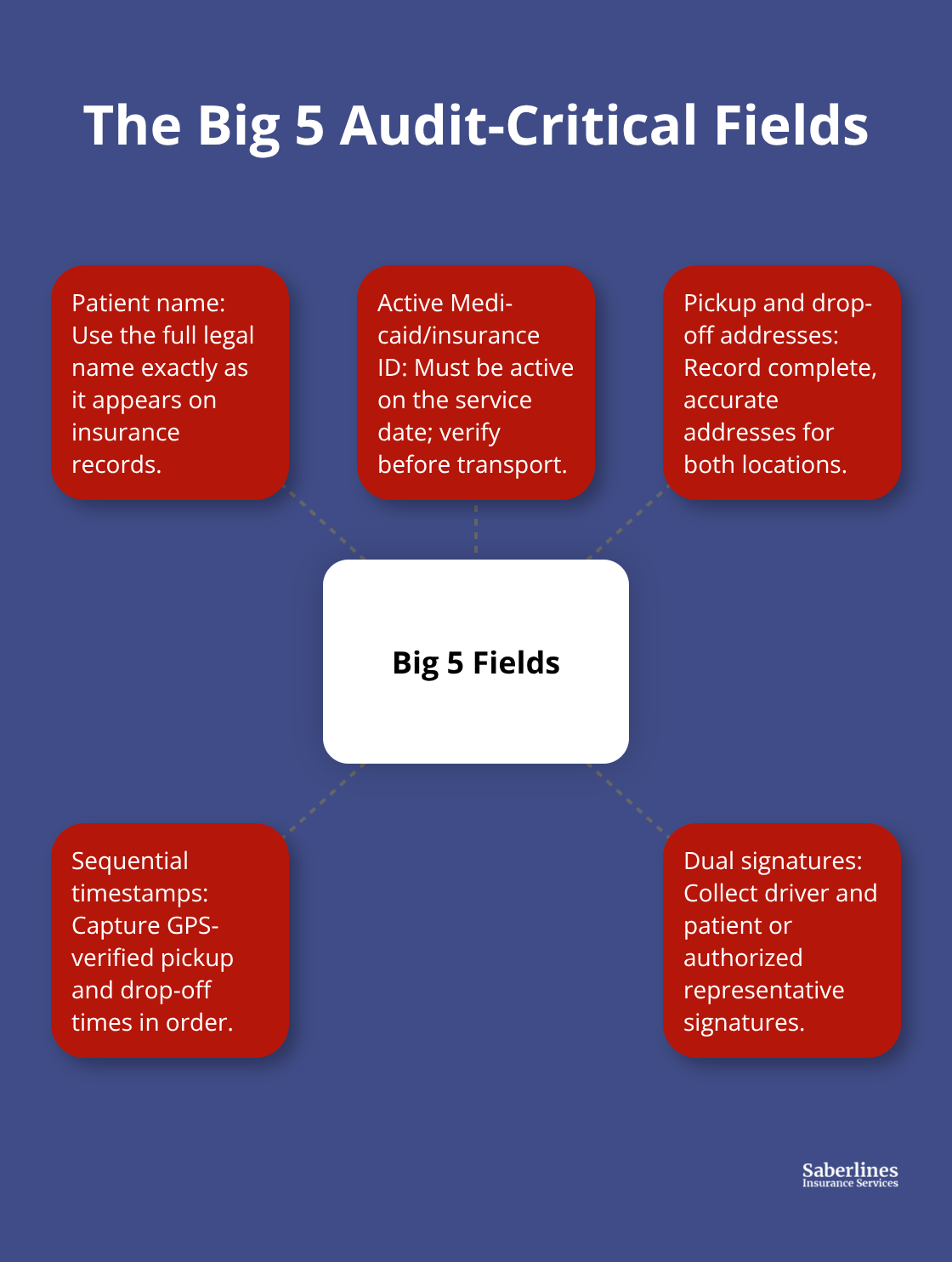
Every trip generates the foundation for payment or denial, and the difference lies entirely in what you capture and how you organize it. Payers require GPS-verified mileage, sequential timestamps showing pickup and drop-off times, complete patient information including active insurance ID, pickup and destination addresses, and dual signatures from both driver and patient or authorized representative. The Big 5 audit-critical fields are patient name, active Medicaid or insurance ID on the service date, complete pickup and drop-off addresses, sequential timestamps, and dual signatures. Missing even one field triggers automatic denial. Paper records fail audits because payers cannot verify authenticity; electronic trip logs with tamper-evident timestamps survive scrutiny.
GPS data matters because it proves the actual mileage you bill; payers compare your claimed miles against their geographic databases and reject mismatches. Medicaid brokers like ModivCare and MTM specifically demand GPS-verified locations in their submission portals.
Medical Certification and Physician Requirements
Physician certification statements become mandatory when you bill wheelchair or stretcher transport. These forms must document medical necessity and mobility limitations, with validity periods ranging from 30 to 180 days depending on your state. If you cannot produce a valid physician certification, that claim gets denied regardless of trip quality. State regulations require you to retain trip documentation for 7 to 10 years, making digital storage non-negotiable for providers managing multiple trips daily.
Building Your Submission Checklist
Organizing claims for submission means centralizing member data in a digital repository where you can retrieve patient records, eligibility status, and trip documentation instantly rather than hunting through email or paper files. Before submission, validate that your HCPCS codes match the actual service provided-ambulatory transport codes differ from wheelchair codes, and mileage add-ons require precise modifiers. Automated billing software flags coding errors before submission, preventing denials that cost $25 to $125 to rework. Submit electronically using EDI 837P format within 24 to 48 hours after service; brokers process electronic claims faster than paper submissions.
Create a checklist for each claim: verify patient eligibility 24 to 48 hours before service, collect complete trip documentation with GPS mileage and timestamps, select correct HCPCS codes and modifiers, include prior authorization number if required, and submit electronically within the payer’s timely filing window. Payers return electronic acknowledgements via 999 transactions confirming receipt; if you do not receive one within 2 to 3 business days, follow up immediately because missing acknowledgements indicate submission failures.
Tracking and Reconciliation After Submission
After submission, track claims using payer portals or your billing software; check status at 14-day intervals to identify delays before they exceed timely filing deadlines. When payment arrives, reconcile the remittance advice against your submitted claims to confirm paid amounts match expectations and identify any underpayments requiring correction. This active monitoring prevents surprises and catches errors while they remain fixable. The next section covers the specific practices that separate providers with low denial rates from those struggling with repeated rejections.
Best Practices to Avoid Claim Denials
Verify Eligibility Before Each Transport
Eligibility verification stands as the single most important action you can take to reduce denials, yet most NEMT providers skip it or perform it too late. Verify patient eligibility 24 to 48 hours before each trip using real-time EDI 270/271 checks through your billing software or clearinghouse, not the day-of or after service completion. Medicaid eligibility changes monthly without warning due to income fluctuations, plan transitions, or coverage gaps. When you transport an ineligible patient, the claim receives an auto-denial with zero opportunity for appeal, and you absorb the entire cost.
Industry data shows that 65 to 70 percent of NEMT denials are preventable, and most of them start with missed eligibility checks. If your software lacks real-time eligibility verification, you operate blind and lose money on trips that never should have been scheduled. Brokers like ModivCare and MTM require you to confirm eligibility before submission; skipping this step wastes the time you spend on documentation and coding. Assign one person responsibility for eligibility checks and track which patients you verified and on what date. This creates accountability and prevents the chaos of multiple staff members checking eligibility independently, which leads to missed updates and duplicate work.
Maintain Accurate Trip Records and Billing Codes
Trip documentation accuracy directly determines whether payers approve or deny your claims, and sloppy records cost far more than the time needed to capture data correctly. GPS-verified mileage is non-negotiable because payers cross-reference your claimed miles against their geographic databases and reject mismatches automatically. Use dispatch software with integrated GPS tracking that records actual mileage in real-time rather than relying on driver estimates or manual calculations.
Sequential timestamps showing exact pickup and drop-off times matter because payers verify that service times align with the trip purpose and detect inflated billable hours. Dual signatures from both driver and patient or authorized representative prevent denials based on missing attestation. Assign the correct HCPCS code to each trip before submission and verify that your code selection matches the actual service provided-ambulatory transport uses different codes than wheelchair transport, and mileage add-ons require precise modifiers aligned with your state’s current rules.
Coding errors alone account for a significant portion of preventable denials, yet many providers use outdated code references or fail to update them when states change rules. Colorado and Minnesota modified their NEMT coding requirements in 2025, and providers still using 2024 code sets trigger denials automatically. Store all trip documentation in a centralized digital repository where any staff member can retrieve patient records, eligibility status, and service details instantly. Paper files scattered across email inboxes and filing cabinets guarantee that you will miss required information during claim submission.
Respond Quickly to Insurance Requests for Information
When payers request additional documentation to support a claim under review, respond within 48 hours with complete, organized records showing patient name, insurance ID on service date, GPS mileage, timestamps, and signatures. Delayed responses push claims past evaluation windows and trigger denials by default. Set calendar reminders for every payer request and assign response responsibility to a specific team member to prevent requests from falling through cracks.
Final Thoughts
The NEMT claims process succeeds or fails based on discipline, not luck. Eligibility verification 24 to 48 hours before service, complete trip documentation with GPS mileage and timestamps, and electronic submission within 48 hours form the foundation of a low-denial operation. When you execute these practices consistently, your clean claim rate climbs toward 95 percent, your days in accounts receivable shrink, and your cash flow stabilizes.
Reworking denied claims costs $25 to $125 per claim while many trips reimburse only $30 to $50, making prevention far cheaper than recovery. Providers who implement real-time eligibility checks and automated claim scrubbing report denial rates below 5 percent, compared to the national average of 10 to 20 percent. That difference translates to tens of thousands of dollars annually in recovered revenue.
If denials exceed 10 percent, prioritize eligibility verification and documentation improvements immediately. At Saberlines Insurance Services, we work with NEMT providers across the country to help you maintain proper commercial auto, workers compensation, and general liability coverage alongside your billing operations. Visit our website to explore coverage options that support your operation while you focus on optimizing your claims process.
The information provided in this blog is for general informational purposes only and does not constitute legal, financial, or insurance advice. Coverage options, terms, and availability may vary. Please consult with a licensed professional for advice specific to your situation.