
NEMT Fleet Coverage Options: Scalability For Growing Operators
Growing your NEMT operation means your insurance needs grow too. What protected you at five vehicles won’t cut it at fifteen, and your coverage gaps become more expensive the larger you get.
We at Saberlines Insurance Services see operators miss critical protection every day because they don’t adjust their NEMT fleet coverage options as they expand. The good news is that right-sizing your coverage is straightforward once you know what to look for.
What Coverage Types Actually Scale With Your Fleet
Commercial Auto Insurance Requires Structural Changes
Commercial auto insurance forms the backbone of any NEMT operation, but most operators get it wrong when they expand. Standard commercial auto policies have per-vehicle limits, meaning adding a third van doesn’t automatically triple your protection. You need to audit your policy structure as fleet size grows. At five vehicles, a 100/300/100 liability limit might feel adequate. At fifteen vehicles, you expose yourself significantly. The National Association for Medically Necessary Transportation reports that larger NEMT fleets face higher accident frequency simply because more vehicles on the road creates more exposure. Your policy should reflect cumulative risk, not just individual vehicle risk.
Aggregate limits matter more than per-vehicle limits once you operate multiple units regularly. Some carriers cap aggregate coverage at three times your per-vehicle limit, which creates dangerous gaps for growing operations. You need a carrier willing to write higher aggregates or structure your policy with umbrella coverage layered on top.
Workers’ Compensation Costs Scale Unpredictably
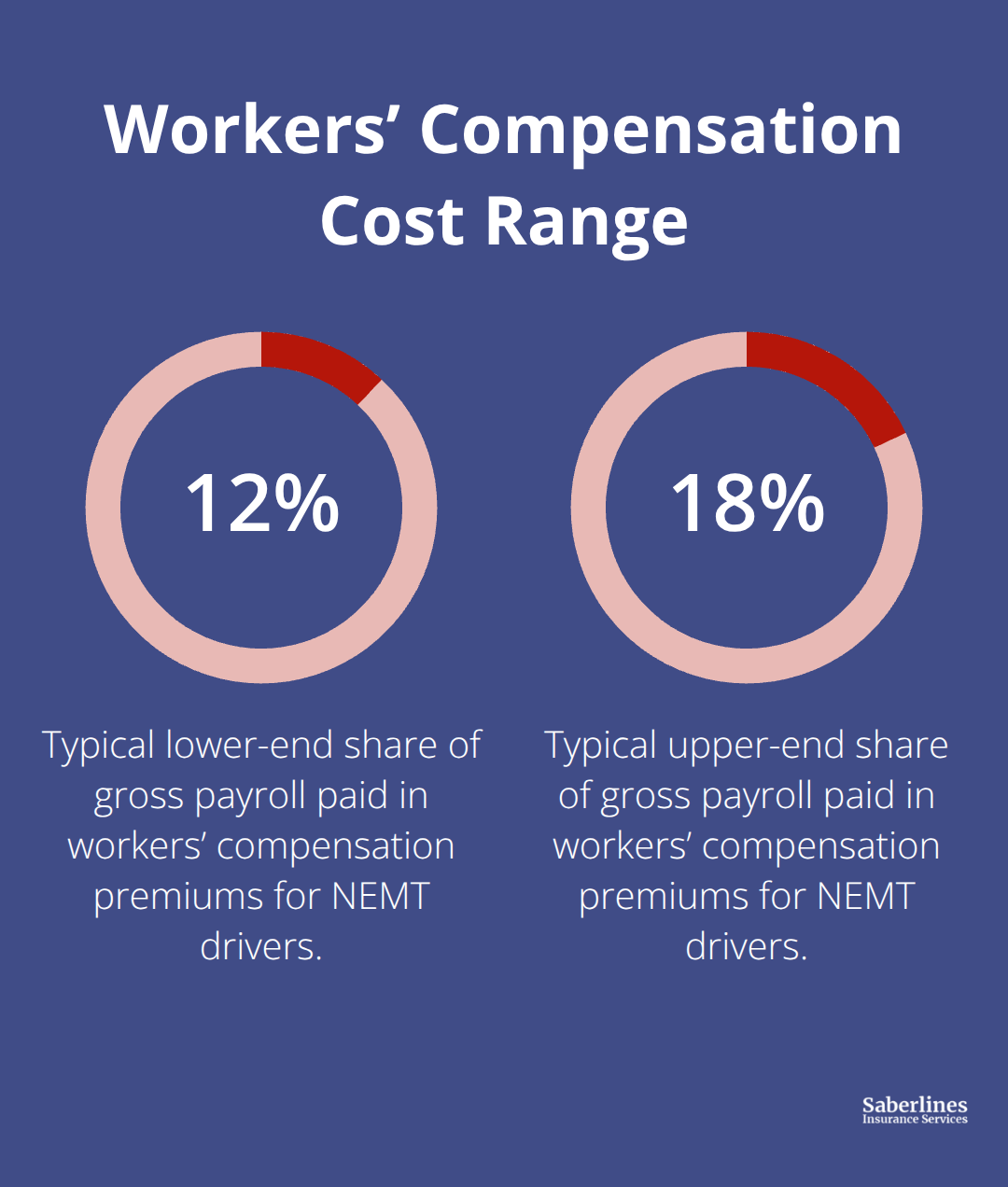
Workers compensation becomes a major cost factor the moment you hire your first employee, and it scales in ways most operators underestimate. The average NEMT driver in California costs between 12 to 18 percent of gross payroll for workers compensation premiums, according to California Department of Industrial Relations rate filings. Hiring five drivers doesn’t cost five times what one driver costs because of experience modification rates.
Your mod rate climbs if you have claims history, so a single serious injury claim can increase your entire payroll cost by 15 to 40 percent for years. This means investing in driver safety training and vehicle maintenance actually reduces your insurance costs, not just your accident risk.
General Liability Exposure Compounds With Passenger Volume
General liability coverage protects against passenger injury claims that happen outside the vehicle, during boarding or at pickup locations. Many NEMT operators carry inadequate limits here, typically 300/500 when they should carry 500/1000 or higher. A single fall during passenger transfer can generate medical expenses exceeding 200,000 dollars, plus legal costs. As your routes expand and you serve more passengers daily, your exposure compounds. Your general liability limit should increase with passenger volume, not remain static from your first year of operation. This growth in exposure makes the next step-assessing your coverage needs at each expansion stage-essential to protecting your operation.
Right-Sizing Your Coverage as Your Fleet Grows
Reassess Coverage at Each Growth Stage
Most NEMT operators wait until something goes wrong to adjust their insurance. That’s expensive. You should reassess your coverage needs every time you add vehicles or staff, not annually or when a claim happens. Start by calculating your actual exposure at each growth stage.
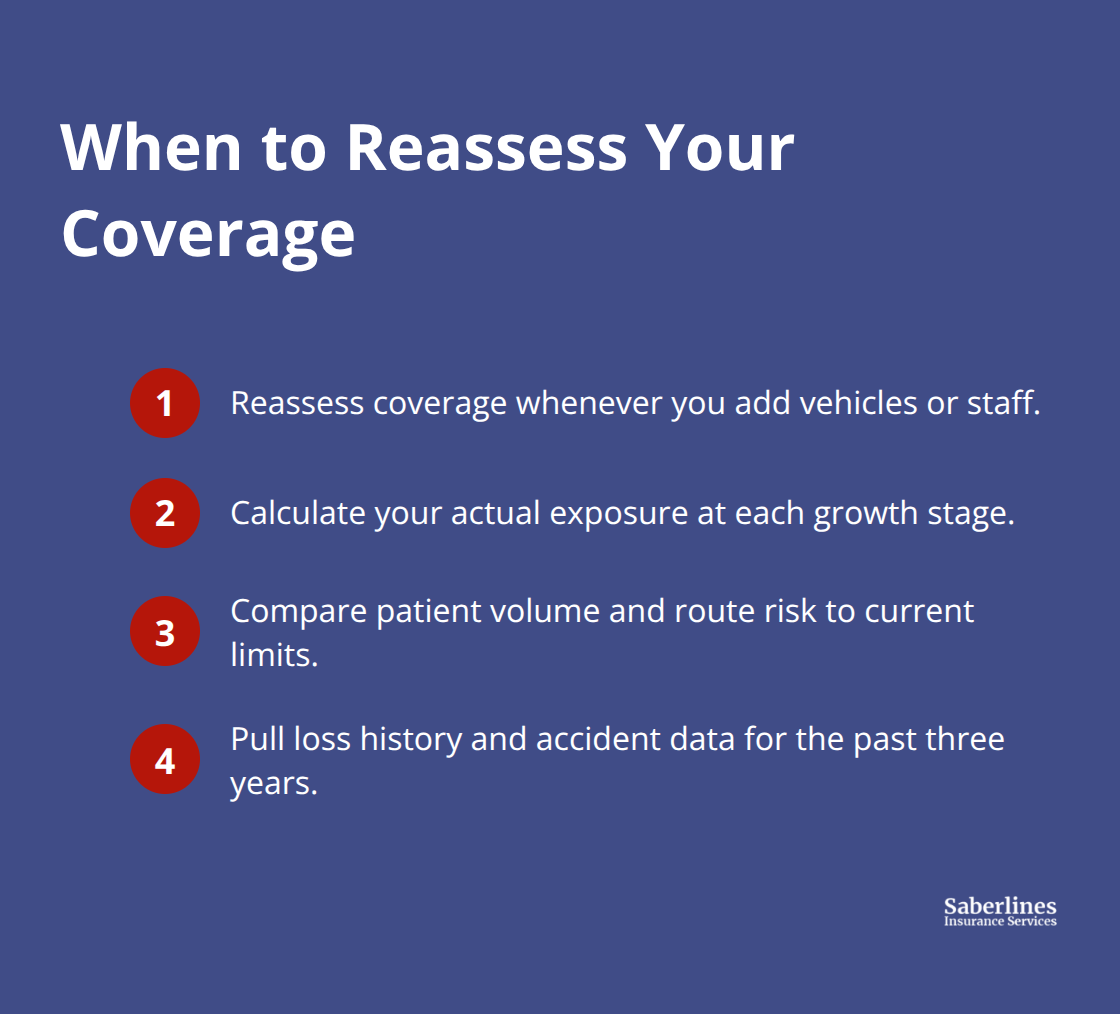
At five vehicles serving 50 patients weekly, your per-vehicle limits might hold up. At fifteen vehicles serving 200 patients weekly, your exposure has quadrupled but your coverage hasn’t.
The increase in vehicles creates compounding liability exposure because more drivers means more accident frequency, more passenger interactions, and more routes with different risk profiles. Pull your loss history and accident data for the past three years. If you’ve had zero claims at five vehicles, don’t assume zero claims continue at fifteen. NEMT operators typically experience a 40 to 60 percent increase in accident frequency when doubling fleet size, according to industry safety data. This means your limits need to jump faster than your vehicle count.
Adjust Deductibles and Aggregate Limits
Deductibles deserve serious attention when scaling. Many operators keep their deductibles at 1,000 or 2,500 from their startup years, which makes sense when you’re lean. At fifteen vehicles, a single accident with that deductible costs you real money across multiple incidents annually. Raising your deductible to 5,000 makes sense if your cash reserves support it. Higher deductibles lower your premium by 15 to 25 percent on commercial auto policies. That savings lets you invest in higher aggregate limits or umbrella coverage instead.
Umbrella policies sit on top of your commercial auto and general liability coverage, adding an extra 1 to 2 million dollars of protection for 300 to 600 dollars monthly. This approach plugs gaps that would otherwise require expensive limit increases on your primary policies. Aggregate limits matter more than per-vehicle limits once you operate multiple units regularly. Some carriers cap aggregate coverage at three times your per-vehicle limit, which creates dangerous gaps for growing operations. You need a carrier willing to write higher aggregates or structure your policy with umbrella coverage layered on top.
Update Coverage When Operations Change
Annual policy reviews matter because your operation changes faster than most carriers track. If you added passenger assistance services or started serving a new geographic area, your coverage should reflect those changes immediately. Document every operational change and notify your insurance agent within 30 days. These updates prevent coverage denials when claims happen and keep your operation compliant with carrier requirements.
Your coverage gaps become more expensive the larger you get, which is why growing operators face higher stakes with every expansion decision. The next step involves identifying the specific coverage gaps that plague most NEMT operators as they scale.
Common Coverage Gaps NEMT Operators Miss
Passenger Liability Falls Through the Cracks
Most NEMT operators think their commercial auto and general liability policies work together to cover everything. They don’t. Passenger liability exists in a gray zone that catches operators off guard. Your commercial auto policy covers accidents involving your vehicle, but a passenger injury claim that stems from something other than the collision itself often falls outside that coverage.
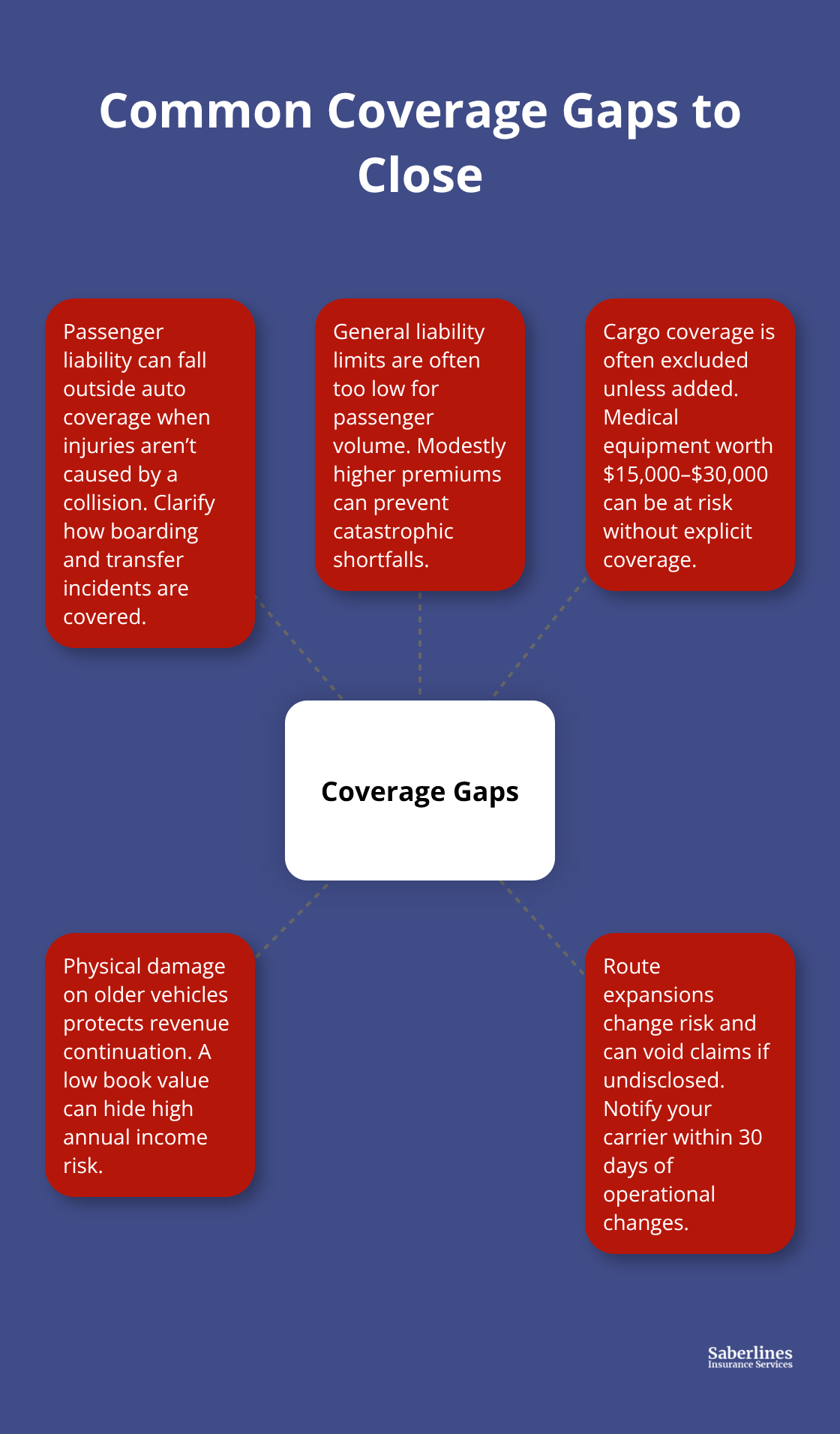
A patient who slips during boarding, or a wheelchair passenger injured during transfer, generates a liability claim that standard commercial auto policies frequently reject.
Operators carry 300,000 dollar general liability limits when they should carry 500,000 to 1,000,000 given their passenger volume. The difference between these limits costs roughly 40 to 80 dollars monthly in additional premium, but the gap between coverage and a catastrophic claim costs everything.
Medical Equipment and Cargo Need Explicit Coverage
Cargo coverage presents another problem area. Many NEMT operators assume their general liability covers medical equipment or personal belongings passengers travel with. It doesn’t. Medical equipment worth 15,000 to 30,000 dollars travels in your vehicle every day, and standard policies exclude cargo damage unless specifically added. A single accident that damages expensive mobility aids or oxygen equipment creates an uninsured loss that your operation absorbs entirely.
You must add cargo coverage to your policy if you transport medical equipment regularly. This addition protects both your passengers’ belongings and your operation from financial exposure that would otherwise fall on you.
Physical Damage Coverage Protects Revenue, Not Just Assets
Physical damage coverage for aging vehicles deserves honest assessment. Operators often reduce or eliminate collision and comprehensive coverage on older vehicles to save premium, reasoning that the vehicle isn’t worth much anyway. This logic fails in NEMT operations. A ten-year-old van worth 12,000 dollars still carries 200,000 dollar annual revenue. Losing that vehicle to an accident without coverage doesn’t just cost you the vehicle-it costs you income while you replace it. Your cash flow cannot absorb that gap.
Maintain physical damage coverage on all vehicles in your fleet, regardless of age. The revenue your vehicles generate far exceeds their book value.
Route Expansion Requires Immediate Coverage Updates
Route expansion frequently happens without matching coverage adjustments. Adding a new service area or expanding into a different geographic region changes your risk profile immediately. Rural routes carry different accident frequencies than urban routes. New passenger demographics mean different claim patterns.
Operators who add routes without notifying their carrier end up with coverage denials when claims happen. The claim gets denied not because the accident wasn’t covered under the policy, but because the operator violated the policy terms by operating outside their disclosed service area. Contact your agent within 30 days of any operational change to prevent this completely preventable gap.
Final Thoughts
Your NEMT fleet coverage options must evolve as your operation grows, and waiting until a claim happens costs far more than adjusting your policies proactively. The gaps we’ve covered-inadequate passenger liability limits, missing cargo protection, and outdated route disclosures-represent real financial exposure that compounds with every vehicle you add. Operators who scale their coverage alongside their fleets protect their revenue and avoid the coverage denials that plague those who don’t.
Regular policy reviews prevent compliance problems and catch coverage gaps before they become expensive. You should review your entire policy structure every time you add vehicles, hire staff, or expand your service area. Pull your loss history, calculate your actual exposure at your current fleet size, and compare it against your limits. If your limits haven’t increased in two years but your fleet has grown by 50 percent, you’re underinsured.
Contact Saberlines Insurance Services to review your current NEMT fleet coverage options and identify the gaps that could cost you everything. We specialize in the specific coverage challenges that NEMT businesses face and work with owner-operators and fleets to find solutions other agencies turn away. Your growing operation deserves insurance that actually protects it.
The information provided in this blog is for general informational purposes only and does not constitute legal, financial, or insurance advice. Coverage options, terms, and availability may vary. Please consult with a licensed professional for advice specific to your situation.