
General Liability Coverage Tips: Boost Your Protection Today
General liability coverage protects your business from costly lawsuits and medical bills when someone gets hurt on your property or you accidentally damage their belongings. Most business owners think their current policy is sufficient-until they face a claim that falls outside their coverage.
At Saberlines Insurance Services, we’ve seen firsthand how the right general liability coverage tips can make the difference between a manageable situation and financial disaster. This guide walks you through what your policy actually covers, where the gaps typically hide, and how to strengthen your protection.
What Your General Liability Coverage Actually Covers
Three Protection Areas You Need to Understand
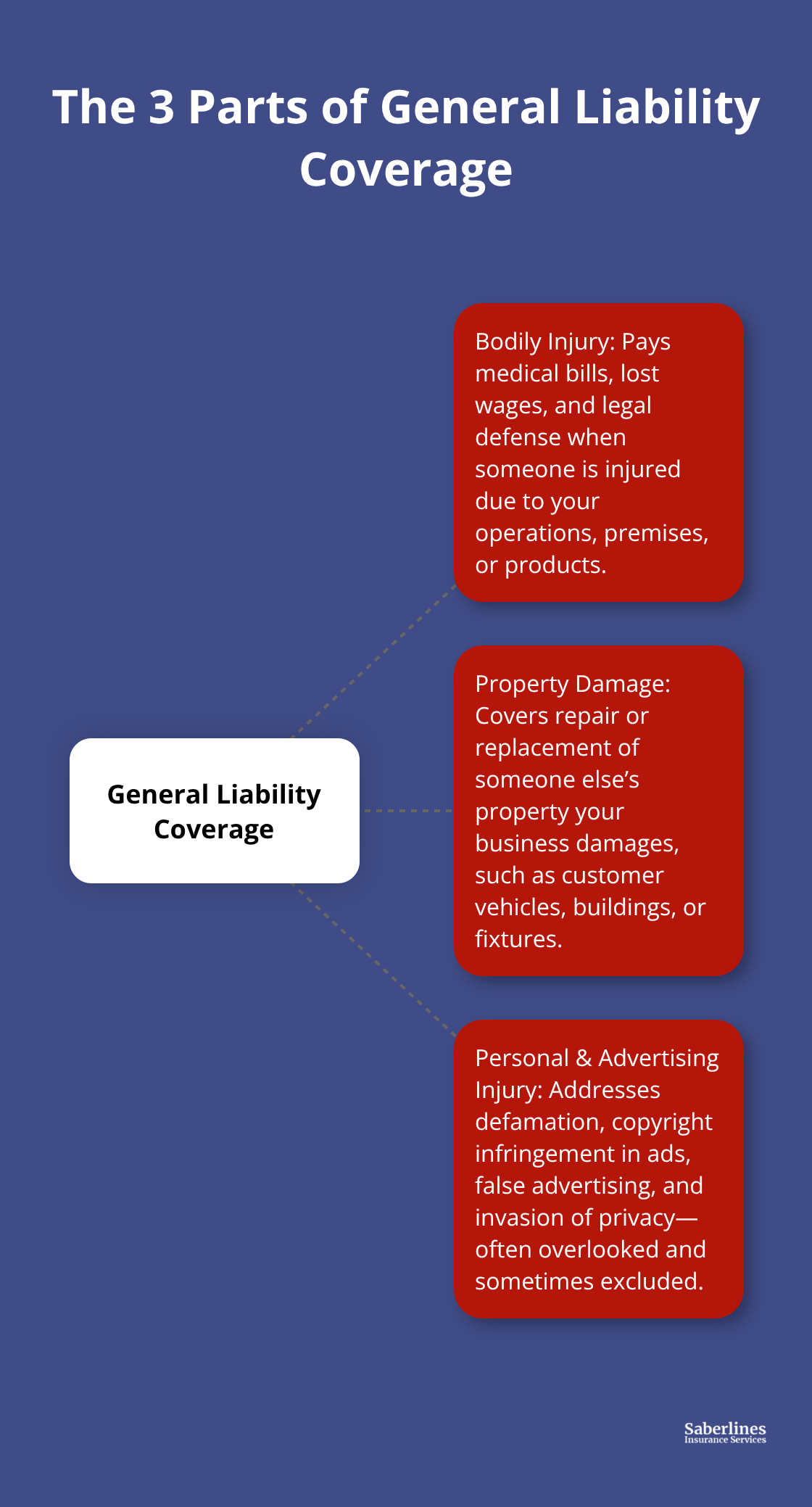
General liability coverage splits into three distinct protection areas, and most business owners misunderstand what happens when claims fall into each category. Bodily injury protection covers medical expenses, lost wages, and legal fees when someone gets hurt because of your business operations or products. This includes injuries that occur on your property, injuries caused by your work, or injuries from products you sold. Property damage coverage handles the cost of repairing or replacing someone else’s property that your business damaged. A delivery driver hits a customer’s fence, a contractor’s equipment damages a client’s roof, or your signage falls and damages a parked car-property damage covers these situations.
The Often-Missed Coverage Layer
Personal and advertising injury protection is the most overlooked component, and it’s where gaps frequently appear. This section covers defamation claims, copyright infringement from your marketing materials, false advertising accusations, and invasion of privacy claims. Many business owners discover too late that their policy excludes these risks entirely.
Why Coverage Limits Matter More Than You Think
The coverage limits matter far more than the existence of coverage itself. The National Association of Insurance Commissioners reports that the average general liability claim costs between $10,000 and $100,000, yet many small businesses carry limits of only $300,000 per occurrence. This creates dangerous exposure when a single incident exceeds your limit.
Construction companies, restaurants, and professional service providers face the highest claim frequencies according to insurance industry data. Your industry determines what limits make sense-a landscaping operation faces different risks than a consulting firm. You should review your specific business operations to calculate realistic exposure amounts rather than selecting arbitrary coverage limits.
Matching Coverage to Your Business Risk
If your business involves higher-risk activities, transportation services, or high-value client interactions, your coverage limits should reflect that exposure level. The cost difference between $300,000 and $1,000,000 in coverage limits is typically modest when spread across annual premiums, yet the protection difference is substantial. These gaps in your current limits often become apparent only when you assess what specific risks your operations actually face.
Where Your General Liability Policy Actually Falls Short
Insufficient Coverage Limits Leave You Exposed
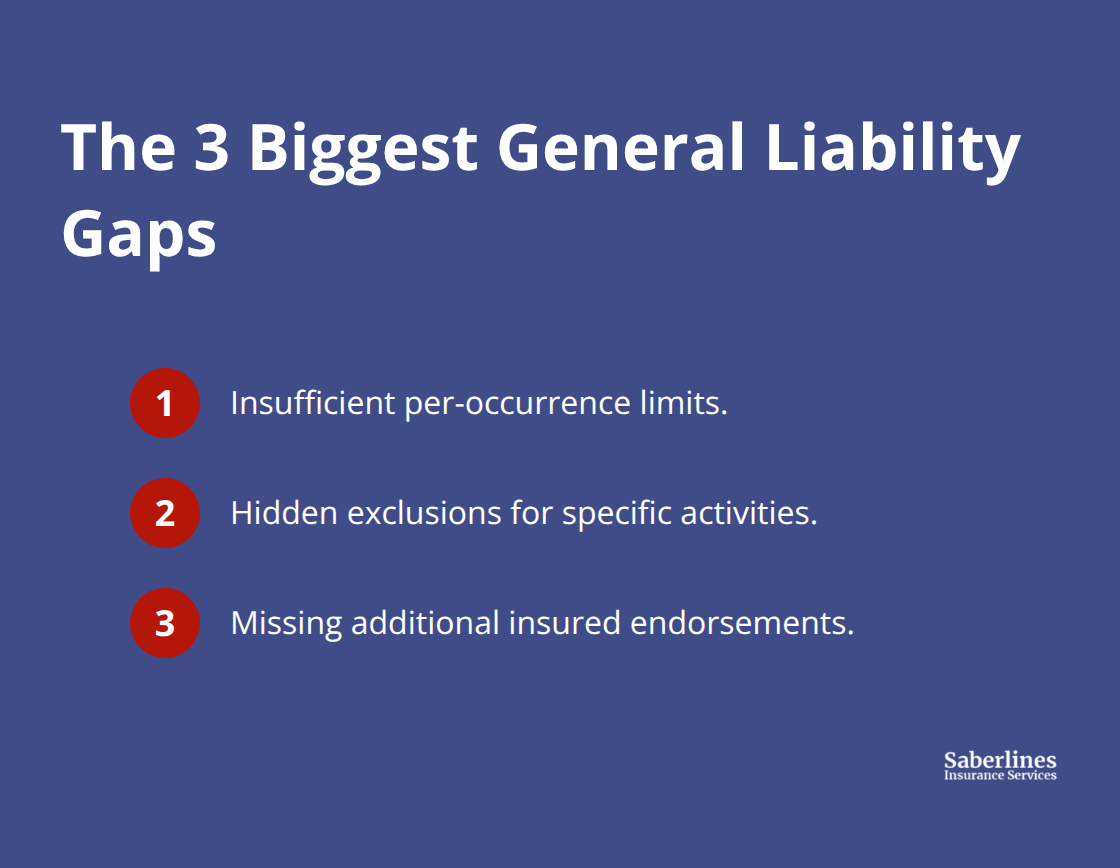
Most business owners discover their coverage gaps only after a claim gets denied. The problem isn’t that policies lack protection entirely-it’s that the protection stops exactly where your business needs it most. Insufficient coverage limits represent the first major gap we see repeatedly. A $300,000 per-occurrence limit sounds substantial until you face a serious injury claim. The National Council on Compensation Insurance reports that the average workers’ compensation claim costs $42,000, but general liability claims involving permanent disability or multiple injured parties routinely exceed $500,000.
If your limit sits at $300,000 and a claim reaches $450,000, you’re personally liable for the $150,000 difference.
This gap expands dramatically for industries with higher exposure. Construction companies report average claims of $87,000 according to industry data, while restaurants face average liability costs of $56,000 per incident due to slip-and-fall and foodborne illness claims. Your current limits were probably set years ago and haven’t adjusted for inflation or business growth.
Hidden Exclusions for Specific Business Activities
Exclusions for specific business activities create the second major gap, and these often hide in the policy language. If your business involves any contracting work, your standard general liability policy likely excludes coverage for damage caused during the work itself-that’s what contractors’ liability should cover, but many business owners don’t realize they need a separate policy. Professional service providers face exclusions for errors and omissions claims, which means legal advice, accounting mistakes, or consulting errors fall outside your general liability protection. Transportation and delivery services encounter exclusions for hired and non-owned vehicle liability, meaning accidents involving rental vehicles or employee-owned cars might not be covered.
Missing Additional Insured Endorsements
The third gap appears when you fail to add additional insured endorsements. Major clients frequently require you to name them as additional insureds on your policy before they’ll hire you. Without this endorsement, your client has zero coverage under your policy if something goes wrong during your work. Construction clients, property managers, and large retailers make this a non-negotiable requirement. The cost to add additional insured status runs between $50 and $150 annually per endorsement, yet skipping this creates situations where your client refuses to pay invoices or terminates contracts.
These gaps don’t fix themselves-they demand your attention now. The next section walks you through how to identify your specific exposures and strengthen your protection against these common vulnerabilities.
How to Strengthen Your General Liability Protection
Map Your Actual Business Risks
Start with your actual business operations, not theoretical risk models. Walk through a typical workday and identify every interaction where someone could get hurt or property could be damaged. If you run a construction company, this means documenting every site where your crew works, every type of equipment used, and every subcontractor relationship. If you operate a restaurant, map out slip-and-fall risks in the dining area, kitchen injuries, and food safety exposure. If you provide professional services, identify where client data handling creates liability exposure.
This assessment should take 2-3 hours maximum and should produce a concrete list of specific scenarios, not generic categories. Once you’ve documented these scenarios, compare them directly against your current policy exclusions. Most business owners skip this step and instead rely on vague assumptions about what their policy covers.
Identify Your Coverage Gaps
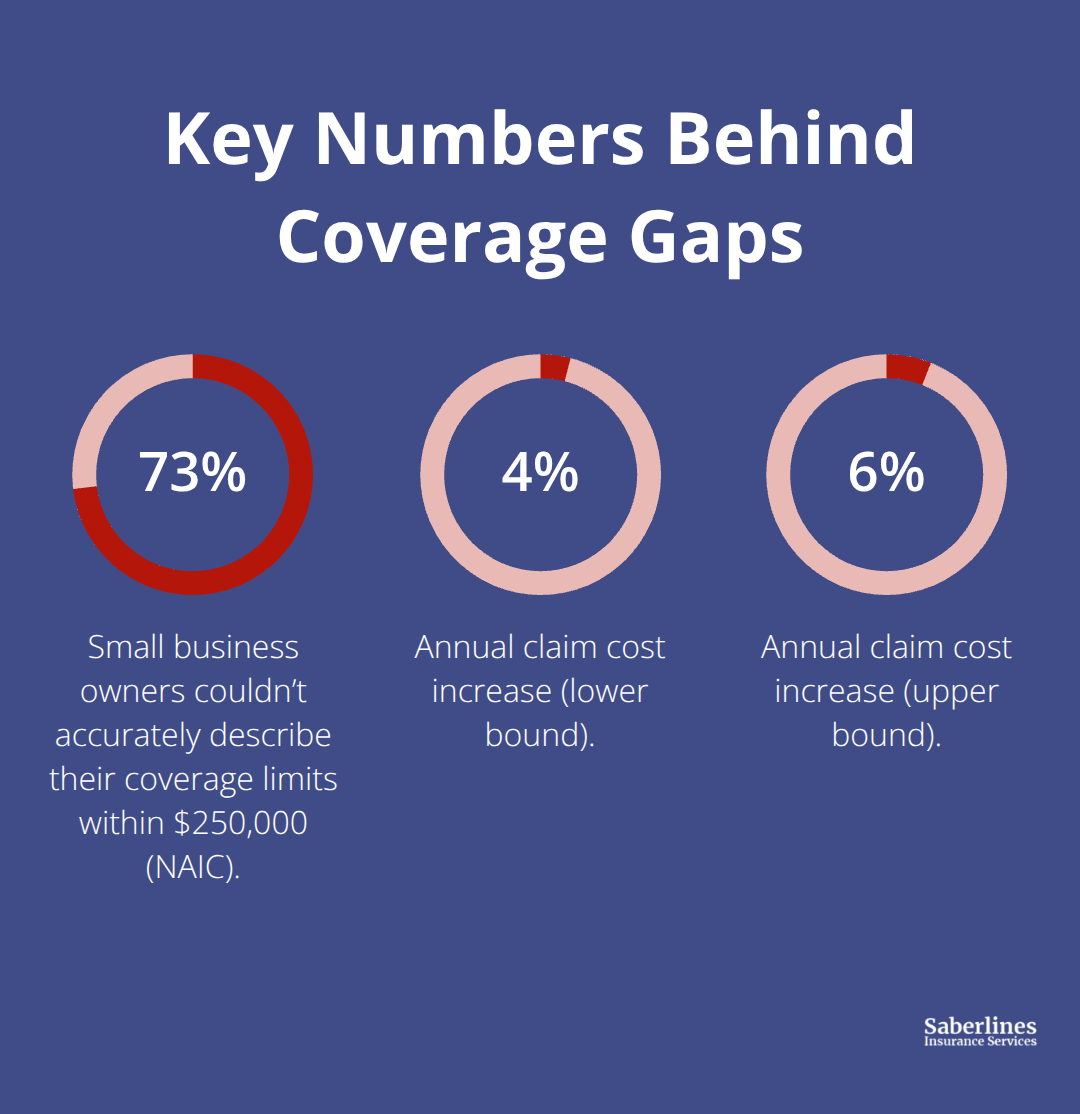
The National Association of Insurance Commissioners found that 73 percent of small business owners couldn’t accurately describe their coverage limits within $250,000, which directly correlates with coverage gaps appearing during claims. Your assessment should answer one critical question: at what dollar amount would a claim from your most likely scenario exceed your current per-occurrence limit?
If you can’t answer that question with a specific number, your coverage limits are set wrong. This exercise forces you to confront the actual exposure your business faces rather than accepting whatever limits your agent recommended years ago.
Increase Coverage Limits Annually
Claim costs increase 4-6 percent annually due to inflation and medical expense growth, yet most business owners lock in the same limits for five years or more. Insurance industry data shows this creates compounding risk that accelerates over time. Construction companies should review limits quarterly given project variability, while service-based businesses should conduct annual reviews minimum.
The cost increase to move from $300,000 to $500,000 in per-occurrence limits typically runs $150-$300 annually, while jumping to $1,000,000 adds roughly $400-$600 per year depending on your industry classification. That modest expense difference becomes critical when a single claim reaches $600,000 and your $300,000 limit leaves you personally responsible for the difference.
Add Required Endorsements for Your Industry
After determining your appropriate limits, add specific endorsements your industry requires. Construction firms must add additional insured endorsements for every client before work begins, not after. Property management companies require the same protection. These endorsements cost $50-$150 each annually but prevent contract terminations and payment holds.
Professional service providers should add errors and omissions coverage as a separate policy, which runs $500-$2,000 annually depending on revenue, rather than assuming general liability covers business mistakes. Transportation and delivery services must separately address hired and non-owned vehicle liability, adding another $300-$600 annually. These aren’t optional add-ons-they’re the difference between being hireable and being unhireable in your industry.
Final Thoughts
Your general liability coverage protects your business only when it actually covers what you face. Pull your current policy and compare it against the specific risks your business encounters daily, then calculate what a realistic worst-case claim would cost in your industry. Most business owners discover their limits are outdated within the first hour of this review, and if your policy hasn’t been updated in three years or more, your coverage almost certainly falls short of current claim costs.
Identify which endorsements your industry requires next. Construction companies need additional insured status before every project starts, professional service providers need errors and omissions coverage as a separate policy, and transportation businesses need hired and non-owned vehicle liability protection (these aren’t optional-they’re what makes your business hireable and compliant with client requirements). The final step involves acting on what you’ve learned by increasing your coverage limits to match your actual exposure, adding the endorsements your industry demands, and scheduling an annual review to adjust for inflation and business growth.
We at Saberlines Insurance Services specialize in helping transportation businesses secure the right general liability coverage tips for their specific operations. Whether you operate a fleet or manage owner-operators, we understand the liability exposures transportation creates and can help you build protection that actually matches your risk. Contact us to review your current policy and identify the gaps before a claim does.
The information provided in this blog is for general informational purposes only and does not constitute legal, financial, or insurance advice. Coverage options, terms, and availability may vary. Please consult with a licensed professional for advice specific to your situation.