
Moving Company Cargo Insurance: Protecting Relocation Freight
Moving companies face significant financial exposure every day. A single accident, theft, or damage claim can cost thousands of dollars and damage your reputation with customers.
At Saberlines Insurance Services, we understand that moving company cargo insurance isn’t optional-it’s essential protection for your business. This guide covers what you need to know about protecting your freight and your bottom line.
What Your Cargo Insurance Actually Covers
Moving company cargo insurance protects three critical areas of your operation, and understanding each one prevents costly coverage gaps. The U.S. moving services industry is worth about $23.3 billion in 2025, with steady growth that means more operators compete for market share and face increased exposure to claims.
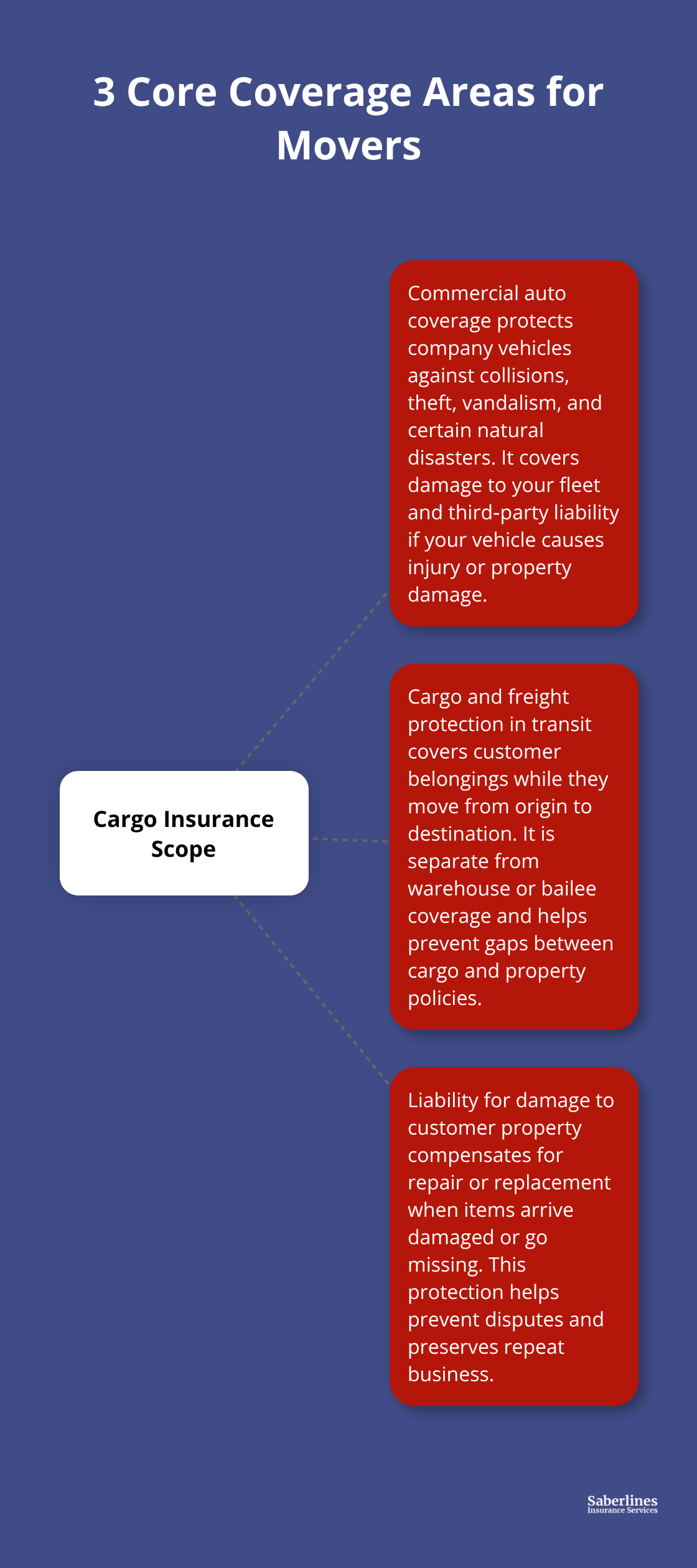
Commercial auto coverage shields your transport vehicles from collisions, theft, vandalism, and natural disasters, covering both damage to your fleet and third-party liability if your vehicle causes injury or property damage to others. Interstate movers must maintain roughly $750,000 to $1,000,000 or more in liability coverage depending on vehicle weight and file proof via BMC-91 or BMC-91X with the FMCSA, with regulators maintaining public databases to verify ongoing coverage. Cargo and freight protection during transit covers customer belongings in your truck, protecting against loss or damage while goods move from origin to destination. This is separate from warehouse or bailee coverage, which protects goods stored in your facility-many operators overlook this distinction and end up with a gap between what their cargo policy covers and what their property policy covers. Liability coverage for damage to customer property is your safety net when items arrive damaged or go missing, compensating customers for repair or replacement costs and preventing disputes that destroy repeat business.
Released Value vs. Full Value Protection
Interstate movers must offer two liability levels to customers: Released Value Protection, which costs nothing but pays only $0.60 per pound per item, and Full Value Protection, which costs roughly 1% of declared shipment value but covers current market value. A 10-pound lamp worth $300 receives only $6 under Released Value, making it obvious why customers often upgrade. Full Value Protection sometimes applies depreciation and may require minimum declared values or written listing of high-value items to guarantee full coverage.
How Loss History Shapes Your Premiums
Loss history is the single biggest factor in premiums-three years of clean operations yields preferred rates, while multiple claims push costs higher or limit availability entirely. A typical moving insurance bundle (general liability, workers’ compensation, and professional liability) averages about $6,312 per year, though actual costs vary by fleet size, claims history, and coverage limits. Each additional vehicle adds exposure, and annual motor vehicle record checks influence premiums, so driver training programs that reduce accidents pay for themselves over time. Your next step involves assessing your actual exposure-fleet size, shipment values, storage capacity, and geographic scope-to tailor coverage that matches your real risks rather than overpaying for unnecessary protection.
Why Your Moving Business Needs Cargo Insurance
Cargo insurance isn’t a nice-to-have for moving companies-it’s the foundation that keeps your business operational when things go wrong. The FMCSA requires interstate movers to maintain minimum liability coverage ranging from roughly $750,000 to $1,000,000 or more depending on vehicle weight, and you must file proof via BMC-91 or BMC-91X forms with regulators who maintain public databases to verify ongoing coverage. Lapses in insurance trigger immediate revocation of operating authority, which means your entire business stops. Beyond federal mandates, state requirements vary significantly: Florida’s recent regulatory overhaul illustrates how coverage needs shift across jurisdictions, with Florida minimum general liability set at $500,000, though most operators wisely carry $1,000,000 or more to match real-world exposure. Operating without proper cargo coverage exposes you to catastrophic financial losses that insurance exists to prevent.
The Financial Reality of Uninsured Claims
A single high-value shipment loss can bankrupt a small moving operation. If a customer’s grand piano worth $15,000 arrives damaged and you lack adequate coverage, you become personally liable for replacement costs that exceed annual profits for many operators. Full Value Protection claims on artwork, antiques, and collectibles reach $50,000 or higher easily, which is precisely why understanding your coverage limits matters more than the premium you pay. Warehouse legal liability coverage protects goods stored in your facility-a risk many operators overlook entirely-and without it, a warehouse fire that destroys customer belongings in storage becomes an uninsured loss. The interplay between transit coverage and storage coverage creates gaps that destroy businesses: your cargo policy covers goods in your truck, but once items sit in your warehouse, you need separate property and warehouse legal liability protection. Operators who treat insurance as a cost rather than an investment discover too late that skimping on premiums created exposures worth hundreds of thousands of dollars.
Compliance Unlocks Revenue Opportunities
Regulators maintain public databases where customers and freight brokers verify that your FMCSA registration includes active insurance coverage-missing proof disqualifies you from bids and jobs immediately. Brokers and corporate clients specifically check these registries before awarding contracts, so compliance directly feeds your revenue pipeline. When you produce certificates of insurance within hours of binding coverage, you win jobs that competitors with slower processes lose. Your contracts may require additional insured language or specific endorsements that non-specialist brokers fumble, creating disputes and coverage denials when claims arrive. Working with an insurance partner who understands moving industry compliance transforms paperwork from a liability into a sales tool that closes deals faster than competitors.
What Happens When Claims Arrive
The moment a customer reports damage, your insurance response determines whether you retain that customer or face a lawsuit. Warehouse risks require property coverage for the building and equipment, business interruption protection, and equipment breakdown for climate-control systems; floods are typically excluded from standard property policies and require separate coverage. A dedicated claims handler who guides you through the process prevents costly mistakes that delay reimbursement or trigger denials. We at Saberlines Insurance Services specialize in trucking and transportation, helping owner-operators and fleets secure cargo coverage that matches moving industry risks. Your next step involves assessing your actual exposure-fleet size, shipment values, storage capacity, and geographic scope-to tailor coverage that matches your real risks rather than overpaying for unnecessary protection.
What Really Causes Moving Claims
Damage During Loading and Unloading
Loading and unloading damage accounts for a substantial portion of moving claims because these moments involve the most physical handling and the highest risk of impact. Your crew drops a sofa onto a stairwell, a dolly wheel punctures drywall, or a box shifts during the hand-off from truck to doorway-these incidents happen constantly across the industry and represent the easiest claims to prevent through operational discipline. The British Association of Removers ADR Scheme, which sets standards for relocation services, recognizes that damage during loading and unloading stems almost entirely from preventable gaps in process rather than unavoidable accidents.
Your crew needs written procedures for each item type: how to pad furniture before loading, how to secure boxes to prevent shifting, how to navigate tight spaces without scraping walls, and how to communicate when moving items as a team. Assign one crew member to inspect the truck bed before loading begins and again before departure-this person becomes accountable for securing straps, padding placement, and weight distribution.
Transit Accidents and Weather Events
Transit accidents and weather events create the second major claim category, though your control over weather is zero, your control over vehicle condition and driver behavior is absolute. Collisions cause property damage to customer goods, but more often they cause damage to your vehicle that cascades into delayed deliveries and unhappy customers who file claims for the inconvenience.
Maintain your fleet on a rigid schedule: tire pressure, brake fluid, windshield wipers, and lighting require monthly checks, not reactive repairs when something fails. Weather-related losses spike during hurricane and flood seasons-from June through November in coastal regions-which means your warehouse should have drainage systems, sump pumps that function, and climate control for sensitive items like artwork and wine.
Theft and Loss of High-Value Items
Theft and loss of high-value items represents your smallest claim category by frequency but your largest by cost, and two separate strategies address this exposure. First, your crew should photograph high-value items before loading and document them on the inventory sheet with serial numbers, condition notes, and declared values-this creates an indisputable record if a claim arrives. Second, implement a chain-of-custody system where every person who touches a high-value item signs off on the inventory, making theft immediately traceable to a specific individual or moment.
Scheduled coverage with appropriate limits prevents underinsurance on pianos, antiques, artwork, and collectibles-items that should never travel under standard cargo limits because a single loss exceeds your annual premium savings. General liability protections help moving operations structure their coverage to match these real risks, ensuring that your policy responds when claims arrive rather than leaving gaps that destroy customer relationships and business margins.
Final Thoughts
Moving company cargo insurance protects your business from the financial devastation that follows a single major claim. Without proper coverage, a damaged piano, a warehouse fire, or a fleet collision can exceed your annual profits and force closure. Compliance with FMCSA requirements keeps your operating authority active, while comprehensive coverage keeps your business solvent when accidents happen.
Your path forward requires three concrete steps: assess your actual exposure by documenting fleet size, typical shipment values, storage capacity, and geographic service area; distinguish between cargo coverage for goods in transit and warehouse legal liability for stored items (most operators overlook this separation and discover the gap only after a loss); and work with an insurance partner who understands moving industry risks rather than treating your policy like a commodity purchase. We at Saberlines Insurance Services specialize in trucking and transportation, helping owner-operators and fleets secure moving company cargo insurance that matches real-world exposure. Founded in 1999 and licensed in California, we combine deep industry expertise with fast quotes and market access for preferred and hard-to-place risks.
Contact Saberlines Insurance Services to review your current coverage and identify gaps before claims arrive. A conversation with our team takes minutes and often reveals exposures you didn’t know existed. Moving companies that treat insurance as a strategic investment rather than a cost consistently outperform competitors who skip this step.
The information provided in this blog is for general informational purposes only and does not constitute legal, financial, or insurance advice. Coverage options, terms, and availability may vary. Please consult with a licensed professional for advice specific to your situation.