
General Liability California Rates: What Small Fleets Really Pay
General liability California rates vary wildly depending on your fleet size, safety record, and the services you offer. Most small fleet operators have no idea what they should actually be paying, which means they’re either overpaying or underinsured.
We at Saberlines Insurance Services have reviewed hundreds of quotes for California fleets, and the numbers tell a clear story. This guide breaks down exactly what small fleets pay and how to cut your premiums without cutting corners on coverage.
What Really Drives Your General Liability Premiums
Fleet Size Creates Unexpected Cost Dynamics
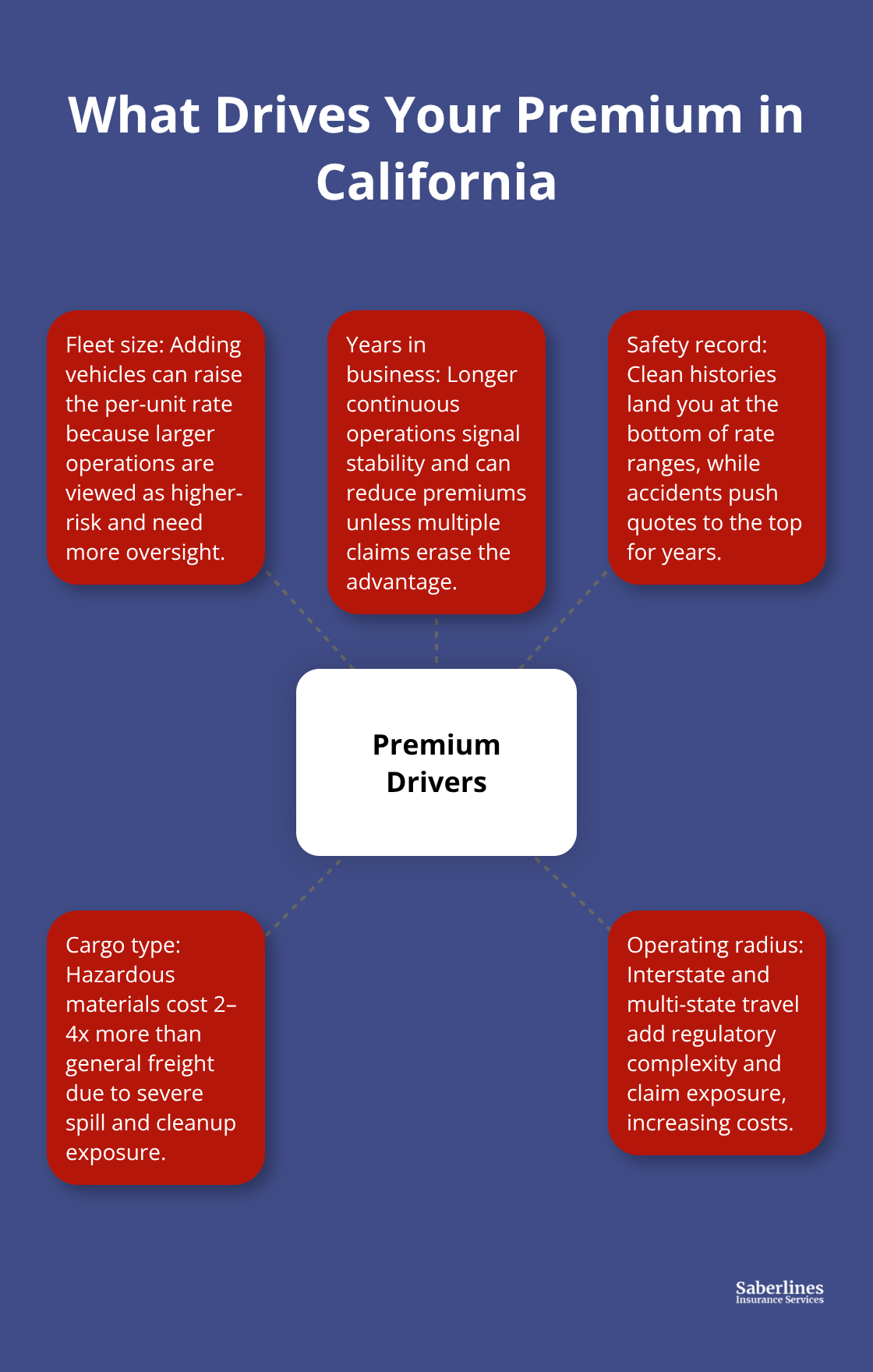
Your fleet size matters far more than most operators realize, but not in the way you’d think. A three-vehicle fleet doesn’t simply pay one-third of what a nine-vehicle fleet pays. Small fleets with three to five vehicles carrying $500,000 in combined single-limit liability coverage pay roughly $3,500 to $10,000 annually across all vehicles. That breaks down to $700–$2,000 per vehicle per year just for liability, but the rate per unit actually increases as you add vehicles because insurers view larger fleets as higher-risk operations requiring more oversight.
Years in business also shift premiums significantly. A fleet operator with five years of continuous operations pays substantially less than someone in their first year, even with identical driving records, because insurers treat longevity as proof of operational stability. However, this advantage disappears instantly if you file multiple claims during those years.
Your Safety Record Determines Your Rate Tier
Claims history dictates whether insurers quote you at the bottom or top of any rate range. A California trucking operator with two accidents in the past three years will pay roughly double what someone with a clean record pays for identical coverage and vehicle type. The California Department of Insurance confirms that driver history and safety records rank as the top factors shaping general liability quotes across the state. This means a single preventable accident doesn’t just cost you in deductibles and claim payouts-it locks you into higher premiums for years.
Conversely, telematics and dashcams reduce premiums by 5–20% because insurers see documented proof of safe driving practices. These tools strengthen your negotiating position when rates come up for renewal.
Cargo Type and Operating Radius Multiply Your Costs
The type of cargo and services you haul directly impacts your rates. Hauling hazardous materials like fuel or chemicals costs 2–4 times more than general freight, often running $22,000–$40,000+ annually per vehicle compared to $9,000–$14,000 for standard dry van operations. Environmental cleanup liability after a spill can exceed hundreds of thousands of dollars, which is exactly why insurers price hazmat operations so aggressively.
Local delivery routes within a 50-mile radius cost significantly less than long-haul interstate operations. Operating across multiple states multiplies your premium because each state adds regulatory complexity and claim exposure. The combination of these factors-fleet size, safety history, cargo type, and operating radius-creates a unique risk profile that determines your final quote. Understanding which levers you control helps you make smarter decisions about coverage and risk management before you approach an insurer.
What California Small Fleets Actually Pay
Per-Vehicle Costs Reveal the Real Price Tag
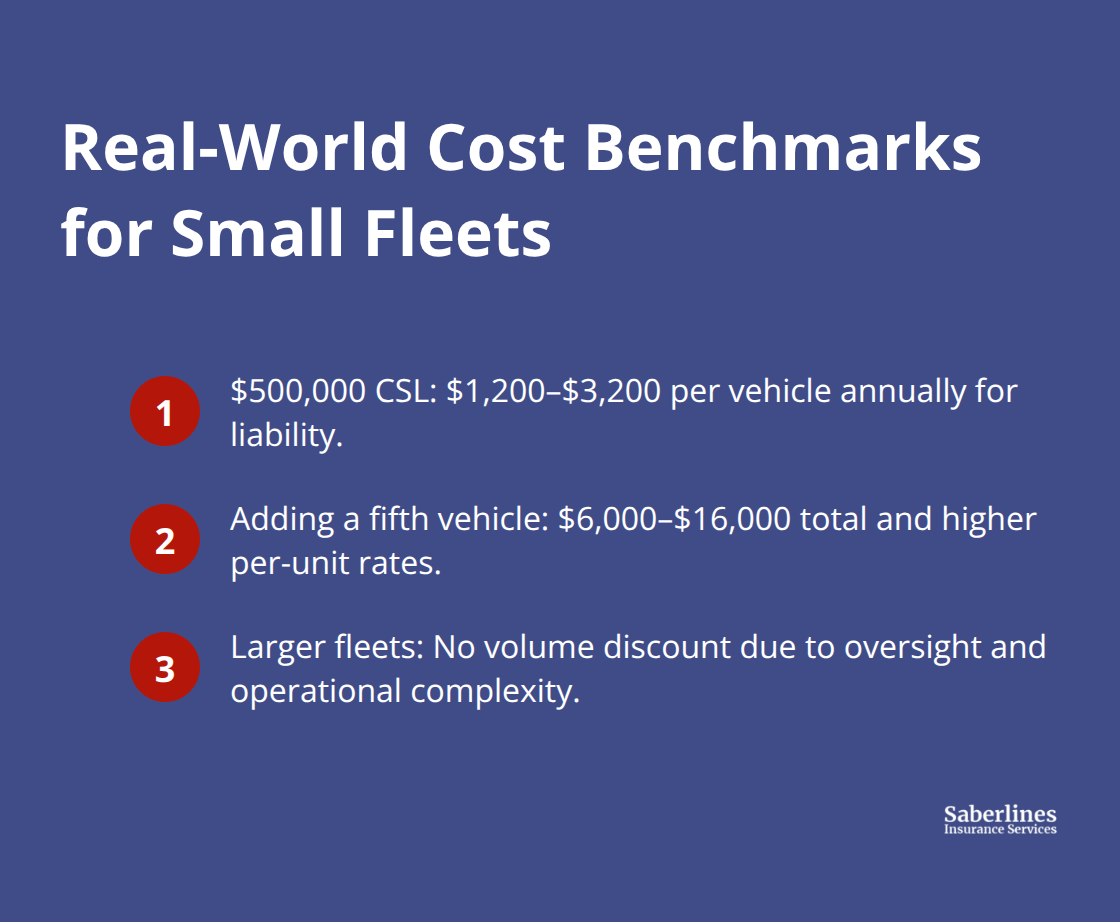
A three-vehicle fleet in California with $500,000 in combined single-limit liability pays roughly $3,500 to $10,000 annually. This translates to $1,200–$3,200 per vehicle per year for liability alone. When you add a fifth vehicle, your total climbs toward $6,000–$16,000 annually, yet the per-unit rate often increases rather than decreases. Insurers penalize larger fleets with higher overhead costs and perceived operational complexity, which means small fleets don’t benefit from volume discounts the way you’d expect.
Higher liability limits change the equation dramatically. If your fleet requires $1,000,000 combined single-limit coverage (which many general contractors and agricultural operations in Salinas need), expect $1,800–$4,500 per vehicle annually just for liability. Physical damage coverage (comprehensive and collision) stacks another $700–$2,200 per vehicle depending on vehicle age and actual cash value. Uninsured and underinsured motorist protection at $100,000/$300,000 limits runs $150–$400 per year. These aren’t theoretical ranges; they reflect actual quotes issued across California’s commercial insurance market.
Location and Regional Risk Factors Shape Your Quote
Regional variation within California matters more than most operators assume. Salinas-based fleets face distinct pricing because the area’s economic mix includes construction, landscaping, food distribution, and agriculture, each carrying different risk profiles. Coastal regions and areas with dense traffic cost more than inland rural operations because claim frequency and severity spike with congestion and urban exposure.
A fleet operating exclusively within Salinas County pays less than one running loads to Los Angeles or the Bay Area. Interstate operations multiply your regulatory exposure and claim risk across multiple jurisdictions, which insurers reflect in higher premiums. The distance you travel and the states you cross directly impact your final quote.
Coverage Limits Determine Both Price and Contract Eligibility
Coverage limits directly determine your final quote; choosing $500,000 liability instead of $1,000,000 saves roughly 30–40% on premiums. This savings vanishes instantly if a single accident exceeds your coverage and leaves you personally liable for the difference. The decision between limits isn’t about saving money on premiums-it’s about matching coverage to your actual operating risk and the contracts you pursue.
Many Salinas job sites require additional insured status and specific liability minimums before awarding work. Selecting inadequate limits doesn’t just expose you financially; it eliminates contracts entirely. Your coverage choice affects not only what you pay today but which opportunities you can bid on tomorrow.
How to Actually Cut Your Premiums Without Gambling on Coverage
Safety Documentation Transforms Into Rate Reductions
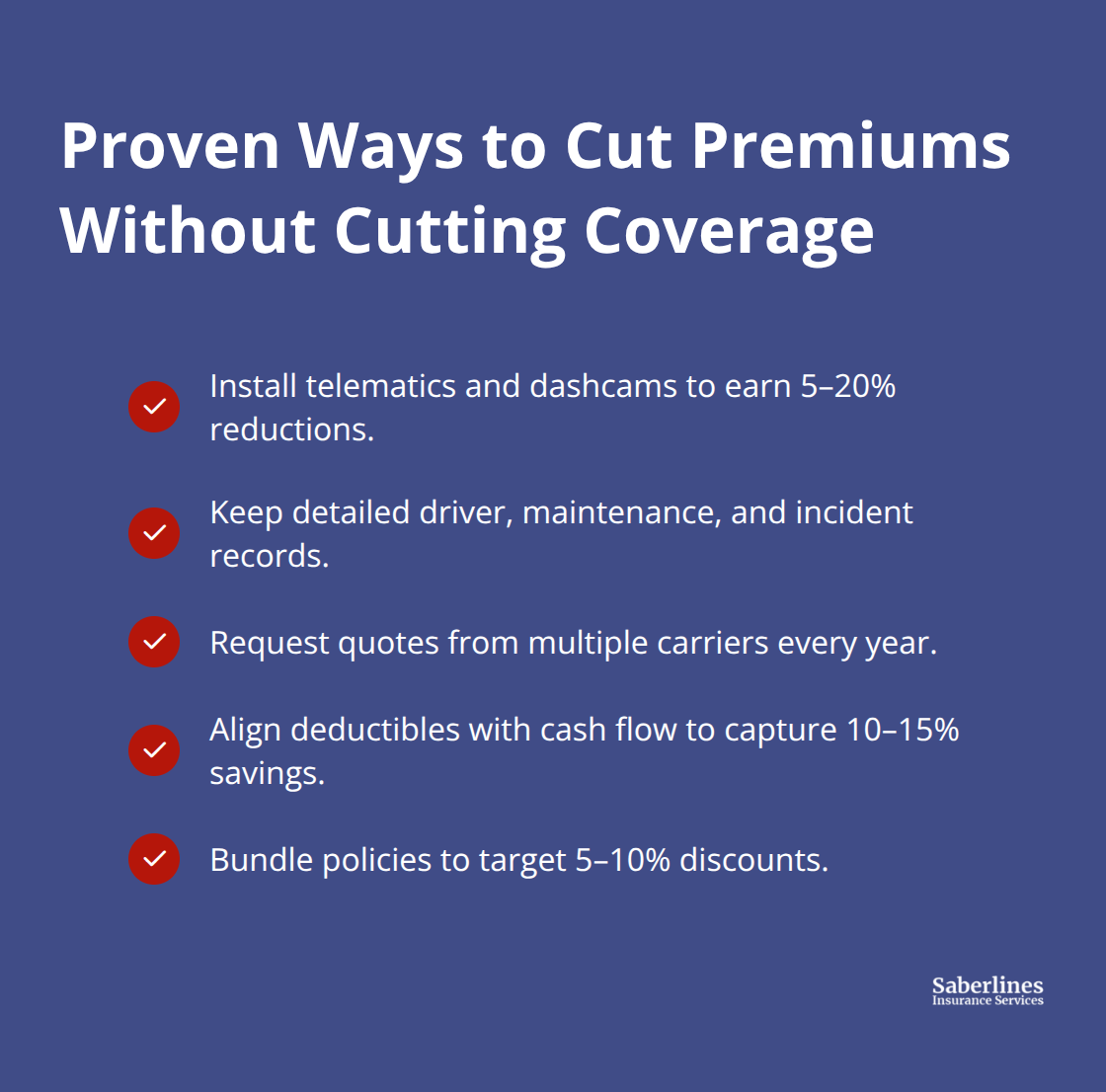
Safety documentation shifts from a nice-to-have into a negotiating tool that directly lowers your rates. Telematics, dashcams, and GPS tracking reduce premiums by 5–20% because insurers see measurable proof that your drivers operate vehicles safely and follow routes strategically. The Hartford, a carrier with strong appetite for California contractors, actively prices down fleets that submit documented safety programs showing defensive driving protocols and hazmat handling procedures.
Installing these systems costs between $500–$2,000 per vehicle upfront, but the 5–20% premium reduction on a five-vehicle fleet paying $6,000–$16,000 annually returns that investment within a single policy year. Detailed records of driver qualifications, vehicle maintenance logs, and incident reports demonstrate operational rigor to underwriters. Fleets with three to five years of clean driving history and documented safety practices consistently receive quotes 20–30% lower than operators without this paper trail, according to actual rate comparisons across California’s commercial market.
Claims History Shapes Your Rate Tier for Years
Your claims history cannot be erased, but a two-year stretch without incidents begins shifting you toward lower rate tiers during renewal negotiations. A single preventable accident locks you into higher premiums for years, so accident prevention pays dividends far beyond the immediate claim cost. Safety technology strengthens your negotiating position when rates come up for renewal because you possess documented proof of responsible operations.
Multiple Carriers Quote Dramatically Different Prices
The same five-vehicle fleet receives wildly different quotes from different insurers, sometimes varying by $3,000–$5,000 annually for identical coverage. Some insurers aggressively pursue small transportation fleets while others avoid them entirely, which means your current carrier’s renewal quote may not reflect market reality. Request quotes annually even if you renew with your current carrier, because rate changes, new discounts for safety technology, and shifting market conditions mean your renewal quote may be 15–25% higher than a competitor’s offer for the same protection.
An independent broker accesses multi-carrier comparisons rather than quoting a single carrier, which matters because this approach reveals pricing gaps that single-carrier quotes miss entirely. When comparing quotes, verify that limits match-a $500,000 liability quote cannot be directly compared to a $1,000,000 liability quote.
Deductibles and Bundling Reduce Your Total Cost
Higher deductibles ($2,500 instead of $1,000) reduce annual premiums by roughly 10–15%, but only if your fleet can absorb that out-of-pocket cost after an accident. Bundling liability, physical damage, cargo, and general liability policies under one insurer often yields 5–10% bundling discounts that single-policy quotes miss entirely. The decision between deductible levels isn’t about saving money on premiums-it’s about matching your financial capacity to your risk tolerance and operational cash flow.
Final Thoughts
California small fleets should expect to pay $3,500 to $10,000 annually for a three-to-five-vehicle operation with $500,000 liability coverage, translating to roughly $1,200–$3,200 per vehicle per year. If your contracts demand $1,000,000 limits, budget $1,800–$4,500 per vehicle. These rates shift based on your claims history, cargo type, operating radius, and the safety systems you’ve installed.
Reducing your general liability California rates starts with actions you control today. Install telematics or dashcams to cut rates by 5–20% and strengthen your negotiating position at renewal, maintain detailed records of driver qualifications and vehicle maintenance because underwriters reward documented operational rigor with lower quotes, and request quotes from multiple carriers annually since the same coverage varies by $3,000–$5,000 across different insurers. Higher deductibles and bundled policies reduce your total cost, but only if they align with your financial capacity and actual risk exposure.
The real advantage comes from working with a specialized agency that understands California’s regulatory landscape and the specific risks your fleet faces. We at Saberlines Insurance Services access multi-carrier comparisons, issue certificates of insurance the same day policies bind, and speak your language through bilingual service. Contact us to see what your fleet should actually pay.
The information provided in this blog is for general informational purposes only and does not constitute legal, financial, or insurance advice. Coverage options, terms, and availability may vary. Please consult with a licensed professional for advice specific to your situation.