
California Workers Compensation: State-Specific Guidance and Rates
California workers compensation rules are complex, and getting them wrong costs businesses thousands in penalties and unnecessary premiums.
We at Saberlines Insurance Services help transportation companies navigate these requirements, understand their actual costs, and build strategies that keep them compliant without overpaying.
California Workers Compensation Requirements and Coverage Types
What Coverage Must California Employers Actually Provide
California law requires every employer with at least one employee to carry workers’ compensation insurance, with no exceptions for size or industry. The California Labor Code section 3700 is unforgiving on this point. If you operate without coverage, the Division of Labor Standards Enforcement issues stop orders, imposes fines, and exposes you to criminal penalties. More practically, the Uninsured Employers Benefits Trust Fund steps in to pay injured workers’ claims, then pursues the employer for full reimbursement plus interest. Transportation businesses face particular scrutiny because driver injuries are common and costly. Sole proprietors and certain executives can elect written waivers to exclude themselves, but this applies only to the owner, not employees. Coverage comes from three sources: licensed private insurers, the State Compensation Insurance Fund, or self-insurance through the Division of Workers’ Compensation’s Office of Self-Insurance Plans.
How Benefits Actually Work for Injured Drivers
California’s no-fault system means an injured employee receives benefits regardless of who caused the accident, but cannot sue the employer in civil court. This trade-off protects your company from lawsuits while guaranteeing workers medical care and wage replacement. Temporary disability replaces two-thirds of lost wages starting after a three-day waiting period, paid every two weeks according to the Division of Workers’ Compensation. For a driver earning $3,000 monthly, that’s roughly $2,000 in weekly benefits during recovery. Medical benefits cover all reasonably required treatment with no caps, though insurers use utilization review to question expensive procedures. Permanent disability follows when the worker reaches maximum medical improvement. The Schedule for Rating Permanent Disabilities calculates compensation based on age, occupation, and disability extent. A driver with 20 percent permanent disability receives a lump-sum award, typically $8,000 to $15,000 depending on age. Supplemental Job Displacement Benefits provide up to $6,000 in retraining vouchers for workers unable to return to driving.
Classification Codes Control Your Premium
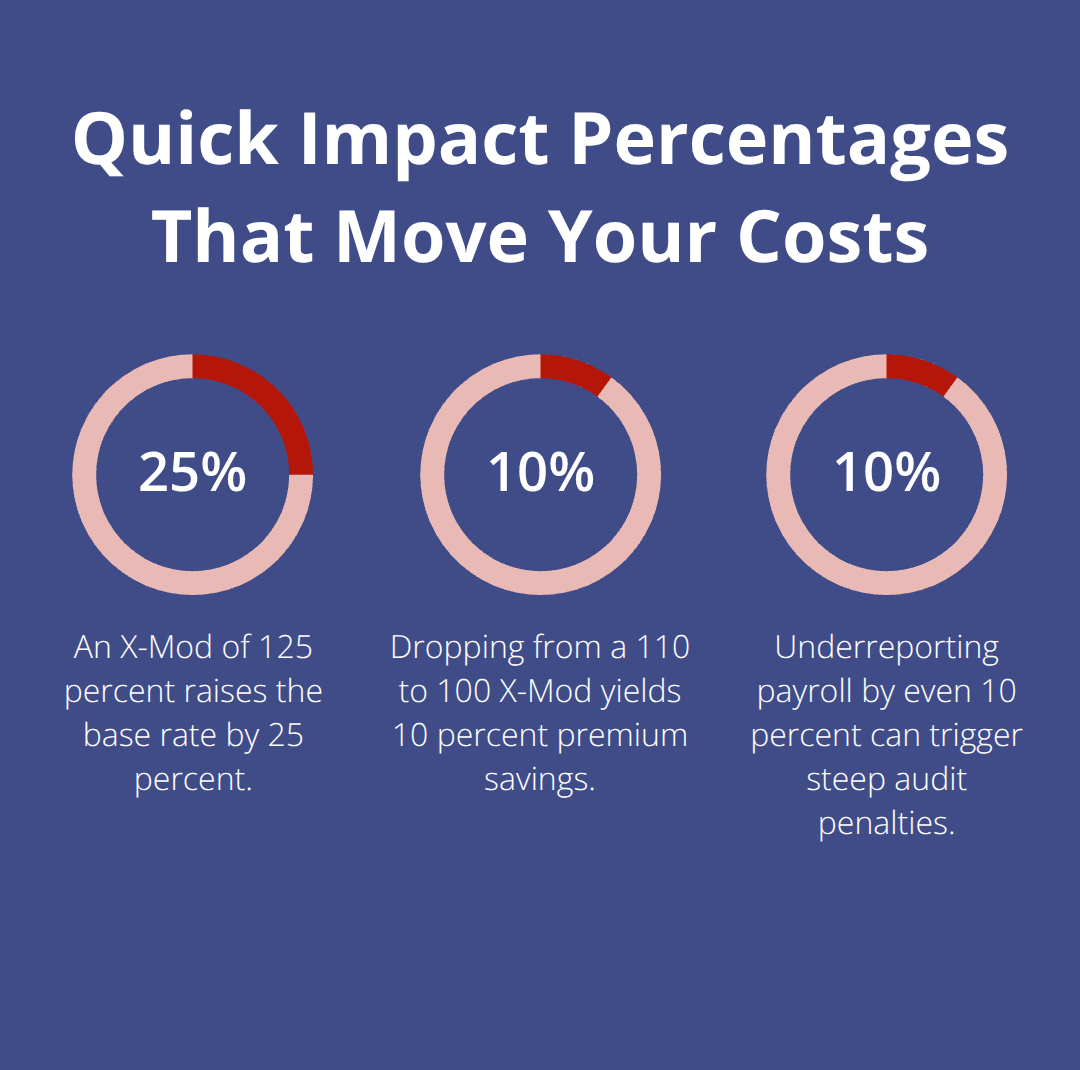
Your premium starts with a four-digit WCIRB classification code that categorizes your operation by risk. Truck drivers, for example, fall under different codes than dispatchers or office staff. Transportation companies often employ workers across multiple codes, and misclassification directly inflates premiums. The base rate for each code is set by WCIRB filings and updates twice yearly in January and July. Truck driver base rates in California range from approximately 8 percent to 12 percent of payroll depending on the specific classification and current rate environment. Experience modification, or the X-Mod, then adjusts this base rate up or down based on your claims history over the past three years. An X-Mod below 100 percent means better-than-average safety performance and lowers your premium; above 100 percent increases it. A company with two serious claims in three years might see an X-Mod of 125 percent, raising the base rate by 25 percent.
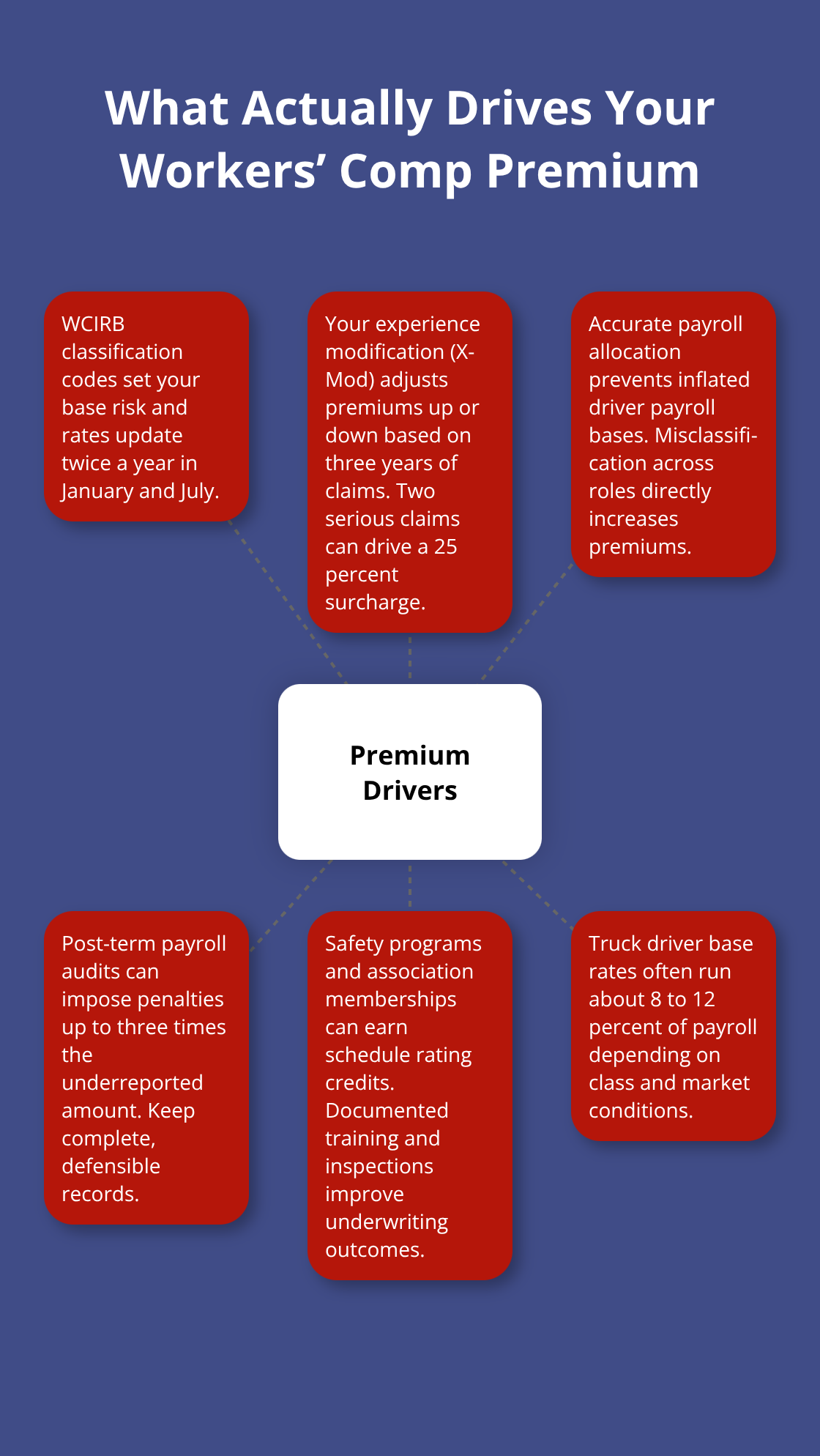
Final premiums also include rating plan adjustments for safety programs, memberships in trade associations, or schedule rating credits. Payroll audits occur after the policy term, and underreporting payroll triggers penalties up to three times the estimated premium. Accurate payroll records and correct classification directly control your costs and compliance status.
What’s Driving Your Premium Up Right Now
Base Rates Hold Steady, But Modifications Spike Costs
California’s workers compensation premiums for transportation companies have shifted noticeably since 2023, and understanding the current cost environment matters more than ever. Base rates themselves have remained relatively stable through 2024-2025, but what has changed is the aggressive application of experience modifications and stricter payroll audits. Transportation companies with even one serious driver injury claim in the past three years face X-Mod adjustments that can push premiums 30 to 50 percent higher than the baseline rate. A driver injury claim averaging $45,000 to $75,000 in medical and indemnity costs directly impacts your modification factor for the next three years, making early return-to-work programs financially essential, not optional.
Classification Accuracy and Audit Exposure Create Hidden Penalties
The real cost pressure comes from classification accuracy and audit exposure. Many transportation operations misclassify dispatchers or administrative staff, accidentally placing them under higher-risk driver codes, which inflates the entire payroll base used to calculate premiums. WCIRB audits have intensified focus on payroll allocation, and underreporting by even 10 percent can trigger penalties of three times the estimated premium difference. For a company with $500,000 in annual payroll, a 10 percent misallocation could mean a $15,000 penalty on top of corrected premium charges.
Your X-Mod Determines Long-Term Cost Trajectory
Your X-Mod is the single largest cost lever under your control, and improving it requires intentional claims management and safety investment. A transportation company that maintains zero serious claims for 24 months typically sees the X-Mod drop from 110 percent to 100 percent or below, translating directly to 10 percent premium savings on the entire policy.
Conversely, a company with recurring minor claims every six months stays locked at elevated modifications year after year. Transportation fleets that document safety initiatives, near-miss reporting, and driver training programs position themselves to receive schedule rating credits and improved X-Mod calculations from insurers.
Rate Variations Across Transportation Segments
Industry-specific rate variations matter significantly within transportation. Owner-operators running single-truck operations typically pay 9 to 11 percent of payroll in workers compensation base rates, while larger fleets with better loss histories can negotiate rates in the 7 to 8 percent range through preferred carrier programs. Non-emergency medical transport operators face different classifications than long-haul trucking, with base rates sometimes 15 to 20 percent lower because the work involves shorter distances and more controlled environments.
Challenge Outdated Claims in Your Rating System
The key actionable step is requesting your loss run every two years, verifying that closed claims are actually closed in the system, and working with your agent to challenge any outdated or inaccurate claims still affecting your modification factor. Outdated or incorrectly valued claims sometimes persist in the rating system, and formal disputes with WCIRB can reduce or eliminate their impact on your X-Mod, potentially saving thousands annually. Once you understand what claims are costing you, the next step is building a compliance and risk management strategy that prevents future claims while keeping your operation within regulatory requirements.
How to Build Compliance Without Bleeding Money on Premiums
Separate Payroll Into Classification Buckets
Payroll accuracy is not a back-office detail-it directly determines whether you overpay or underpay premiums and whether you face audit penalties that dwarf your annual insurance cost. Transportation companies that treat payroll records as a compliance afterthought typically discover during audit that they’ve misallocated 8 to 15 percent of labor costs across classification codes, triggering retroactive premium adjustments plus penalties up to three times the underreported amount. The Division of Workers’ Compensation expects insurers to audit policies within three years of expiration, and incomplete or inaccurate records leave you defenseless against substantial bills.
Truck drivers, dispatchers, office staff, and mechanics each belong in different codes with different base rates. A dispatcher earning $50,000 annually misclassified as a driver code costs an extra $2,000 to $3,000 in annual premium, and over three years that error compounds. Use payroll software that tags each employee with their correct WCIRB code from hire date through termination, then export quarterly reports to your insurance agent for verification. This single practice eliminates 90 percent of audit exposure and positions you to defend your records if questions arise.
Document Safety Programs to Lower Your X-Mod
Safety programs directly lower your X-Mod and unlock schedule rating credits that reduce premiums 5 to 15 percent depending on program depth and insurer participation. Transportation companies with documented driver training programs, vehicle inspection logs, and near-miss reporting systems receive preferential X-Mod treatment from most carriers because these programs statistically reduce serious claims.
A fleet that invests $3,000 annually in driver safety training and maintains zero preventable accidents for 24 months recovers that investment through X-Mod improvement alone, then continues saving 8 to 12 percent on premiums year after year. The key is documentation-safety initiatives that exist only in your head mean nothing to WCIRB or your insurer. Create a safety manual specific to your operation, require written acknowledgment from each driver, conduct quarterly safety meetings with attendance records, and photograph or video-document training sessions. When your insurer evaluates your application for schedule rating credits, these materials become your evidence that your safety culture is real, not theoretical.
Work With Agents Who Understand Transportation Classification
A licensed agent who understands transportation classification nuances prevents costly misclassification and ensures you’re not leaving premium credits on the table. Many transportation companies work with general insurance agents unfamiliar with WCIRB codes or California-specific rating adjustments, missing 10 to 20 percent in potential savings through correct classification or applicable discounts.
An agent experienced in transportation should immediately ask whether your fleet qualifies for preferred carrier programs, whether your loss history supports large risk deductible plans, or whether safety group memberships through industry associations reduce your baseline rates. Saberlines Insurance Services specializes in transportation and understands these classification details, preferred carrier relationships, and rating strategies that generic agents overlook.
Challenge Outdated Claims in Your Rating System
Request your loss run annually from your current carrier, review it line by line with your agent, and challenge any claims that appear incorrectly valued or still open despite settlement. Many transportation companies discover during this review that old claims affecting their X-Mod should have been closed years ago, and formal disputes with WCIRB can remove these from your rating calculation, improving your modification factor retroactively.
Schedule your policy renewal 90 days before expiration, not 30 days, so you have time to shop multiple carriers and negotiate preferred rates based on your safety record and accurate classification data.
Final Thoughts
California workers compensation compliance and cost control rest on three concrete actions that transportation companies can execute immediately. First, separate your payroll into correct classification codes and maintain quarterly verification with your agent-this single step eliminates audit penalties and prevents overpaying premiums on misclassified workers. Second, document safety programs with written records, driver training logs, and near-miss reports; these materials directly lower your X-Mod and unlock schedule rating credits worth 5 to 15 percent in annual savings.
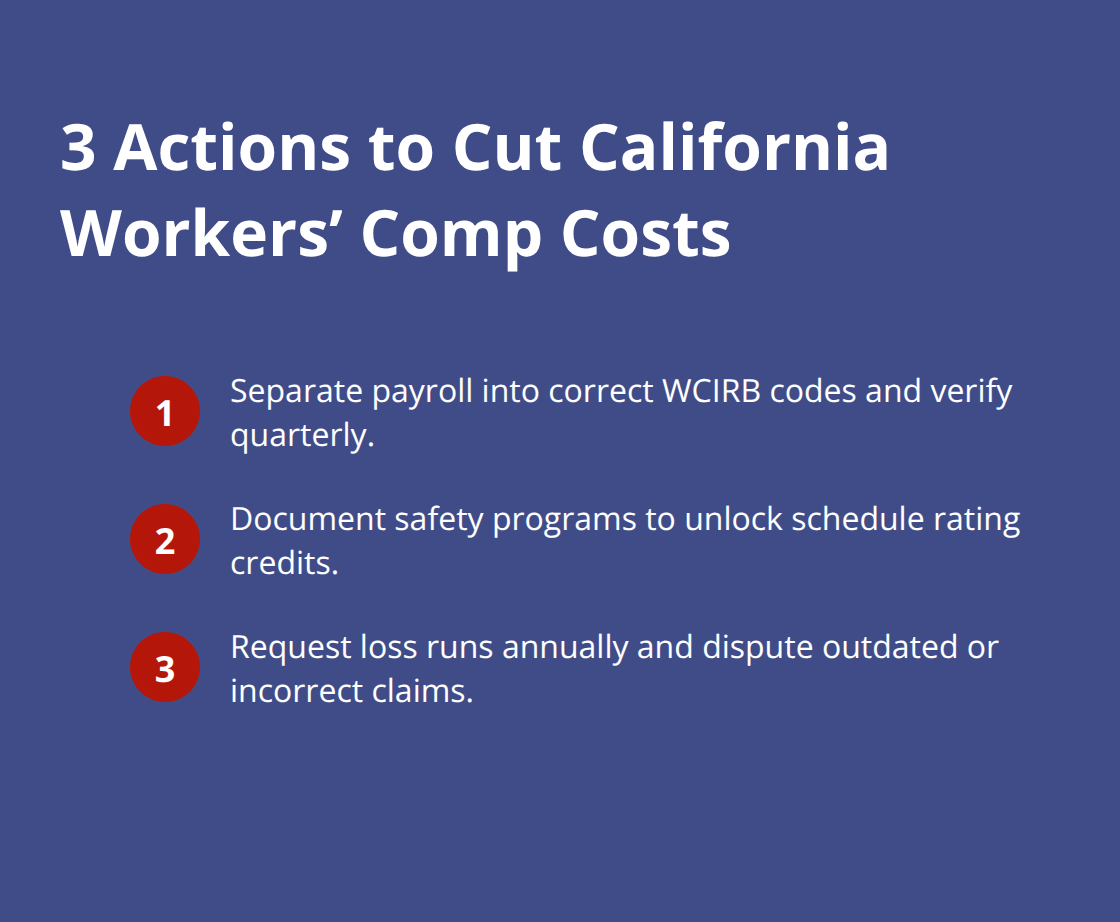
Third, request your loss run annually and challenge outdated claims still affecting your modification factor; many transportation companies recover thousands by removing closed claims that persist in the rating system.
Your X-Mod represents the largest cost lever under your control. A fleet that maintains zero serious claims for 24 months typically drops from 110 percent to 100 percent or below, translating to 10 percent premium savings on the entire policy. That improvement compounds year after year, making early return-to-work programs and safety investment financially essential, not optional.
Transportation businesses that treat payroll accuracy and safety documentation as ongoing compliance practices, not annual checkbox exercises, consistently pay 15 to 25 percent less in premiums than competitors with reactive approaches. Schedule your policy renewal 90 days before expiration so you have time to shop multiple carriers and negotiate preferred rates based on your safety record and accurate classification data. Contact Saberlines to review your current coverage, verify your classification accuracy, and identify premium savings opportunities specific to your operation.
The information provided in this blog is for general informational purposes only and does not constitute legal, financial, or insurance advice. Coverage options, terms, and availability may vary. Please consult with a licensed professional for advice specific to your situation.