
Small Fleet Workers Compensation: Efficient Coverage for Growing Teams
Running a small fleet means juggling tight budgets, regulatory requirements, and the constant worry about protecting your team. Small fleet workers compensation isn’t just a legal checkbox-it’s the foundation that keeps your business stable when injuries happen.
At Saberlines Insurance Services, we’ve seen how the right coverage transforms how small operators manage risk. This guide walks you through what you need to know to get affordable, effective protection for your growing team.
Why Small Fleets Must Have Workers Compensation
Workers compensation isn’t optional for small fleet operators, and the sooner you accept that reality, the better your business functions. Most states require workers compensation insurance the moment you hire your first employee, regardless of fleet size. California, for example, mandates coverage for any business with employees, with penalties starting at $10,000 for operating without it. Operating illegally exposes you to fines that dwarf the cost of actual coverage, plus potential criminal liability if an employee gets injured and you lack insurance. The legal requirement isn’t negotiable, but it’s also just the foundation of why this coverage matters.
What an Injury Actually Costs Your Business
A single workplace injury can devastate a small fleet’s finances faster than most operators realize. According to the National Safety Council, the average cost of a serious workplace injury in transportation exceeds $40,000 when accounting for medical expenses, lost wages, and administrative costs. For a small fleet with tight margins, one major injury claim without proper insurance coverage forces you to choose between paying medical bills or keeping trucks on the road. Workers compensation handles those medical expenses, rehabilitation costs, and partial wage replacement for injured employees, which protects your business from direct liability. Without this coverage, you remain personally responsible for every penny, and injured employees can sue you directly for additional damages beyond medical costs. That financial exposure is why skipping workers compensation isn’t just illegal, it’s financially reckless.
Growth Requires Protection You Can Afford
Small fleets expanding from five to fifteen trucks face a critical insurance gap. Your workers compensation costs scale with payroll, but smart bundling strategies keep premiums manageable as you grow. Combining workers compensation with commercial auto, general liability, and cargo coverage through a single carrier typically reduces your overall costs by 10-20 percent compared to separate policies. Safety programs specifically designed for transportation operations also lower your premiums significantly, making compliance actually profitable. Operators who implement driver training programs and vehicle maintenance protocols see workers compensation claim reductions of 15-30 percent over time, according to data from the American Trucking Associations. This means growing your fleet doesn’t require proportionally growing your insurance expenses if you structure coverage correctly from the start.
Finding Affordable Rates Without Sacrificing Coverage
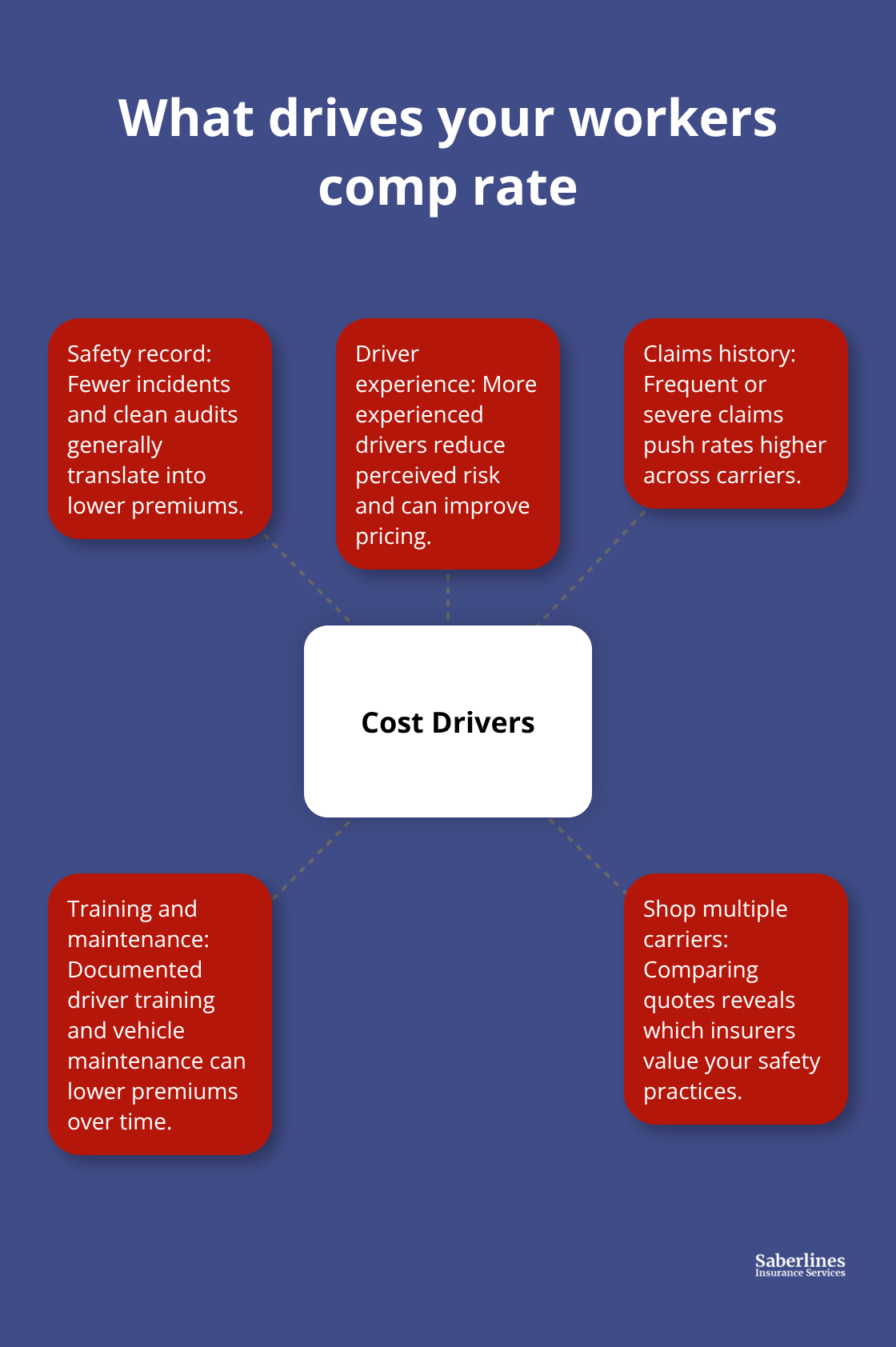
The challenge most small fleet operators face isn’t whether they need workers compensation-it’s how to afford it while maintaining other essential policies. Rates vary dramatically based on your operation’s safety record, driver experience, and claims history (factors that remain within your control). Operators who invest in safety training programs and vehicle maintenance protocols reduce their premiums substantially, turning risk management into a cost-saving strategy. Shopping multiple carriers reveals significant price differences for identical coverage, which is why comparing quotes from at least three insurers makes financial sense.
The next section covers the specific obstacles small fleet operators encounter when securing this coverage and how to overcome them.
Challenges Small Fleet Operators Face When Getting Workers Compensation
Why Quotes Vary So Dramatically Between Carriers
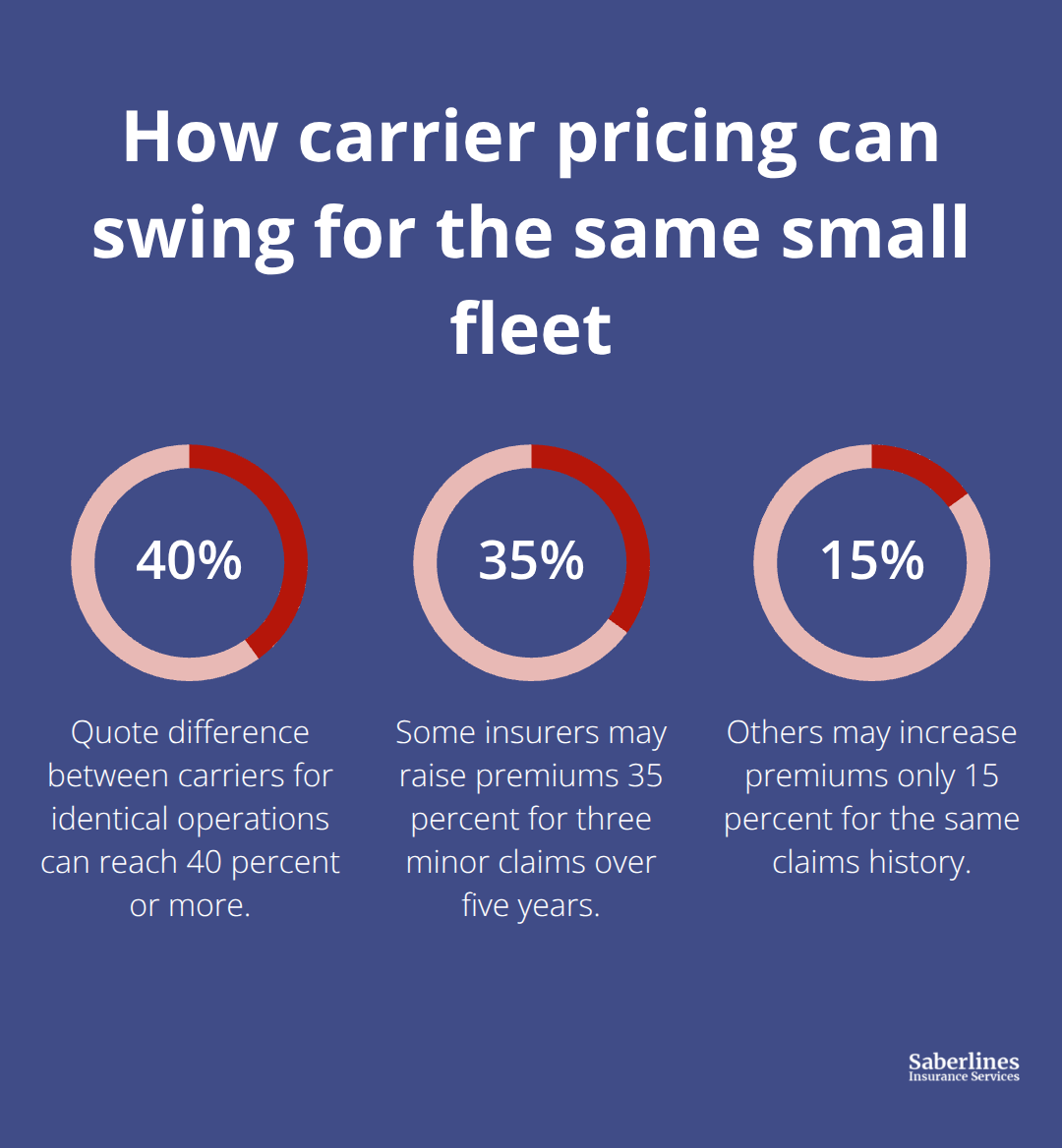
Small fleet operators quickly discover that workers compensation quotes vary wildly between carriers, sometimes by 40 percent or more for identical operations. Insurers weight risk factors differently, which creates massive price swings. One carrier might heavily penalize a fleet with drivers under 25 years old, while another focuses primarily on accident history and safety certifications. A fleet with three minor claims over five years might face a 35 percent premium increase from one insurer but only 15 percent from another.
The transportation industry carries higher injury rates than most sectors. The Bureau of Labor Statistics reports that transportation and warehouse workers experience 5.3 injuries per 100 full-time workers annually, compared to 3.5 across all industries. This elevated risk means insurers scrutinize every detail of your operation, from maintenance records to driver training documentation. Getting quotes from at least five carriers reveals these differences and helps you identify which insurer actually values your specific safety practices.
Some carriers specialize in small fleets and price accordingly, while national carriers sometimes treat small operations as unprofitable nuisances and quote accordingly high. Transportation specialists understand your operational realities in ways that generalist insurers simply cannot match.
Understanding Coverage Limits for Your Specific Fleet
The complexity multiplies when you try to understand what coverage limits actually mean for your business. Most small fleet operators don’t know whether they need $500,000 or $1,000,000 in workers compensation limits, and many insurers provide generic recommendations rather than analysis specific to your payroll and injury exposure.
Your payroll size directly determines your premium. A fleet with $400,000 annual payroll pays roughly half the premium of one with $800,000, all else equal. Coverage limits should reflect your worst-case scenario, not industry averages. If your fleet operates in high-cost-of-living areas like California or New York, medical costs and wage replacement obligations run substantially higher, requiring higher limits than fleets in lower-cost regions.
Many small operators underbuy coverage to save money, then face massive out-of-pocket costs when a serious injury occurs that exceeds their limits. Finding an insurer who takes time to analyze your actual exposure-not just applying standard formulas-separates adequate protection from financial vulnerability.
Getting Specialized Analysis Instead of Generic Recommendations
Transportation operations require insurers who understand your specific challenges. An insurer analyzing your fleet should examine your driver composition, geographic footprint, vehicle types, and claims history to match coverage limits to your actual exposure. Generic recommendations leave you either overinsured or dangerously exposed.
Saberlines Insurance Services specializes in transportation operations and understands how to match coverage limits to your specific fleet size, geographic footprint, and driver composition rather than applying one-size-fits-all approaches. This specialized analysis becomes your foundation for the next critical step: implementing cost-effective strategies that actually reduce your premiums while maintaining protection.
How to Cut Workers Compensation Costs Without Cutting Corners
Safety Programs That Actually Lower Your Premiums
Safety programs directly reduce your premiums, and the math is straightforward: fleets that implement driver training and vehicle maintenance protocols see workers compensation claims drop 15-30 percent over time according to the American Trucking Associations. This isn’t theoretical savings-it’s measurable reduction in actual injury frequency. A fleet with $500,000 in annual payroll spending 2 percent on safety initiatives invests $10,000 yearly but recovers that investment through premium reductions within 18 months.
Documentation separates fleets that save money from those that don’t. You must record driver training completion dates, vehicle inspection records, safety meeting attendance, and incident reports. Insurers review these records when calculating renewal premiums, and documented safety practices become your negotiating leverage. Fleets operating in California or other high-cost states see even larger savings because medical expenses and wage replacement obligations run substantially higher, making injury prevention more valuable to insurers. Many small operators skip safety documentation thinking it’s administrative overhead, then wonder why their premiums stay flat despite years without claims. Insurers cannot reward what they cannot verify.
Bundling Policies to Maximize Savings
Combining workers compensation with commercial auto, general liability, and physical damage coverage through a single carrier typically reduces your overall costs by 10-20 percent compared to purchasing policies separately. This matters enormously for small fleets operating on tight margins. A fleet paying $3,000 annually for workers compensation, $4,500 for commercial auto, $800 for general liability, and $2,000 for physical damage saves $2,100-$4,200 yearly through bundling-money that goes directly to your bottom line.
Bundling only works if you compare identical coverage limits across carriers, which requires obtaining detailed quotes from at least five insurers who specialize in transportation. National carriers often quote higher for small fleets because they lack transportation expertise and price accordingly to discourage small accounts. Transportation specialists understand your operational realities and price competitively. Comparing quotes reveals not just price differences but also which insurers actually value your safety practices versus those applying generic formulas. Most small operators obtain one or two quotes then accept the first reasonable price, leaving thousands in annual savings on the table. Shopping five carriers takes roughly four hours but generates data showing which insurer genuinely wants your business and understands your specific risk profile.
Conclusion
Small fleet workers compensation shapes your business’s financial stability today, not tomorrow. Legal compliance protects you from fines exceeding $10,000, but proper coverage protects you from financial devastation when injuries happen. A single serious workplace injury costs over $40,000 on average, and without insurance, that bill lands directly on your business.
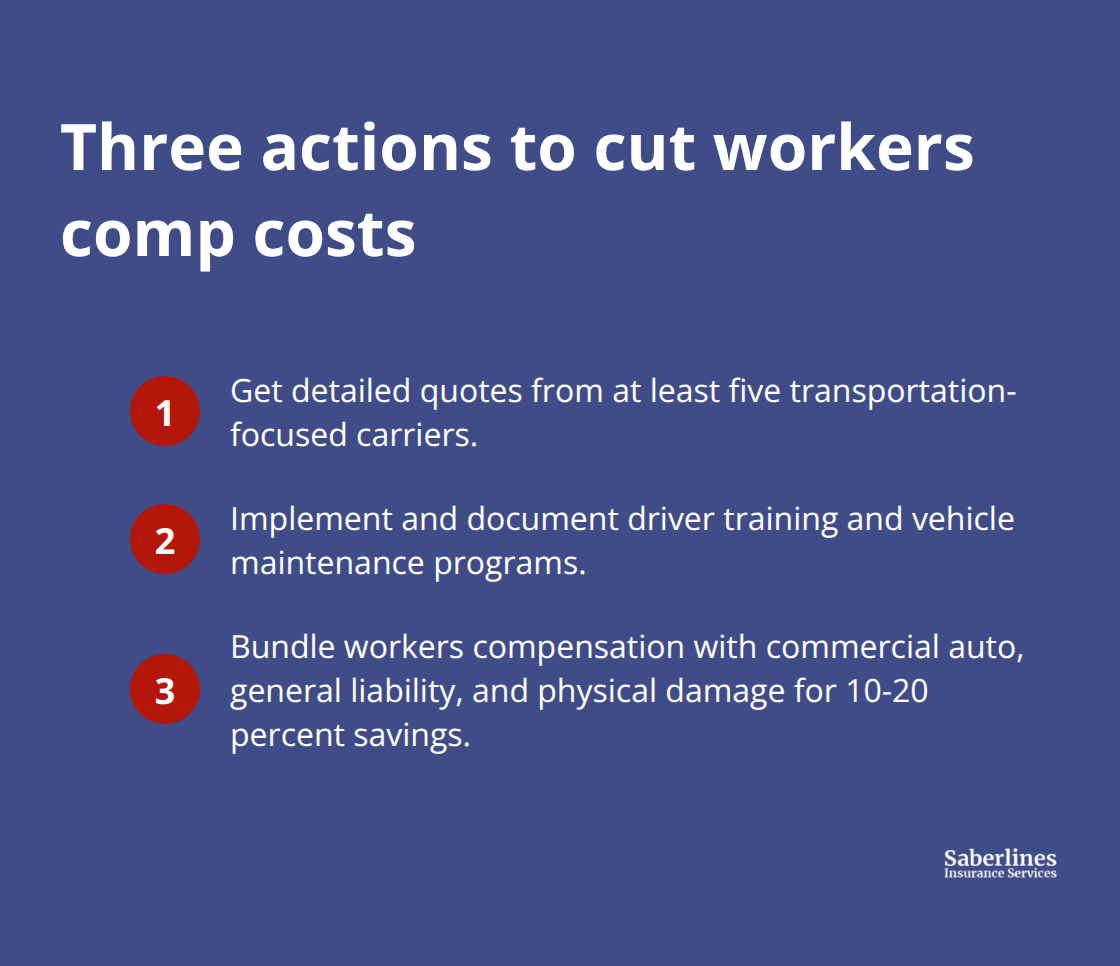
Your path forward requires three concrete actions. First, obtain detailed quotes from at least five carriers who specialize in transportation operations, not generalist insurers who treat small fleets as afterthoughts (price differences of 40 percent or more for identical coverage are common). Second, implement documented safety programs that reduce your premiums while protecting your team-fleets investing in driver training and vehicle maintenance see workers compensation claims drop 15-30 percent. Third, bundle workers compensation with commercial auto, general liability, and physical damage coverage through a single carrier to capture 10-20 percent savings compared to separate policies.
We at Saberlines Insurance Services specialize in helping transportation businesses like yours secure affordable, comprehensive coverage that fits your operation. Visit Saberlines Insurance Services to get quotes from a team that knows transportation inside and out.
The information provided in this blog is for general informational purposes only and does not constitute legal, financial, or insurance advice. Coverage options, terms, and availability may vary. Please consult with a licensed professional for advice specific to your situation.