
Contractor Business Insurance: Protecting Your Projects
One accident on site, one equipment theft, or one injury claim can wipe out months of profit. Contractor business insurance isn’t optional-it’s the difference between staying in business and facing financial ruin.
At Saberlines Insurance Services, we’ve seen too many contractors operate without proper coverage or with dangerous gaps in their policies. The right insurance protects your projects, your employees, and your bottom line.
What Coverage Actually Protects Your Business
The Foundation: General Liability and Professional Coverage
General Liability covers third-party bodily injury and property damage on your job sites, but it won’t cover your own equipment or professional mistakes. Professional Liability, also called Errors & Omissions insurance, protects you when your advice or services cause a client’s financial loss-including defense costs. These two form the foundation, but most contractors need more than just these two policies to operate safely.
Required Coverage for Employees and Assets
Workers’ Compensation is required in nearly every state if you have employees, covering medical costs and lost wages when someone gets hurt on the job. Texas is the only state that doesn’t mandate it, but even there, operating without it is reckless. Commercial Property insurance protects your physical location, fixtures, and improvements from fire, theft, or damage, and bundling it with General Liability into a Business Owner’s Policy typically saves money compared to buying them separately.
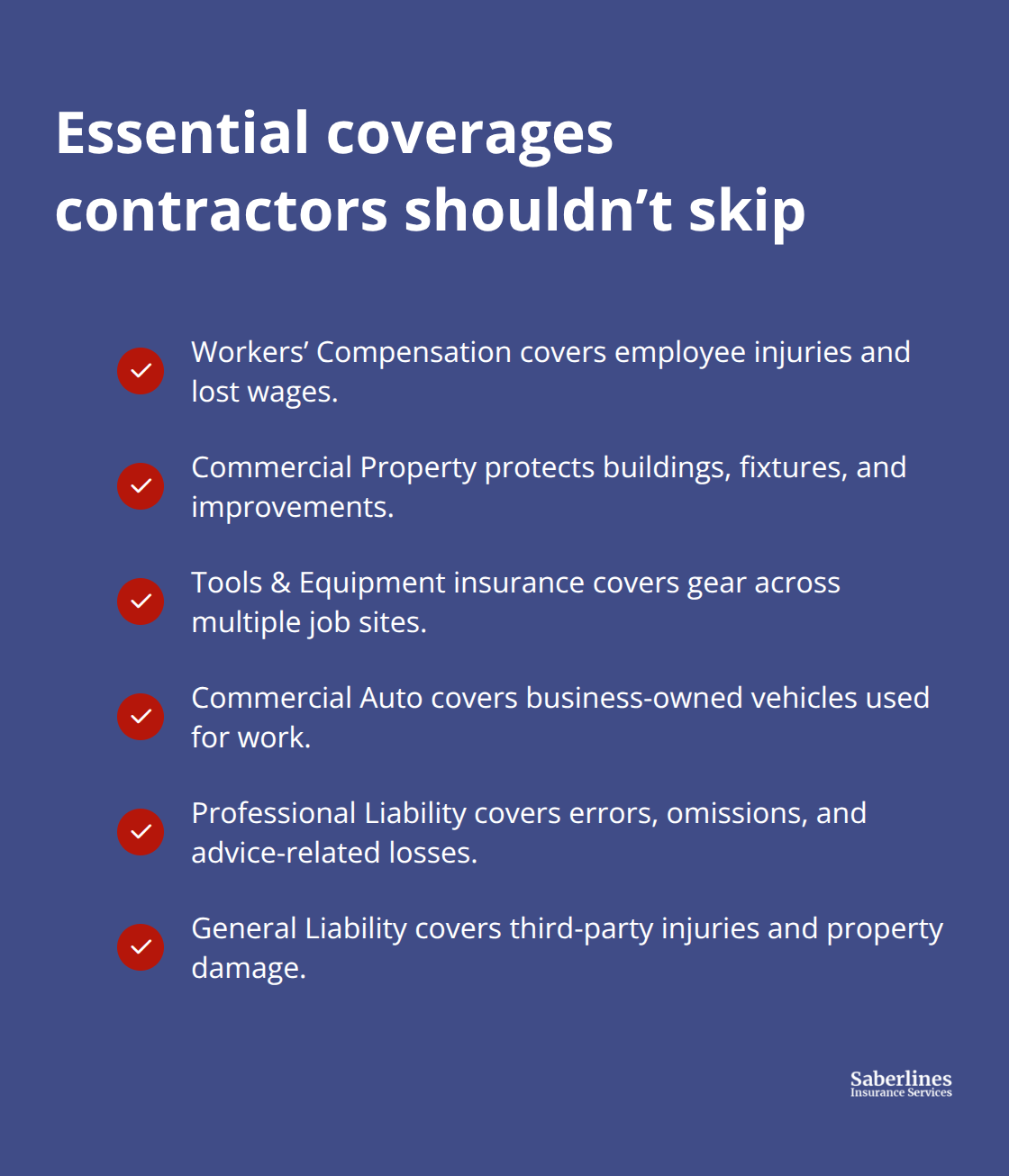
Tools & Equipment insurance covers your gear across multiple job sites-something standard property coverage won’t do. Commercial Auto insurance is mandatory for business-owned vehicles; your personal auto policy explicitly excludes business use, which means you’re uninsured if something happens while you’re driving to a job. Many contractors miss this gap entirely.
The Limits Problem That Costs Contractors Real Money
The biggest mistake contractors make is buying only the minimum limits their contracts require, typically $1–$2 million in General Liability. When a serious injury or major property damage claim hits, those limits evaporate fast, and you’re liable for the rest. Inflation is making this worse-medical and legal fees keep rising, and social inflation pushes settlements and verdicts higher than they used to be. Your insurance costs are climbing because claim costs are climbing. Higher interest rates also affect your risk exposure: projects take longer, workers spend more time on site, and injury risk increases. Labor shortages compound this by driving up on-site incidents and workers’ compensation claims.
Protecting Yourself Through Subcontractor Management
Verify that your subcontractors carry their own contractor liability coverage with limits equal to or greater than yours, and have them name you as additional insured on their policies. If they don’t, you’re exposed to their liability. Certificates of Insurance should be verified before work starts, not after an accident happens. The coverage you buy must match your actual operations-your location, the types of projects you take, the equipment you use, and the number of employees you have. One-size-fits-all policies leave you exposed.
Your next step is understanding how different contractor specialties face unique risks and require tailored coverage solutions.
Coverage That Matches Your Contractor Specialty
How Your Trade Determines Liability Exposure
General Liability protects you when someone gets injured or their property gets damaged because of your work, but the type of contractor you are determines how much coverage you actually need. An electrician working in occupied homes faces different liability exposure than a foundation contractor working on vacant lots. Roofers deal with fall risks that framers don’t, and plumbers encounter water damage scenarios that equipment operators avoid entirely. The $1–$2 million limits that satisfy many contracts become dangerously thin when you do high-risk work. A single serious injury claim in a residential setting can easily exceed $500,000 in medical costs alone, according to data from the National Safety Council. If your contract requires $2 million but a jury awards $3 million, you pay the difference out of pocket.
Setting the Right Liability Limits for Your Work
Contractors specializing in high-risk work like roofing, electrical, or plumbing should carry at least $2 million in General Liability, with consideration for $5 million if you do commercial projects or work in densely populated areas. Professional Liability becomes critical if you do design work, value engineering, or provide advice that clients rely on. A structural engineer or design-build contractor absolutely needs this coverage; a basic framing crew typically doesn’t.
Reducing Costs Through Safety Performance
Workers’ Compensation premiums are based on your experience modification factor, which reflects your actual injury history. If you’ve had three serious claims in five years, your mod rate climbs, and your premiums follow. The best way to lower your insurance costs isn’t negotiating with your carrier-it’s preventing injuries. Companies that implement formal safety programs, use proper equipment, and train workers consistently see mod rates drop by 10–25%, according to the National Council on Compensation Insurance. That translates to thousands in annual savings.
Equipment Coverage That Follows Your Tools
Tools and equipment coverage needs to match where your gear actually lives. If you store tools at a central yard, standard Commercial Property works. If you move equipment between job sites constantly or store gear at a warehouse you don’t own, you need inland marine coverage that follows your equipment. A theft of $15,000 in power tools at a temporary site won’t be covered under basic property insurance-inland marine will. Your specialty determines which coverage gaps will cost you the most money, and the wrong policy choice can expose you to losses that threaten your entire operation. Understanding your specific risks leads directly to identifying which policies protect your projects most effectively.
What Actually Drives Your Insurance Costs
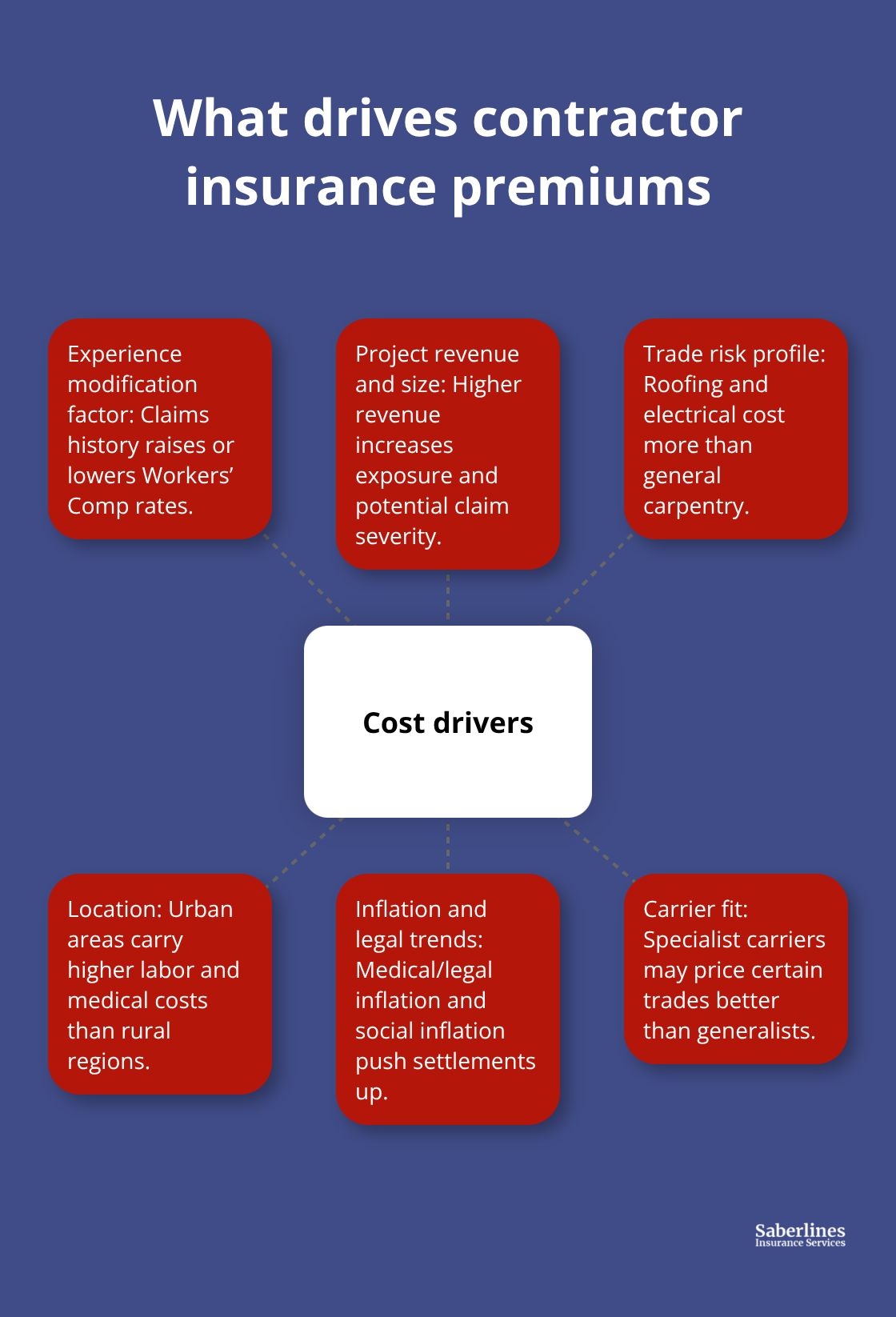
Insurance premiums for contractors aren’t arbitrary numbers pulled from thin air-they’re calculated based on concrete factors that you can actually control. Your experience modification factor, which reflects your Workers’ Compensation claim history, is the single biggest lever you have. If you’ve had zero claims in three years, your mod rate sits at 1.0 and you pay standard rates.
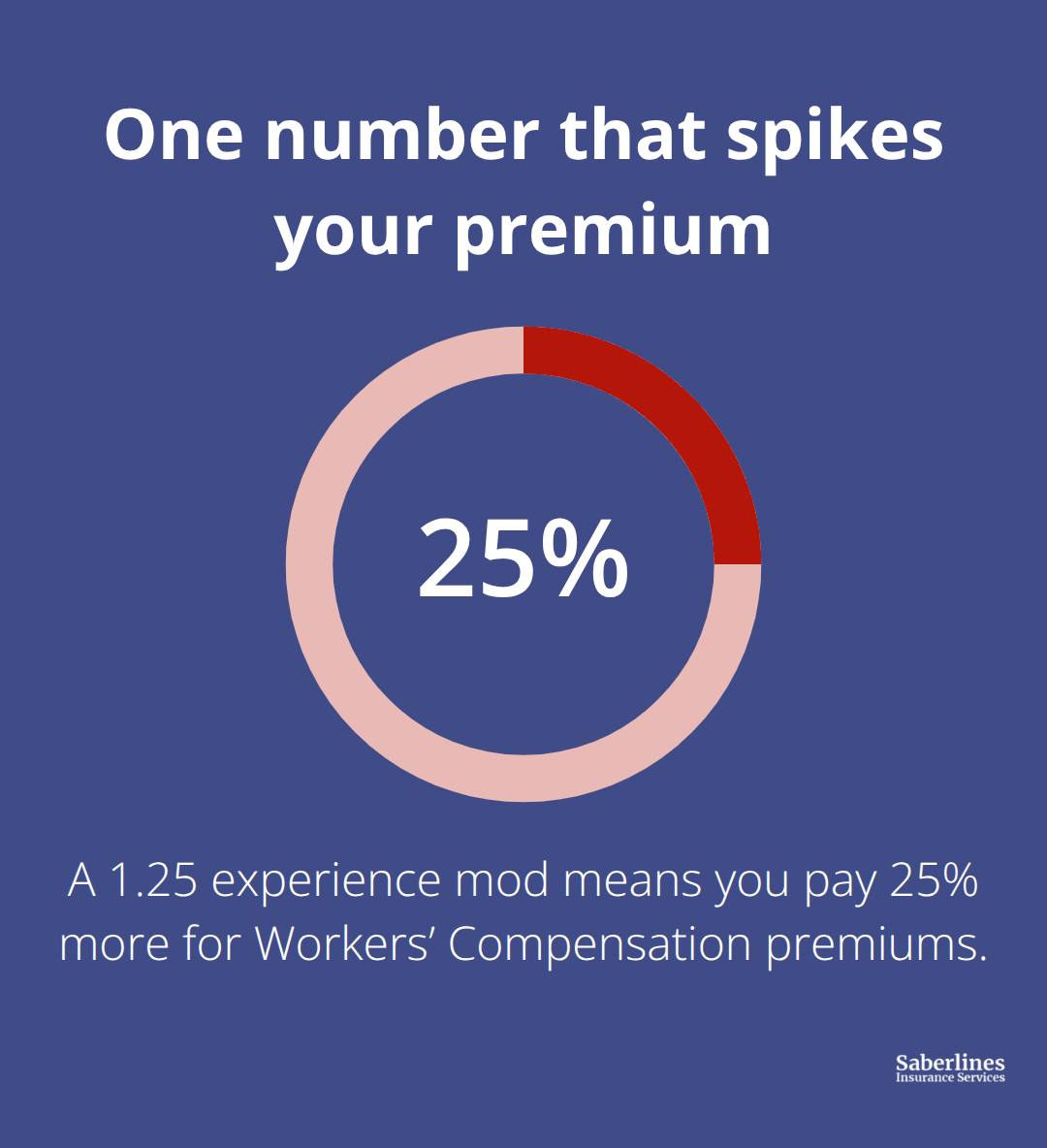
If you’ve had multiple serious injuries, your mod rate climbs to 1.25 or higher, meaning you pay 25% more for Workers’ Compensation coverage. The National Council on Compensation Insurance reports that contractors who implement formal safety programs and reduce injury claims see mod rates drop by 10–25% within two to three years-that’s thousands in annual premium reductions just from preventing incidents.
How Your Operations Shape Premium Costs
Your project type, location, and revenue determine what you’ll pay. A contractor doing $500,000 annually in residential work pays far less than one doing $2 million in commercial projects, because larger revenue means larger exposure and higher potential claim costs. The type of work itself drives premiums up or down: roofing and electrical work cost more to insure than general carpentry because injury rates are higher. Your location affects rates too-contractors in urban areas with higher labor and medical costs pay more than those in rural regions. Inflation has become the dominant cost driver since 2022, with medical and legal fees rising 8–12% annually, pushing claim costs higher even when injury rates stay flat. Social inflation-the tendency for juries to award larger settlements and verdicts than they did five years ago-compounds this problem. Your insurance carrier watches these trends closely and reprices accordingly.
Providing Accurate Information for Real Quotes
Honest disclosure takes five minutes more but prevents catastrophic gaps later. When you tell a quote engine you have five employees but actually have twelve, or you downplay the percentage of work you do at heights, you’ll receive a quote that doesn’t reflect your real risk. That quote gets approved, you purchase the policy, and then a claim happens that your underpriced coverage won’t fully cover. Most online quote platforms can generate preliminary pricing in 10–15 minutes if you have your basic information ready: business structure, annual revenue, number of employees, types of work, and loss history.
Comparing Quotes Across Multiple Carriers
Preliminary quotes often differ significantly from final quotes because underwriters examine deeper during the full application process. The gap between preliminary and final pricing typically ranges from 10–30%, depending on how detailed your initial application was. Don’t rely on the first quote you receive-obtain three to five quotes from different carriers to establish a real market range. Comparing quotes across carriers matters because one insurer might specialize in your contractor type and offer better rates than a generalist. For example, a roofing contractor might receive significantly better pricing from a carrier that focuses on roofing than from a general commercial insurance provider.
When you compare quotes, verify you’re looking at apples-to-apples coverage: same liability limits, same deductibles, same policy terms. A $500-per-month quote with a $5,000 deductible and $1 million limits isn’t comparable to a $400-per-month quote with a $2,500 deductible and $2 million limits.
Bundling your policies-combining General Liability, Commercial Property, and Workers’ Compensation into one package-typically saves 10–15% compared to purchasing each policy separately. A Business Owner’s Policy bundles General Liability and Commercial Property specifically for this reason. The savings are real, but only if the bundled package actually covers your operations. Bundling just to save money while leaving coverage gaps is false economy.
Building Long-Term Relationships With Your Carrier
Cost management isn’t about finding the cheapest premium-it’s about paying the right price for coverage that actually protects your business. Contractors who switch carriers annually to save a few hundred dollars often face higher premiums later because they lack continuity with underwriters. Carriers that have insured you for three years understand your operations, your safety practices, and your claims history. They’re more likely to work with you on renewals and less likely to drop you after a single claim. Smaller premium increases from a carrier that knows you are often better than larger decreases from a carrier that will eventually reprice aggressively once they understand your real risk.
Track your actual claims costs and safety metrics quarterly. If your mod rate improves, you have documentation to show carriers during renewal negotiations. If you’ve gone two years without a claim, that’s leverage for better rates. Carriers respond to demonstrated risk reduction because it lowers their costs. Implementing specific safety improvements-fall protection systems, tool safety training, equipment maintenance schedules-gives you concrete evidence that your risk profile improves. Document these improvements and share them during renewal conversations. The contractors paying the most for insurance often aren’t those with the highest risk-they’re those who never communicate their risk management efforts to their carriers. Your insurance strategy should evolve as your business changes. Taking on a new type of work, expanding into a new state, or adding significant revenue changes your risk profile and should trigger a policy review. Waiting until renewal to discover your current policy doesn’t cover your new work direction costs you time and exposes you to gaps.
Final Thoughts
Contractor business insurance protects your operation when something goes wrong, and the coverage you need depends entirely on your specific work, location, and risk profile. General Liability and Professional Liability form the base, but Workers’ Compensation, Commercial Property, Tools & Equipment, and Commercial Auto fill the gaps that sink unprepared contractors. Most contractors operate with dangerously thin limits because they buy only what contracts require, not what claims actually cost-a $2 million General Liability limit disappears fast when medical costs, legal fees, and social inflation push claim settlements higher than they were five years ago.
Gather your business information (annual revenue, number of employees, types of work, and loss history) and obtain quotes from multiple carriers to establish your real market range. Verify you compare identical coverage limits and deductibles across quotes, and bundle policies to save 10–15% compared to buying separately-but only if the bundle actually covers your operations. Don’t sacrifice coverage to save a few hundred dollars monthly.
The contractors paying the least for contractor business insurance aren’t those with the lowest risk-they’re those who actively manage it through formal safety programs, subcontractor verification, and quarterly tracking of their experience modification factor. When your mod rate improves or you complete two years without claims, use that documentation during renewal negotiations to secure better rates. Contact Saberlines Insurance Services today to build protection that matches your actual operations.
The information provided in this blog is for general informational purposes only and does not constitute legal, financial, or insurance advice. Coverage options, terms, and availability may vary. Please consult with a licensed professional for advice specific to your situation.