
Moving Van Cargo Insurance: Safeguarding Every Relocation Load
Moving van cargo insurance protects your belongings during relocation, yet many people overlook this critical safeguard. Damage, theft, and loss happen more often than you’d think during moves.
At Saberlines Insurance Services, we’ve seen firsthand how the right coverage makes the difference between a smooth transition and a financial setback. This guide walks you through everything you need to know.
What Moving Van Cargo Insurance Actually Covers
Understanding Your Coverage
Moving van cargo insurance protects the belongings inside your vehicle during transit, covering damage from accidents, theft, weather, and other incidents that occur while items are being transported. This coverage is distinct from your general moving liability, which handles injuries or damage you cause to someone else’s property. Cargo insurance reimburses you for damaged, destroyed, or lost goods-whether that’s furniture crushed in a collision, electronics stolen during a loading stop, or boxes ruined by unexpected rain. The coverage typically includes removal expenses if debris from an accident ends up on the road, and in some cases, it covers earned freight charges if a load never reaches its destination.
Most policies let you choose your coverage limit and deductible, meaning a $50,000 load of household goods might carry a $5,000 or $10,000 deductible depending on what you select and what your shipper requires. This flexibility allows you to balance premium costs against your risk tolerance and the value of items you transport.
Basic vs. Comprehensive Policies
Two main policy types exist in the moving industry, and the difference between them matters significantly for your wallet. Basic cargo coverage handles standard relocation loads with standard protections against fire, collision, and theft, but it excludes valuables like jewelry and art, restricted items such as alcohol and pharmaceuticals, and anything stored longer than 72 hours. Comprehensive policies go further, often including refrigeration breakdown coverage if you transport temperature-sensitive goods, protection against wetness and corrosion, and broader coverage for specialty items-though exclusions for live animals, explosives, and radioactive materials remain across all policies.
The FMCSA requires minimum cargo coverage of $5,000 per vehicle and $10,000 per occurrence for household goods movers, but many shippers demand higher limits, sometimes $25,000 or more, to cover high-value relocations. When you move a $100,000 household load, a basic policy with a $1,000 deductible costs roughly 1% of your declared value annually, while comprehensive coverage with lower deductibles runs closer to 2–3%, making the premium difference minimal compared to the financial exposure you’d face without it.
Real Claims Data
Damaged goods represent one of the top three complaint categories filed with state moving regulators, with weather and accident-related damage accounting for the majority of claims. This pattern shows that cargo damage during moves is far from rare-it’s a predictable risk that affects many relocations. Understanding these trends helps you recognize why adequate coverage protects both your business and your customers’ peace of mind.
Now that you understand what cargo insurance covers and how policies differ, the next step is assessing your specific load value and determining which coverage limits actually match your operation.
What Actually Damages Moving Loads Most Often
Collisions: The Primary Threat
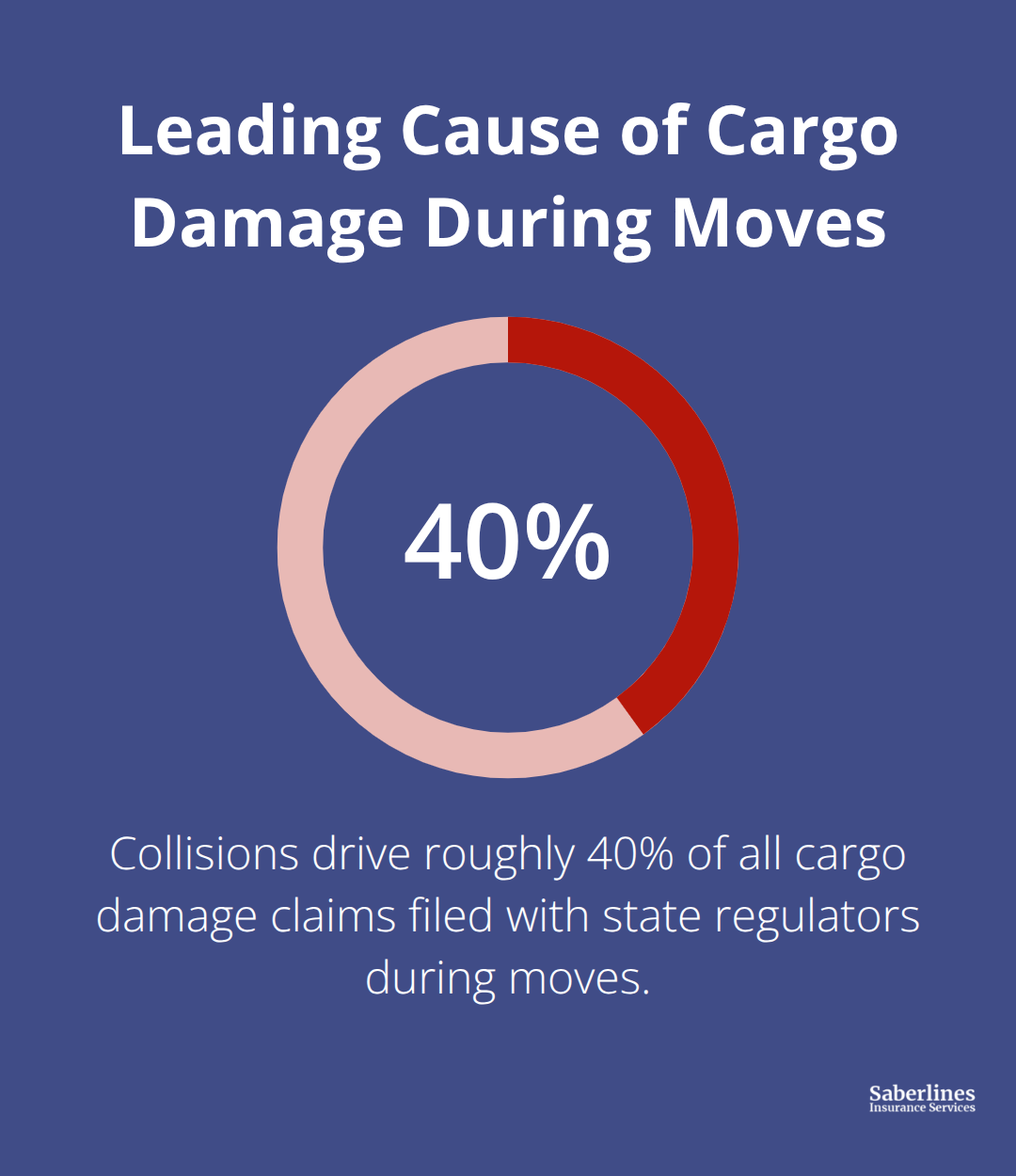
Collisions rank as the leading cause of cargo damage during moves, accounting for roughly 40 percent of all claims filed with state regulators. When a moving truck hits another vehicle, a guardrail, or a low-hanging structure, the sudden impact sends boxes flying, crushes fragile items, and can total entire loads worth thousands of dollars. A rear-end collision at highway speeds destroys $50,000 in household goods in seconds, and your basic liability coverage won’t cover it.
Cargo insurance specifically protects against collision damage, but the real defense starts before you hit the road.
Conduct a vehicle safety inspection before every load. Check brake condition, tire tread depth, and verify that mirrors and lighting work properly. Many movers skip this step and end up filing claims that prevention could have avoided. These inspections take 15 minutes and eliminate the most preventable collision risks on your routes.
Weather and Environmental Damage
Weather presents a second major threat that catches operators off guard. Rain, hail, and snow don’t just wet boxes-they cause rust on metal items, mold growth inside sealed containers, and structural damage to wood furniture. Temperature swings during long-distance moves warp wooden pieces and crack ceramics.
Comprehensive cargo policies that include protection against wetness and corrosion cost only slightly more than basic coverage, yet they cover scenarios that happen regularly in interstate relocations.
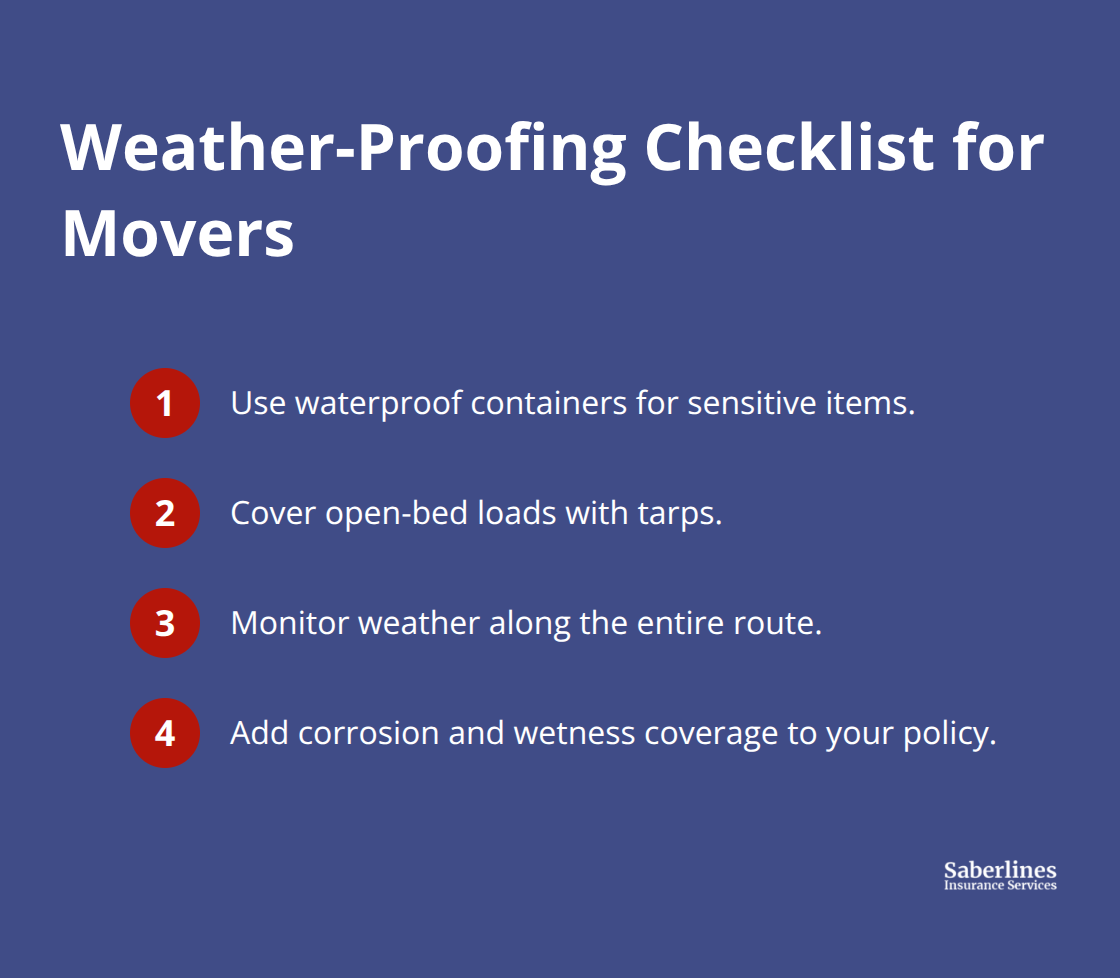
Pack weather-sensitive items in waterproof containers and use tarps on open-bed trucks. Monitor weather forecasts along your entire route before departure. This combination of preparation and proper coverage protects high-value loads from losses that basic policies exclude.
Theft During Loading and Unloading
Theft during loading and unloading stops represents the third major risk, with criminals specifically targeting moving trucks because they know valuable items sit exposed and vulnerable. High-value electronics, jewelry, tools, and collectibles disappear at rest stops, warehouses, and overnight parking areas at alarming rates. Never leave a truck unattended with cargo visible or accessible, and if you must stop for more than 30 minutes, position the vehicle where you can see it from inside a building or stay with it.
Cargo insurance covers theft losses, but prevention costs far less than filing claims. Document everything your customers load into the truck with photos and detailed inventory lists-this evidence becomes critical if theft occurs and you need to prove what was inside. High-value items worth more than about $100 per pound require separate listing on shipping documents to ensure full coverage under comprehensive policies.
Protecting High-Value Shipments
Movers who transport declared high-value loads should match cargo coverage limits to shipment value, reducing exposure if theft or damage occurs during transit. This alignment between declared value and coverage limits transforms cargo insurance from a reactive expense into an active business safeguard. Understanding your specific load composition and the risks each type of cargo faces allows you to select the right policy limits before problems arise.
Matching Coverage Limits to What You Actually Transport
Calculate Your Real Load Values
Start with your actual load values, not industry averages or what competitors carry. Measure your typical relocation by adding up the replacement cost of items you move most often-furniture, appliances, electronics, boxes of household goods. A standard residential move averages $50,000 to $100,000 in declared value, but high-end relocations easily exceed $200,000. The FMCSA minimum of $5,000 per vehicle and $10,000 per occurrence exists only to meet federal baseline requirements; shippers and customers routinely demand $25,000, $50,000, or higher limits because they refuse to absorb losses beyond your coverage.
Your cargo insurance limit should match or exceed what your customers declare as shipment value, not fall short of it. If you regularly transport loads valued at $75,000 but carry only $25,000 in coverage, you become personally liable for the $50,000 gap-a financial exposure that kills small moving operations. Set your coverage limit at or above your 90th percentile load value, meaning the amount that covers your highest-value moves.
Understand How Deductibles Affect Your Cash Flow
Deductibles matter far more than most operators realize because they directly impact your cash flow after a claim. A $500 deductible means you absorb the first $500 of every loss before insurance pays; a $1,000 deductible doubles that out-of-pocket expense. Moving companies typically pay around $876 monthly for commercial auto coverage according to median quotes from TechInsurance, and comprehensive cargo with a $500 deductible costs roughly $120 to $200 monthly depending on your claims history and vehicle count.
Higher deductibles ($1,000 to $2,500) lower premiums but expose you to larger immediate expenses when damage occurs. Choose a deductible you can actually pay from operating cash without disrupting payroll or delaying repairs. This alignment between deductible size and your financial capacity prevents coverage from becoming a liability rather than a protection.
Compare Quotes from Multiple Carriers
Get quotes from at least three carriers and compare not just premium price but the actual coverage terms, exclusion lists, and claims processing speed. Progressive advertises itself as the number one commercial truck insurer in America based on 2025 national written premium data from S&P Global Market Intelligence, while GEICO’s app and website ranked first in both Forrester’s 2021 benchmark and Alan Newman Research’s 2024 study for mobile auto insurance functionality. Request online quotes or call carriers directly to understand what each policy actually covers for your specific operation.
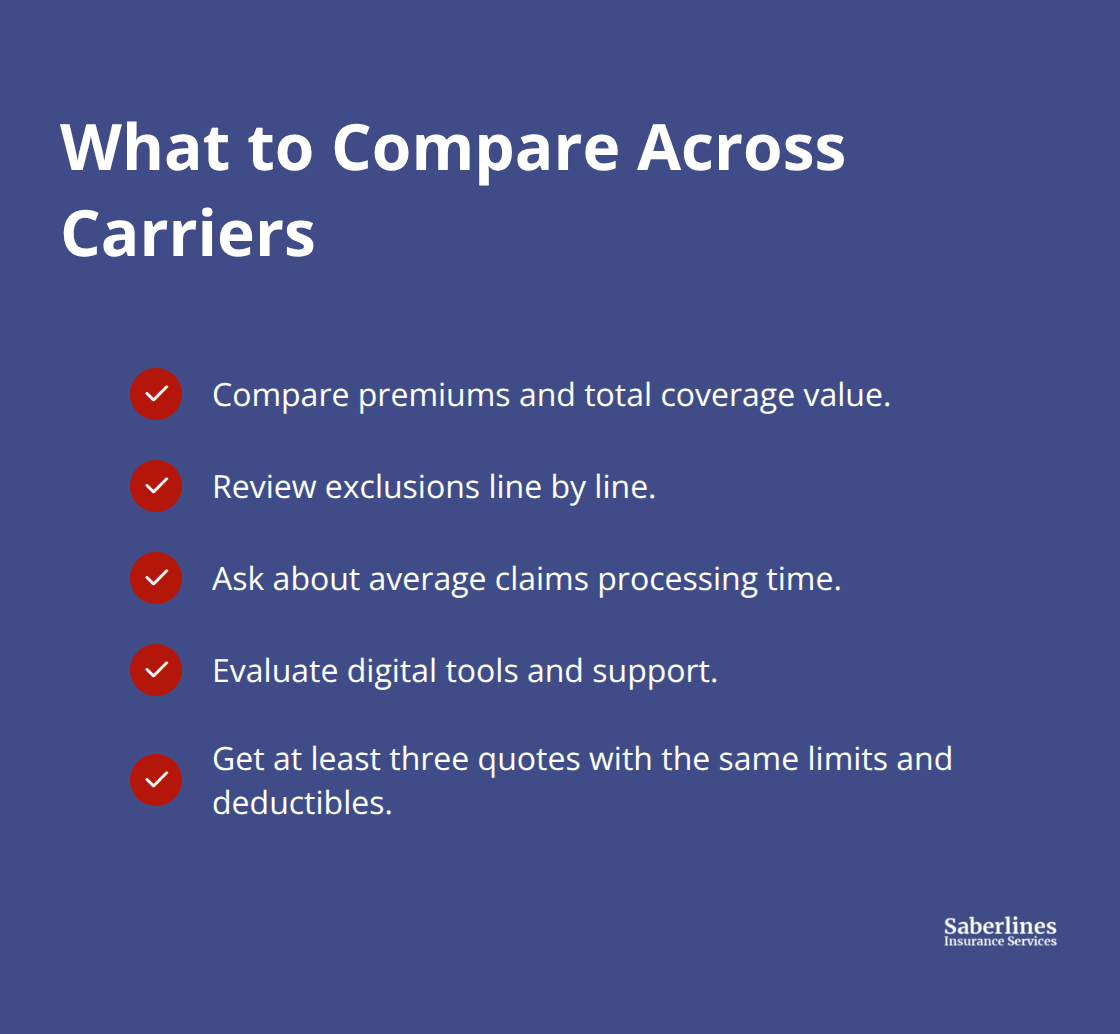
The cost difference between carriers often reflects their claims handling speed and coverage breadth more than their premium alone. A carrier that processes claims in five days versus thirty days saves you money in operational downtime, even if their monthly premium runs slightly higher. Evaluate the total value proposition, not just the lowest price.
Align Coverage with Shipment Value
Comprehensive policies that cover wetness, corrosion, and broader cargo scenarios cost roughly 1% to 2% of your declared value annually-a fraction of the risk you’d carry otherwise. This approach transforms cargo insurance from a reactive expense into an active business safeguard. Understanding your specific load composition and the risks each type of cargo faces allows you to select the right policy limits before problems arise.
Final Thoughts
Moving van cargo insurance protects your operation from financial collapse when damage, theft, or weather strikes a load. The operators who survive and grow match their coverage limits to actual load values, select deductibles they can afford to pay, and compare quotes from multiple carriers before committing. A single damaged load worth $75,000 to $100,000 can wipe out months of profit, making adequate coverage a business necessity rather than an optional expense.
Calculate your typical load value by adding replacement costs for items you move most often, then set your cargo coverage limit at or above that number. Don’t settle for the FMCSA minimum of $5,000 per vehicle when your customers regularly ship substantially higher-value loads. Request quotes from at least three carriers and evaluate not just the premium but also the claims processing speed and coverage terms, since a carrier that handles claims in five days instead of thirty saves you operational downtime that costs far more than a slightly higher monthly premium.
We at Saberlines Insurance Services help moving operations and owner-operators secure the right moving van cargo insurance fast. Whether you run a single truck or manage a fleet, we understand the specific coverage gaps that expose your business to financial loss and combine deep industry expertise with affordable quotes for risks that other agencies turn away. Get a quote today and protect every relocation load with coverage that actually matches your operation.
The information provided in this blog is for general informational purposes only and does not constitute legal, financial, or insurance advice. Coverage options, terms, and availability may vary. Please consult with a licensed professional for advice specific to your situation.