
Commercial Vehicle Personal Use Insurance: Balancing Business Needs and Personal Use
Your commercial vehicle does double duty-it powers your business during the week and handles personal errands on weekends. That flexibility comes with a hidden cost: most standard commercial policies have strict limits on personal use, leaving you exposed to claim denials when you need coverage most.
At Saberlines Insurance Services, we’ve seen too many business owners discover this gap only after an accident. The good news is that commercial vehicle personal use insurance doesn’t have to be complicated-you just need the right structure.
What Personal Use Really Means for Your Commercial Vehicle
The IRS Definition That Insurance Companies Follow
The IRS draws a clear line: only business use is deductible, and personal mileage cannot be deducted. That distinction matters far more than most business owners realize because insurance companies use the same dividing line to decide whether they’ll pay your claim. Personal use includes commuting to the office, stopping for errands during the day, or driving home at the end of your shift. Technically, no hard limit exists on how much personal use you can allow, but the tax treatment and insurance coverage differ significantly.
When your employee picks up supplies for the office on Tuesday afternoon, that’s business use. When that same employee stops at the grocery store on the way home, that’s personal use-and if an accident happens during that grocery run, your standard commercial policy may deny the claim entirely. The problem intensifies because many business owners assume their commercial auto policy automatically covers both business and personal driving as long as the driver is named on the policy. That assumption is wrong.
Named Insureds vs. Permissive Users: Coverage That Depends on Status
Coverage depends on whether the driver is a Named Insured or a Permissive User, and not all permissive users are automatically covered. Exclusions to permissive use can leave a personal-use incident without coverage, creating gaps you must address before an accident forces you to discover them. Your policy language determines who qualifies as covered under each category, and those distinctions directly affect whether a claim gets paid.
How Insurance Companies Track and Classify Your Driving
Insurance carriers don’t just accept your word for how vehicles are used. They examine your industry classification, the vehicle type, driver roles, and whether you maintain detailed mileage records to separate business miles from personal miles within the same vehicle. Contractors face different scrutiny than delivery businesses, and a dump truck will be classified differently than a passenger van. If you cannot produce records showing which trips were business-related and which were personal, adjusters assume the worst-case scenario: that personal use exceeds what your policy allows.
Maintaining a detailed usage log matters tremendously-it supports both your tax deductions with the IRS and your insurance claims when something goes wrong. One accident can threaten a small business’s financial stability, which is why the structure of your policy must align precisely with how you actually operate. The financial risk of operating without proper coverage extends beyond the accident itself. If a claim gets denied because personal use wasn’t properly covered, your business absorbs the full cost of medical expenses, property damage, and legal defense fees out of pocket.
Why Coverage Gaps Create Real Financial Exposure
A denied claim leaves you vulnerable to catastrophic losses that no business owner can afford to ignore. The gap between what you think is covered and what your policy actually covers (when personal use is involved) represents your true exposure. Understanding this gap is the first step toward fixing it-and that requires examining the specific endorsements and policy structures that actually extend coverage to mixed-use vehicles.
Why Your Commercial Policy Won’t Cover Personal Driving
The Design of Standard Commercial Policies
Standard commercial auto policies exclude personal use by design, and most business owners misunderstand what that exclusion actually means. Your policy covers business-related driving with named employees and permissive users, but the moment someone drives for personal reasons, coverage becomes conditional or disappears entirely. Insurance carriers distinguish between business use and personal use because the risk profiles differ dramatically. A delivery driver stopping at a client location operates under predictable conditions, scheduled routes, and business accountability. That same driver running a personal errand operates without supervision, with different liability exposure, and with motivations outside your business control.
Why Carriers Price Policies Lower for Business Use
Carriers price commercial policies lower than personal policies precisely because they assume business use dominates. When personal use becomes frequent or undocumented, you shift into territory your policy was not designed to cover. The financial exposure grows exponentially once you operate outside the policy’s intended scope.
What Happens After an Accident During Personal Use
The real problem surfaces when you examine what happens after an accident during personal use. An employee uses a company van to pick up groceries on a Friday evening and causes a three-car collision. The injured driver’s medical bills total $85,000, and property damage reaches $22,000. Your adjuster reviews the claim and discovers the vehicle was being used for personal errands, not business operations.
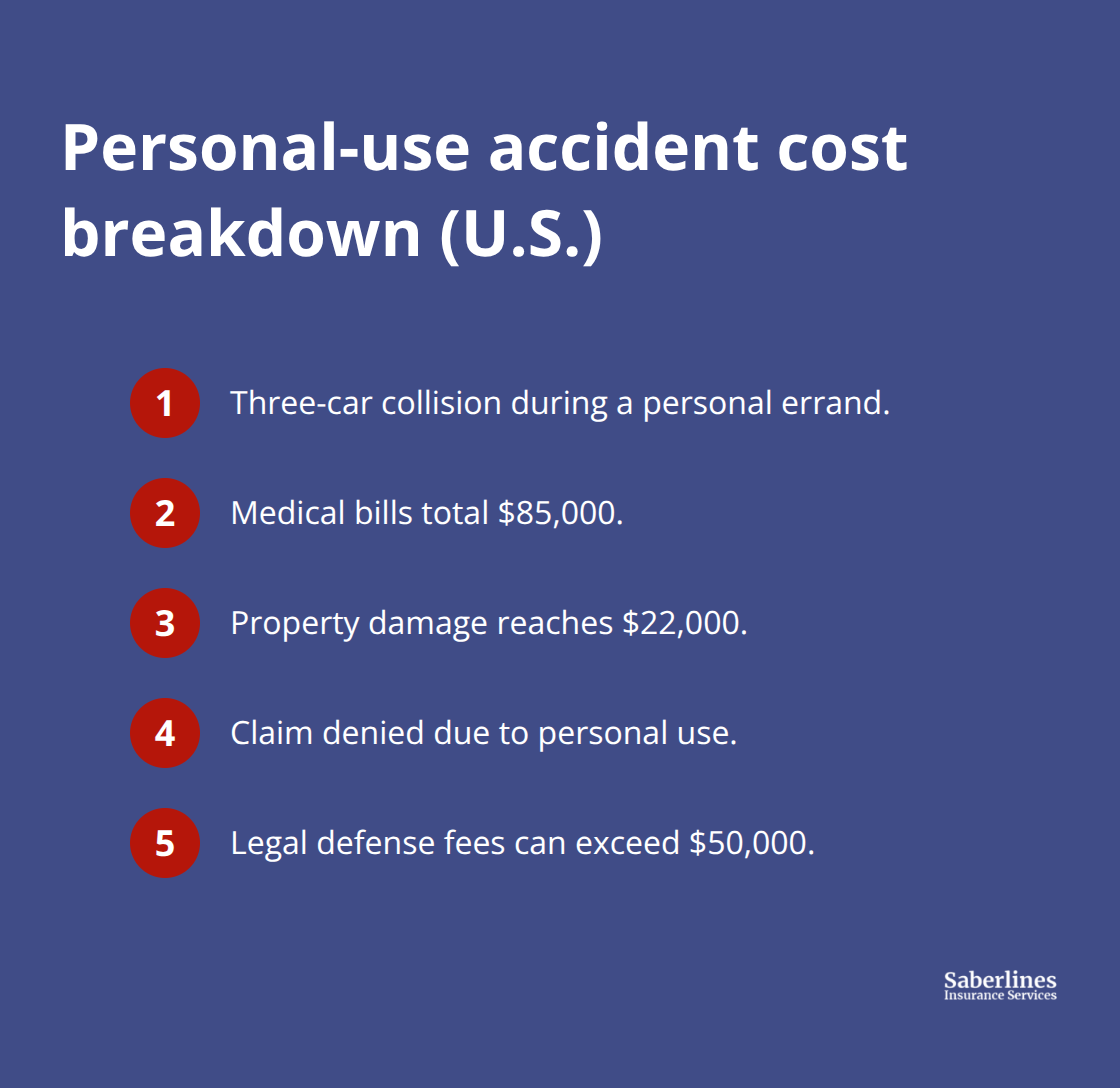
The policy language restricts coverage to business use, and the carrier denies the claim outright.
Your business now faces the full financial exposure: $107,000 in liability costs, plus potential legal defense fees that can exceed $50,000 depending on injury severity and state requirements. That scenario happens regularly to contractors, delivery services, and small fleet operators who assumed their commercial auto policy protected them regardless of how vehicles were actually used.
The Cascading Financial and Legal Consequences
The financial devastation extends beyond the immediate accident. A denied claim triggers a lawsuit from the injured party against your business directly, creating legal costs that drain cash flow for months. Your business reputation suffers when accident victims discover they cannot recover damages from your insurance. Employees face personal liability exposure if they are named in the lawsuit, which creates retention problems and potential wrongful termination claims if you attempt to hold them financially responsible.
The gap between assumed coverage and actual coverage represents the most dangerous blind spot in commercial vehicle operations. This exposure explains why the structure of your policy must align precisely with how you actually operate-and why endorsements and riders exist to close these gaps. Understanding which coverage options extend protection to mixed-use vehicles becomes your next critical step.
Fixing Coverage Gaps With the Right Endorsements
Hired and Non-Owned Auto Liability: Your First Line of Defense
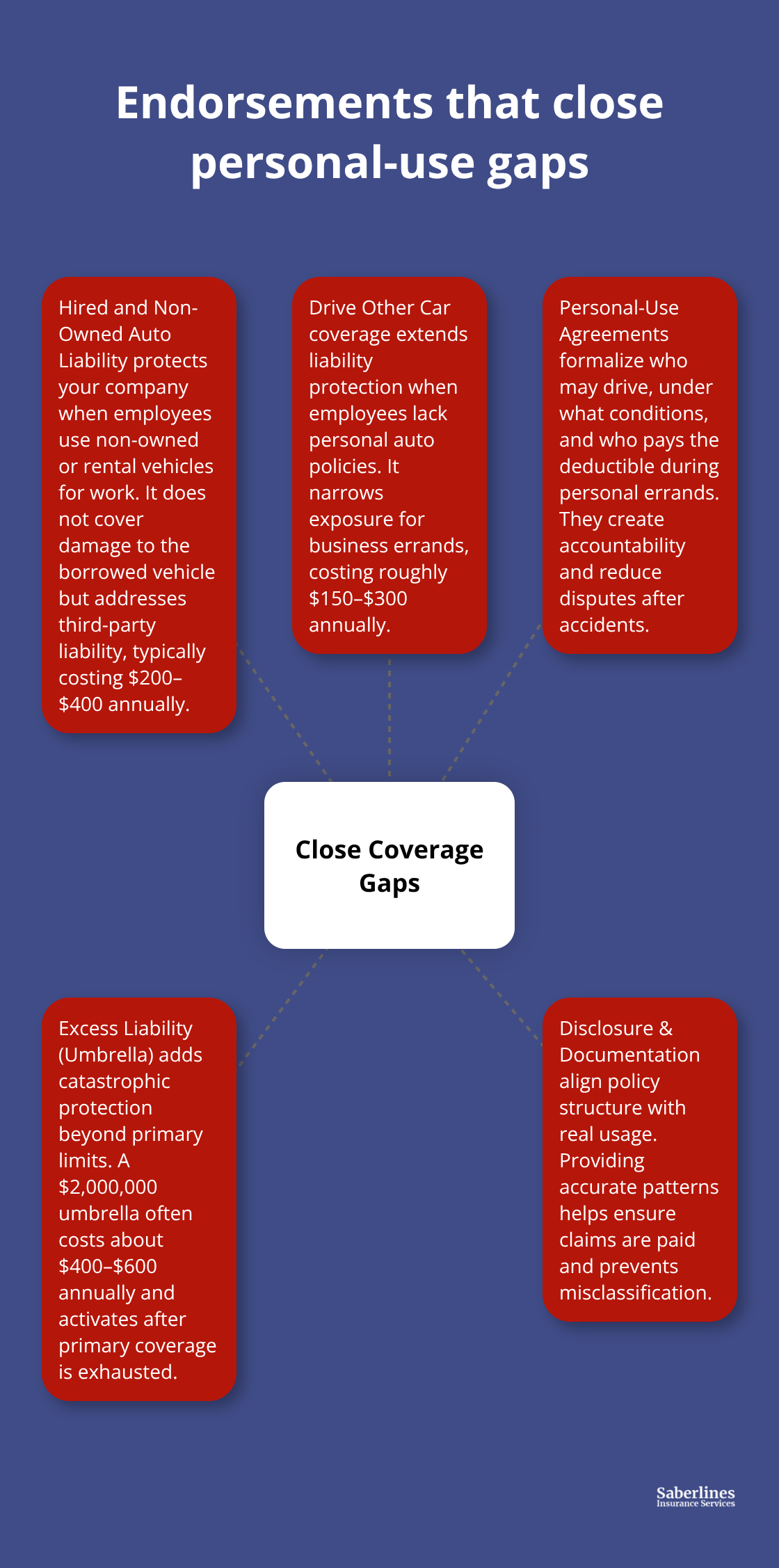
The gap between what your commercial policy covers and what you actually need closes through specific endorsements and policy structures designed for mixed-use vehicles. Hired and non-owned auto liability stands as the most direct solution when your employees regularly use their own vehicles or rental cars for business purposes. This endorsement attaches to your General Liability policy or Business Owners Policy and protects your company when someone drives a non-owned vehicle for work, covering liability if that driver causes an accident. The coverage does not protect the borrowed vehicle itself from damage, but it shields your business from third-party claims. For a restaurant running deliveries with employee personal vehicles, this endorsement prevents a catastrophic gap where neither the employee’s personal policy nor your business coverage would respond. Costs for this endorsement typically add $200 to $400 annually depending on your operation size and vehicle exposure, which is negligible compared to the liability exposure you eliminate.
Drive Other Car Coverage for Uninsured Employees
Drive Other Car coverage provides a second layer of protection when employees lack their own personal auto policies. This coverage extends liability protection to personal vehicles your employees drive for business, though it operates narrowly compared to a full personal auto policy. The distinction matters because an employee without personal insurance who uses their own car for a business errand creates direct exposure to your company if an accident occurs. Adding Drive Other Car coverage costs roughly $150 to $300 annually and prevents your business from absorbing full liability when an uninsured employee causes damage.
Personal-Use Agreements: Documentation That Protects Your Business
If personal use of company vehicles is genuinely necessary, you must implement a formal personal-use agreement with each driver that documents which employees can drive, under what conditions, and who bears responsibility for damages during personal errands. This agreement protects you legally by establishing that drivers understood the coverage limits and accepted the conditions. Without written documentation, an injured party’s attorney will argue your company failed to adequately protect against foreseeable risks, increasing settlement exposure substantially. The agreement should explicitly state that the driver is responsible for the insurance deductible if the accident occurs during personal use, which creates financial accountability and discourages unnecessary personal driving.
Excess Liability: Protection Beyond Standard Limits
Excess liability coverage beyond your standard $1,000,000 primary limit becomes essential once personal use enters the picture, because claim severity often exceeds baseline limits when injuries or multiple vehicles are involved. A $2,000,000 umbrella policy costs approximately $400 to $600 annually for most small fleets and provides catastrophic protection that standard commercial policies cannot deliver. This coverage activates after your primary commercial policy exhausts its limits, protecting business assets from judgments that would otherwise bankrupt smaller operations.
Disclosure and Documentation: The Foundation of Proper Coverage
Your agent must know exactly how vehicles are used because that information determines whether your current policy structure actually covers personal use at all. Many agents write policies based on industry classification alone without asking detailed questions about actual driving patterns, which leaves dangerous gaps. You should provide your agent with specific information: the percentage of business versus personal use, which employees drive which vehicles, whether personal use includes commuting or only occasional errands, and whether family members ever access company vehicles.
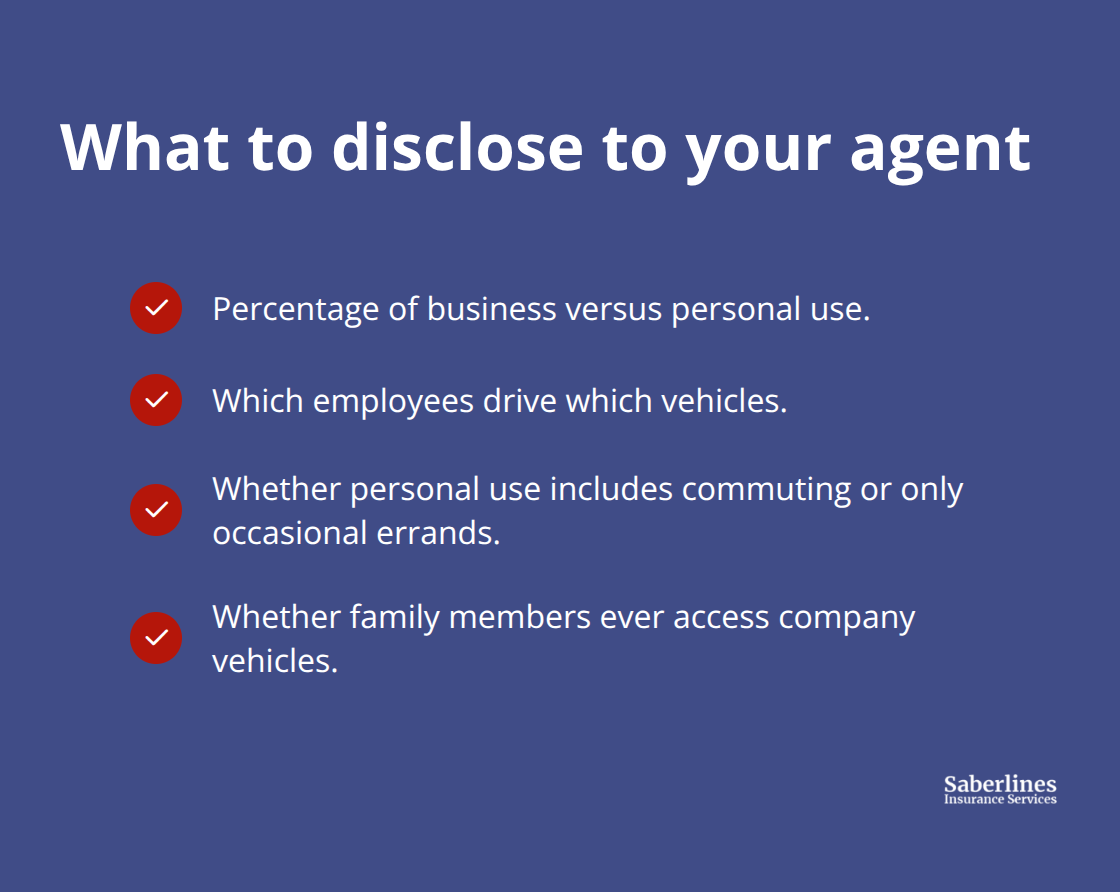
This documentation becomes your evidence if a claim is disputed, proving you disclosed the actual usage pattern rather than misrepresenting it to get a lower rate.
Final Thoughts
The gap between what you assume your commercial policy covers and what it actually protects represents your most dangerous blind spot in fleet operations. Your standard commercial auto policy was designed for business driving, and personal use creates exposure that standard coverage simply does not address. The financial consequences of a denied claim-medical bills, property damage, legal defense costs, and potential bankruptcy-far exceed the cost of proper endorsements and documentation.
Start by auditing your current policy with brutal honesty and asking your agent directly whether it covers personal use. Request the specific policy language that addresses permissive users and personal driving, then document how your vehicles are actually used rather than how you wish they were used. Implement a formal personal-use agreement with every driver if personal use is genuinely necessary, add hired and non-owned auto liability coverage if employees use personal vehicles for business, and consider excess liability protection beyond your standard limits (since personal-use accidents often generate claims that exceed baseline coverage).
We at Saberlines Insurance Services specialize in helping transportation businesses navigate commercial vehicle personal use insurance and the real-world gaps that create financial disasters. Contact us today and let our team review whether your current structure actually protects your business or leaves you exposed to catastrophic loss.
The information provided in this blog is for general informational purposes only and does not constitute legal, financial, or insurance advice. Coverage options, terms, and availability may vary. Please consult with a licensed professional for advice specific to your situation.