
Fleet Auto Liability Coverage: Protect Every Truck and Driver
One accident involving your fleet can wipe out years of profit. A single driver hitting a pedestrian or damaging someone’s property creates liability that extends far beyond the vehicle itself.
Fleet auto liability coverage is the foundation that protects your business from these financial disasters. At Saberlines Insurance Services, we’ve seen too many fleet owners operate with gaps in their coverage that cost them hundreds of thousands when claims hit.
What Fleet Auto Liability Coverage Actually Covers
Bodily Injury Liability Protects Against Serious Claims
Bodily injury liability is where most fleet owners focus, and rightfully so. When your driver causes an accident that injures or kills someone, this coverage pays medical expenses, lost wages, pain and suffering, and legal defense costs for the injured party. The FMCSA sets minimum standards under 49 CFR Part 387, with requirements ranging from $300,000 for smaller vehicles up to $5,000,000 for hazardous materials carriers. These minimums exist because a single serious injury claim can easily exceed $500,000 when you factor in emergency care, ongoing rehabilitation, and court awards.
Property Damage Liability Covers More Than You Think
Property damage liability is equally important but often underestimated. This covers damage your fleet causes to someone else’s vehicle, building, fence, utility pole, or any other property. A truck backing into a storefront or sideswiping a parked car generates repair bills that pile up fast, and that’s before legal fees enter the picture.
Medical Payments and Legal Defense Create Hidden Value
Medical payments coverage, sometimes called PIP or Personal Injury Protection, pays immediate medical costs for your drivers and passengers without waiting for fault determination. This speeds up treatment and reduces the friction that turns minor incidents into major disputes. Legal defense costs are the hidden expense most fleet owners discover too late. When a claim goes to court, your insurer covers attorney fees, expert witnesses, and court costs, which can run $50,000 to $200,000 even before a verdict. Without this component, you’re paying defense costs from your own pocket while the claim is still being investigated.
Coverage Gaps That Drain Your Bottom Line
The gap between what coverage sounds like and what it actually pays is where fleet owners lose money. Many policies include hired and non-owned vehicle coverage, but only if you request it explicitly. If your drivers use rental trucks or borrow equipment during operations, standard liability may not apply. Loading and unloading operations create exposure that general liability doesn’t cover, yet many fleet owners assume their auto policy handles it.
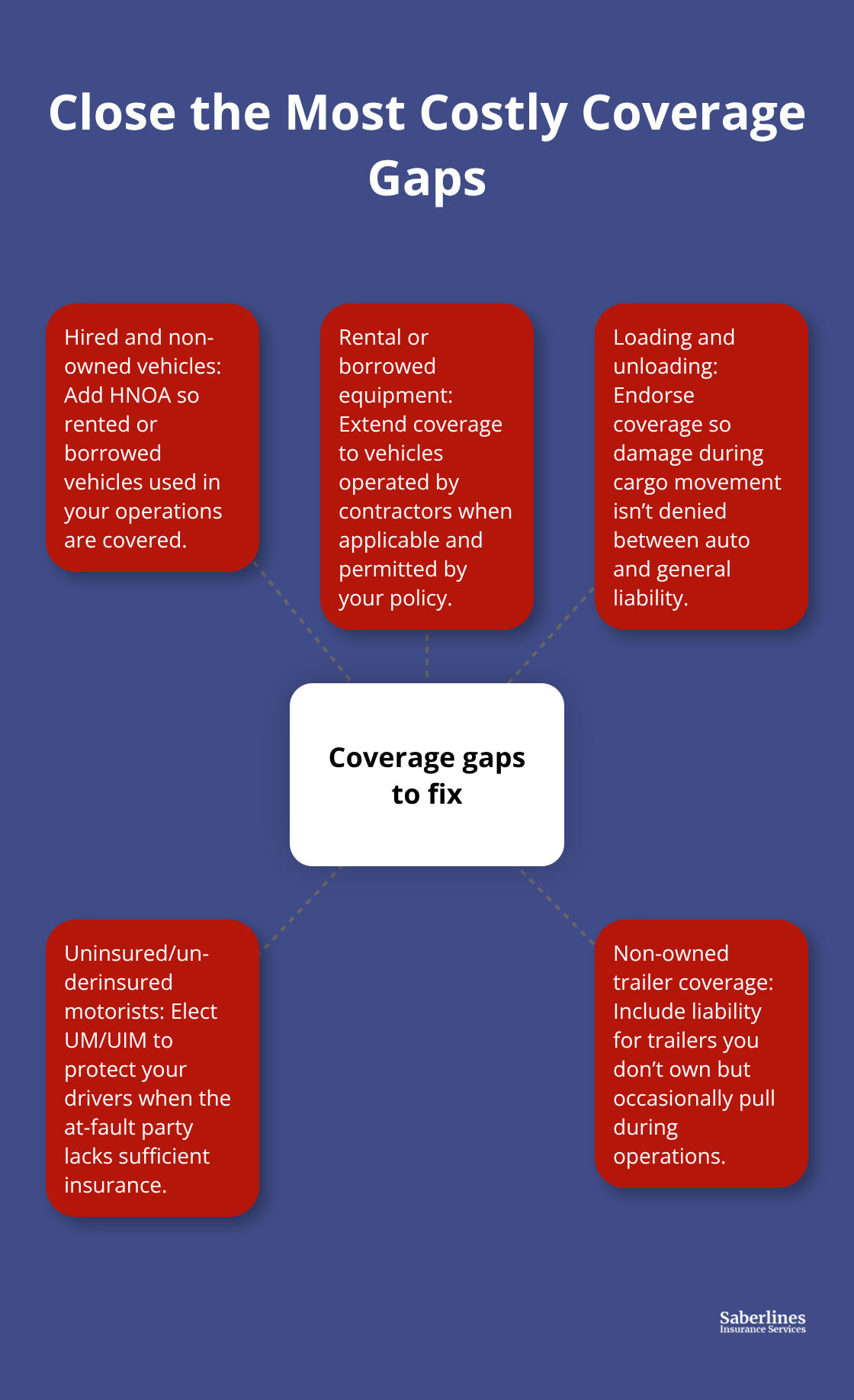
Uninsured and underinsured motorist coverage is optional in most states, but it protects your drivers when the other party lacks sufficient insurance. Given that roughly 13% of drivers nationwide carry no insurance, this gap costs fleets real money.
Verify Your Coverage Matches Your Operations
The practical move is to work with an insurance partner who understands your specific operations, verifies that hired and non-owned vehicles are explicitly included, and confirms that loading, unloading, and non-owned trailer coverage align with how your fleet actually works. These details matter when you assess whether your liability limits match the actual risks your fleet faces.
Common Gaps in Fleet Coverage That Cost Owners Money
Liability Limits That Collapse Under Real Claims
Most fleet owners discover their coverage shortfalls only when a claim lands on their desk. Liability limits that seemed adequate on paper collapse under the weight of real-world accidents. A single serious injury claim involving your fleet can reach $500,000 to $1,000,000 when medical care, lost wages, and court awards combine. If your policy carries a $300,000 limit, you become personally liable for the difference.
State minimums exist to meet regulatory thresholds, not to protect your business. The FMCSA sets minimums under 49 CFR Part 387 ranging from $300,000 for smaller vehicles to $5,000,000 for hazardous materials carriers, but these are legal floors, not ceilings for adequate protection. Fleet owners operating without cushion above state minimums are betting that their worst accident never happens.
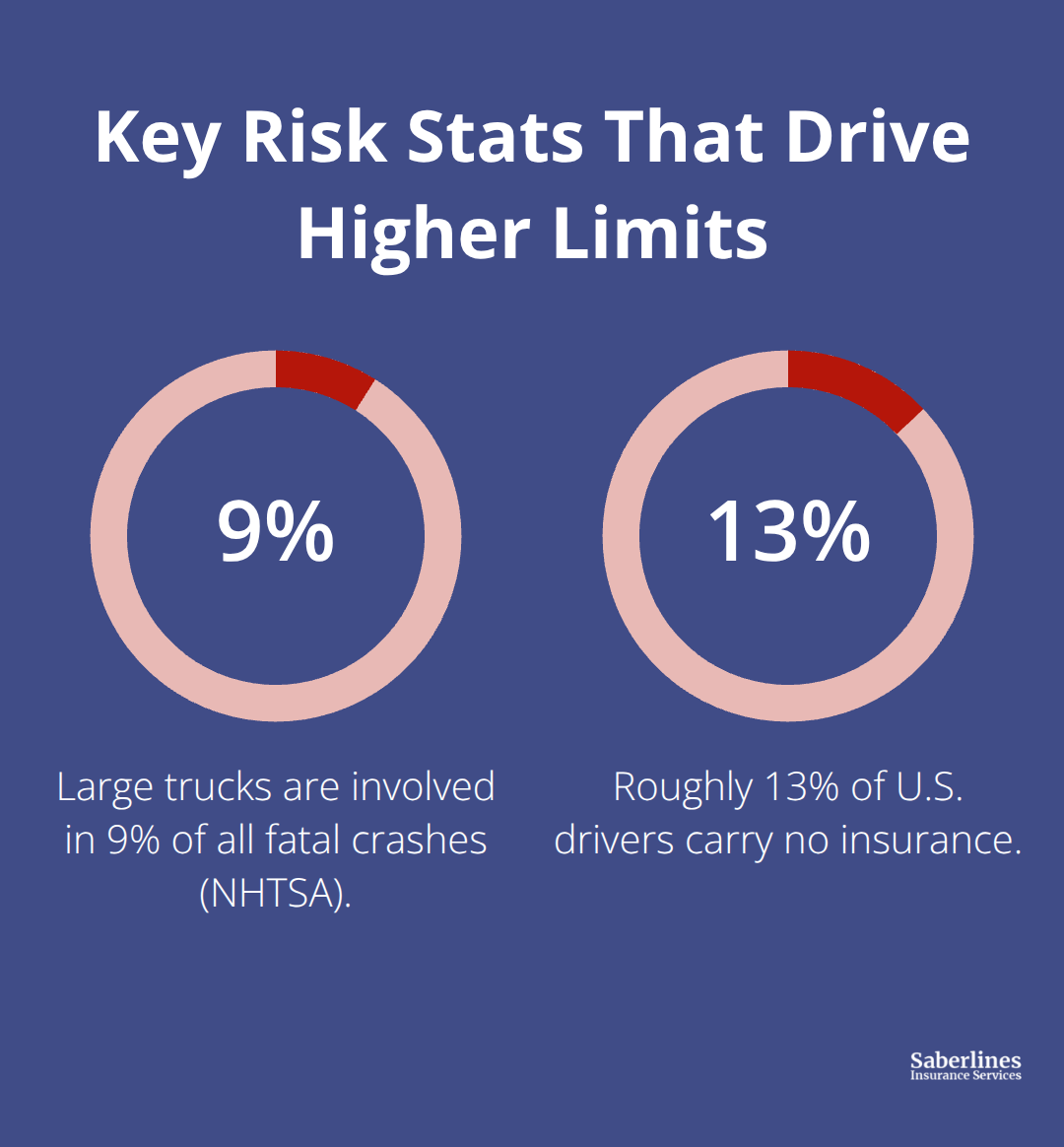
Large trucks account for 9% of all vehicles involved in fatal crashes according to NHTSA data, making higher liability limits a business necessity rather than an option.
Hired and Non-Owned Vehicles Create Uninsured Exposure
Hired and non-owned vehicle coverage presents another expensive blind spot. Your drivers regularly operate rental trucks, borrowed equipment, or vehicles belonging to contractors, yet standard fleet policies exclude these unless you explicitly add them. A driver operating a rental truck in an accident discovers coverage doesn’t apply because the policy names only your owned vehicles. This gap forces you to absorb costs that should transfer to your insurer.
Non-owned trailer coverage represents a similar miss, especially for fleets that occasionally pull trailers they don’t own. Your operations may require this flexibility, but your policy may not cover it without specific endorsement language.
Loading, Unloading, and Uninsured Drivers
Loading and unloading operations create liability exposure that many fleet owners incorrectly assume falls under their auto policy. Damage occurring while freight moves on or off your vehicles often falls into a coverage gap between auto liability and general liability. Your insurer may deny the claim, leaving you to pay repair costs and legal fees from your own pocket.
Uninsured and underinsured motorist coverage remains optional in most states, yet roughly 13% of drivers nationwide carry no insurance. Your drivers face financial exposure when hit by uninsured drivers unless you specifically request this protection. This coverage protects your team when the other party lacks sufficient insurance to cover injuries or damages.
Align Your Policy to Your Actual Operations
The fix requires reviewing your actual operations with specificity. What vehicles do your drivers operate? Where and how do you handle cargo? Do you use trailers or equipment you don’t own? Your policy should answer yes to coverage for each operational reality, not leave gaps that surface only after an incident. These details determine whether your liability protection holds when accidents happen, and they directly influence how you assess whether your limits match the actual risks your fleet faces.
How to Set Your Liability Limit Above the Legal Minimum
State Minimums Protect Regulators, Not Your Business
State minimums satisfy legal requirements, not financial reality. The FMCSA sets floors under 49 CFR Part 387, but these numbers reflect the absolute legal threshold, not the real cost of serious accidents. For vehicles under 10,001 pounds GVWR, the minimum stands at $300,000 in bodily injury and property damage coverage. Vehicles over 10,001 pounds require $750,000. Hazardous materials carriers face $1,000,000 minimums, and explosive or radioactive materials require $5,000,000.
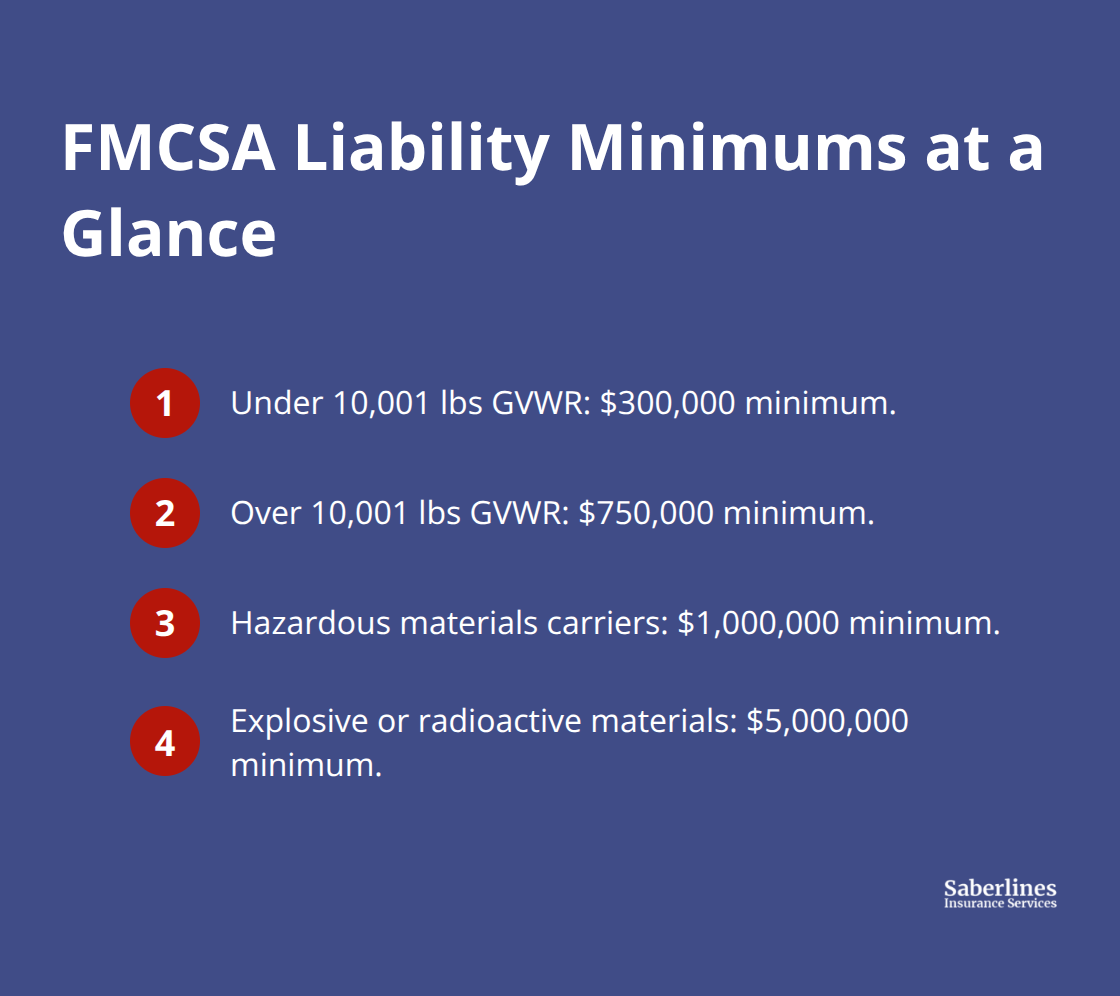
These minimums exist because legislators recognized that accidents cost real money. A single serious injury claim involving multiple people or permanent disability easily exceeds $500,000, leaving you personally liable for anything above your policy limit.
Real Accident Costs Exceed Legal Minimums
Large trucks represent 9% of all fatal crashes according to NHTSA, which means your fleet operates in territory where worst-case scenarios happen. Operating at state minimums amounts to betting that your worst accident never occurs. Most fleet owners carry liability limits of $1,000,000 to $2,000,000 in bodily injury and property damage combined, which provides meaningful cushion without excessive expense. The specific number depends on your fleet size, routes, and cargo, but the principle remains constant: your limit should reflect the maximum loss you can absorb without threatening your business.
Fleet Composition and Geography Shape Your Risk Profile
Your fleet composition and operational geography determine where your actual risk sits within that range. A five-truck local delivery operation faces different exposure than a fifteen-truck regional freight carrier, which differs again from a hazmat specialist operating across state lines. A delivery fleet making short urban runs with lower speeds carries less severe injury potential than a fleet running long-haul routes at highway speeds. Driver experience matters significantly; fleets with younger or less experienced drivers should weight their limits higher because accident severity correlates with driver skill. Cargo value and type also factor in: high-value electronics or pharmaceuticals create larger property damage exposures than general freight. Location influences frequency and severity-urban areas with higher traffic density generate more incidents than rural routes.
Calculate Your Worst-Case Scenario
Work backward from your actual operations to establish your floor. Identify your largest single-vehicle exposure: what is the worst accident your fleet could realistically cause? A fully loaded truck hitting a school bus creates different exposure than a van sideswipe. Calculate the potential medical costs for multiple serious injuries in that scenario, then add legal defense costs of $100,000 to $200,000 for a contested case. That number becomes your floor. Add a safety margin for unexpected costs or underestimated damages. This exercise transforms liability limits from abstract policy language into concrete financial strategy aligned with the real risks your fleet generates.
Final Thoughts
Fleet auto liability coverage protects your business from financial disasters that state minimums cannot absorb. A single serious accident involving your fleet generates medical costs, legal defense expenses, and court awards that easily exceed $500,000, leaving you personally liable for anything above your policy limit. Your actual liability exposure depends on your fleet size, driver experience, routes, and cargo type-not on regulatory thresholds designed to satisfy government requirements rather than protect your bottom line.
Coverage gaps cost fleet owners tens of thousands in out-of-pocket expenses after accidents happen. Hired and non-owned vehicle coverage, loading and unloading protection, and uninsured motorist coverage require explicit attention during policy review, not assumptions about what your policy includes. Work backward from your worst-case scenario (the most severe accident your fleet could realistically cause) to establish concrete liability limits that reflect the real risks your fleet generates.
We at Saberlines Insurance Services help owner-operators and fleets across California secure fleet auto liability coverage that matches your actual operations. Contact us to review your coverage and verify that your liability protection holds when accidents happen.
The information provided in this blog is for general informational purposes only and does not constitute legal, financial, or insurance advice. Coverage options, terms, and availability may vary. Please consult with a licensed professional for advice specific to your situation.