
NEMT Insurance for Fleets: Scaling Coverage for Growth
Growing a NEMT fleet means juggling multiple insurance needs at once. Commercial auto, workers compensation, and liability coverage all demand attention as you add vehicles and staff.
At Saberlines Insurance Services, we know that NEMT insurance for fleets gets complicated fast. The right coverage strategy keeps your operation compliant and protected without draining your budget.
NEMT Insurance Coverage Types for Growing Fleets
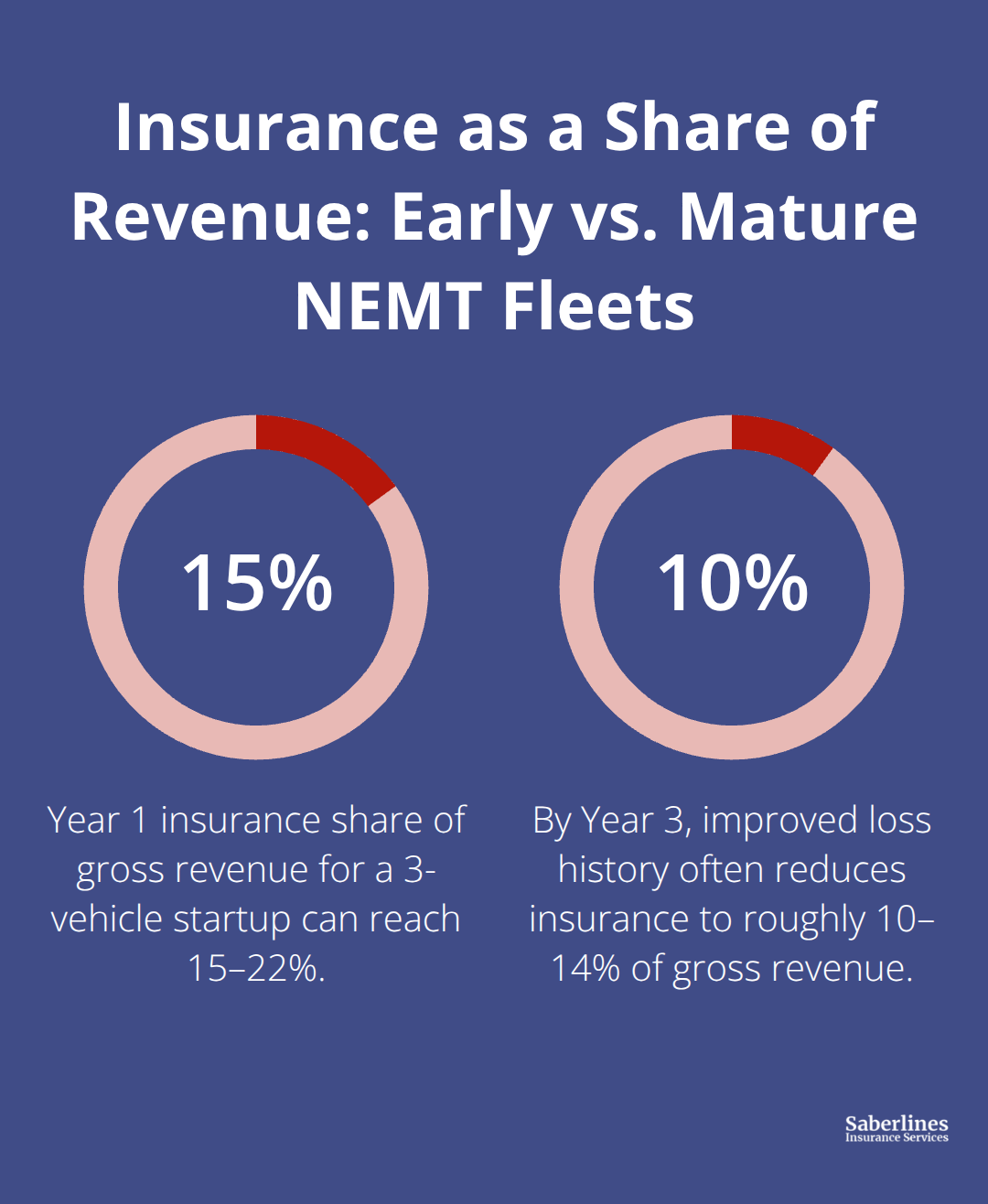
Commercial auto insurance forms the foundation of your NEMT coverage, and it’s non-negotiable. Most state Medicaid programs require a minimum of $1,000,000 per occurrence, though some states demand $1.5 million or higher. This policy covers accidents involving your fleet vehicles and protects you when a passenger sustains injury during transport. The cost varies significantly by vehicle type: a single sedan for a new operator typically runs $540–$835 per month, while a wheelchair-accessible van costs $750–$1,165 per month. A 5-vehicle mixed fleet generally costs $3,500–$6,200 monthly. The reality is stark-a 3-vehicle startup should budget $3,000–$4,800 monthly for insurance alone, representing 15–22% of gross revenue in Year 1. As your loss history improves by Year 3, this drops to roughly 10–14% of gross revenue, which is why early cost management matters.
Driver Screening and Premium Reduction
Workers compensation is legally required in nearly every state once you hire W-2 drivers, covering medical costs and lost wages from on-the-job injuries. The quality of your driver screening directly influences your premiums, however. Documented driver screening-including thorough background checks, annual MVR pulls, CPR certification tracking, and defensive driving training-reduces your renewal costs by demonstrating lower risk to underwriters. Insurers view fleets with inconsistent driver standards as higher-risk operations, which translates to steeper premiums. General liability coverage protects incidents outside the vehicle, such as a passenger slipping during a transfer, with common limits around $1,000,000 per occurrence. Together, commercial auto, workers compensation, and general liability form the core of your coverage stack. New operators face a new business penalty with premiums 25–40% higher in the first two years due to lack of loss history, which underscores why building clean claims records from day one matters.
Reducing Premiums Through Technology and Payment Strategy
Installing GPS telematics cuts your premiums by 8–15% after 6–12 months of clean data, with hardware costs typically $200–$500 per vehicle-a quick payback given the savings. Paying annually instead of monthly saves 5–12% of your premium; for a $40,000 annual premium, that’s $2,000–$4,800 in savings. A clean 36-month claims history unlocks preferred-risk pricing and access to lower-cost carriers. Working with a NEMT-specialist broker rather than a generalist delivers 10–20% renewal savings because they understand the industry’s underwriting landscape.
Avoiding the Growth Insurance Gap
Most growing fleets encounter renewal surprises because their coverage lags behind fleet expansion. Underwriters evaluate long-term performance and claims patterns, and if your policy structure doesn’t align with your operations, premiums jump and carrier options shrink. This misalignment surfaces most often at renewal time, when underwriters assess claim frequency, driver turnover, vehicle classification accuracy, and documentation quality. The cost of scaling without insurance alignment includes renewal volatility, fewer carrier options, higher administrative burden, and potential claim delays. Addressing this gap early-ideally 90–120 days before renewal-helps you identify loss trends, address underwriting concerns, improve documentation, and adjust coverage to match your fleet’s current size and risk profile. This preparation transforms your operations into underwriting confidence, signaling to carriers that you manage risk proactively rather than reactively.
Scaling Your NEMT Fleet While Maintaining Compliance
Compliance isn’t optional in NEMT, and it directly drives your insurance costs and coverage structure. State Medicaid programs set minimum liability requirements that vary dramatically-some demand $1,000,000 per occurrence while others require $1.5 million or higher. Federal FMCSA regulations apply if you transport across state lines, adding another layer of requirements you must meet. Your insurer needs to confirm that your policy meets every state and federal mandate where you operate, and many providers miss this step until renewal arrives with rejected quotes. Some states are highly regulated for NEMT insurance, such as California, where alignment with state guidelines directly affects your licensing eligibility and contract ability. MCO contracts with Molina, Centene, and similar networks often push liability limits to $2,000,000, meaning a single contract can exceed your current policy structure.
Audit Requirements Before Expansion
You cannot scale coverage reactively. Instead, audit your state requirements and any upcoming contracts 90–120 days before renewal, document exactly which coverage limits apply to each state and each contract, and communicate those needs to your insurer in writing. Underwriters evaluate whether your policy structure matches your operational footprint, and mismatched coverage signals poor planning to them.
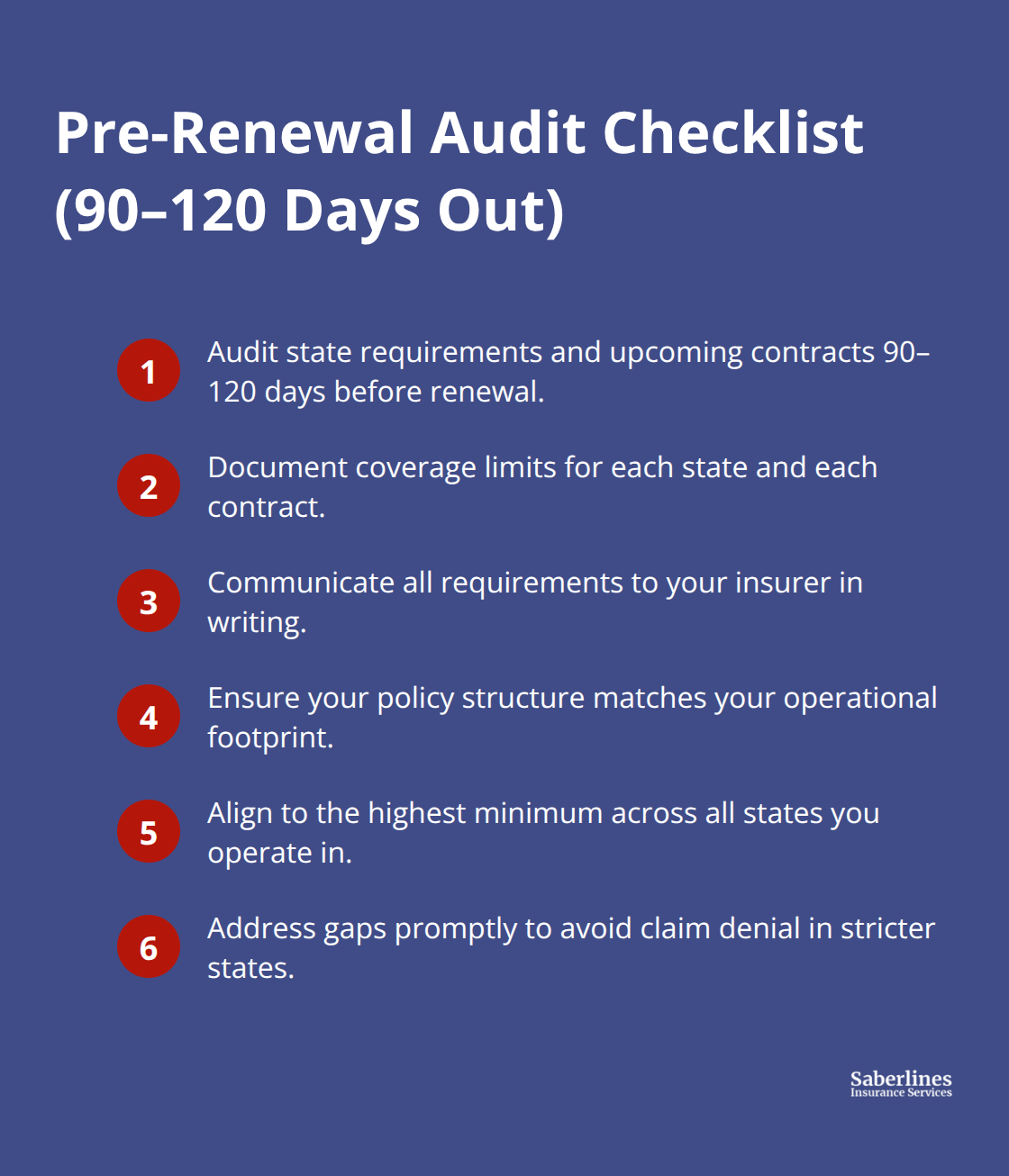
If you operate in multiple states, each with different minimums, your policy must reflect the highest requirement across all locations. Failing to do this leaves you exposed to claim denial if an incident occurs in a state where your coverage falls short.
Control Costs Through Vehicle Classification and Payment Strategy
Your insurance costs climb as you add vehicles and expand service areas, but that climb is avoidable with deliberate cost management. A 5-vehicle mixed fleet costs roughly $3,500–$6,200 monthly in 2026, and adding a sixth vehicle doesn’t simply add one-sixth to that bill-large fleets increase accident exposure and drive up premiums even if individual drivers have spotless records. The critical move is separating vehicle classification accuracy from fleet size. Wheelchair-accessible vans and standard sedans carry different risk profiles and repair costs, so misclassifying vehicles inflates your premiums across the board. Document your exact vehicle mix (capacity, equipment, age, and modification type) and provide this to your broker quarterly, not annually.
Paying annually instead of monthly saves 5–12% of your premium; for a fleet spending $45,000 yearly, that’s $2,250–$5,400 in direct savings. Installing GPS telematics across your fleet yields 8–15% discounts after 6–12 months of clean data, with hardware costs under $500 per vehicle. Maintaining a clean 36-month claims history unlocks preferred-risk pricing and access to carriers offering better rates. The leverage here is real: a single accident can cost you thousands in premium increases over the next three years, so driver training and vehicle maintenance are not soft costs-they are insurance cost controls.
Coordinate Coverage Adjustments With Growth
Coordinate your coverage adjustments with fleet growth by scheduling quarterly reviews with your broker, not waiting for renewal surprises. If you hire new drivers or add vehicle types, notify your insurer immediately; delayed disclosure creates gaps that insurers use to deny claims or spike renewals. This proactive approach transforms your operations into underwriting confidence, signaling to carriers that you manage risk deliberately rather than scrambling at renewal time. As your fleet grows, the complexity of managing multiple vehicles across different locations intensifies, which is why addressing coverage gaps and operational inconsistencies now prevents far costlier problems later.
Why NEMT Fleets Struggle to Find Affordable Coverage
Finding affordable NEMT coverage feels impossible because most general insurance brokers treat NEMT as a niche afterthought rather than a specialized transportation segment. This misunderstanding cascades into inflated quotes, coverage gaps, and renewal surprises that drain your budget. Fleets overpay by 20–30% simply because their broker lacks NEMT underwriting expertise or hasn’t invested time in carrier relationships that value the industry. The core problem is that wheelchair-accessible vans, patient liability exposure, and driver turnover create risk profiles that standard commercial auto carriers either reject outright or price aggressively to offset their uncertainty.
How Generalist Brokers Miss the Mark
Generalist brokers respond by shopping your account to five to ten carriers, accepting the first quote that sticks, and calling it done. Specialist NEMT brokers, by contrast, know which carriers actively write NEMT business, which ones offer telematics discounts, and which ones demand specific documentation to unlock preferred pricing. The difference translates to 10–20% renewal savings compared with generalist brokers, according to industry underwriting data. Your vehicle classification accuracy directly impacts this equation: if your broker cannot distinguish between a standard sedan and a wheelchair-accessible van on your declarations page, your entire fleet gets priced as high-risk. This misclassification alone inflates premiums across the board and signals poor operational standards to underwriters, making future renewals even more expensive.
Coverage Gaps That Surface at Claims Time
The second major challenge is coverage gaps that emerge during growth but surface only at claims time. Many NEMT fleets carry commercial auto and general liability but miss Non-Owned and Hired Auto coverage, which protects you when drivers use personal vehicles or rentals for company trips. Others fail to classify all their vehicles correctly, leaving modified vans under-insured relative to their actual repair costs. State requirements compound this problem: California, for example, imposes stricter NEMT licensing standards than most states, and your policy must explicitly align with those requirements or your coverage becomes unenforceable. Hard-to-place risks-fleets with prior claims, multiple violations, or rapid growth-face even steeper challenges because preferred carriers simply decline the account.
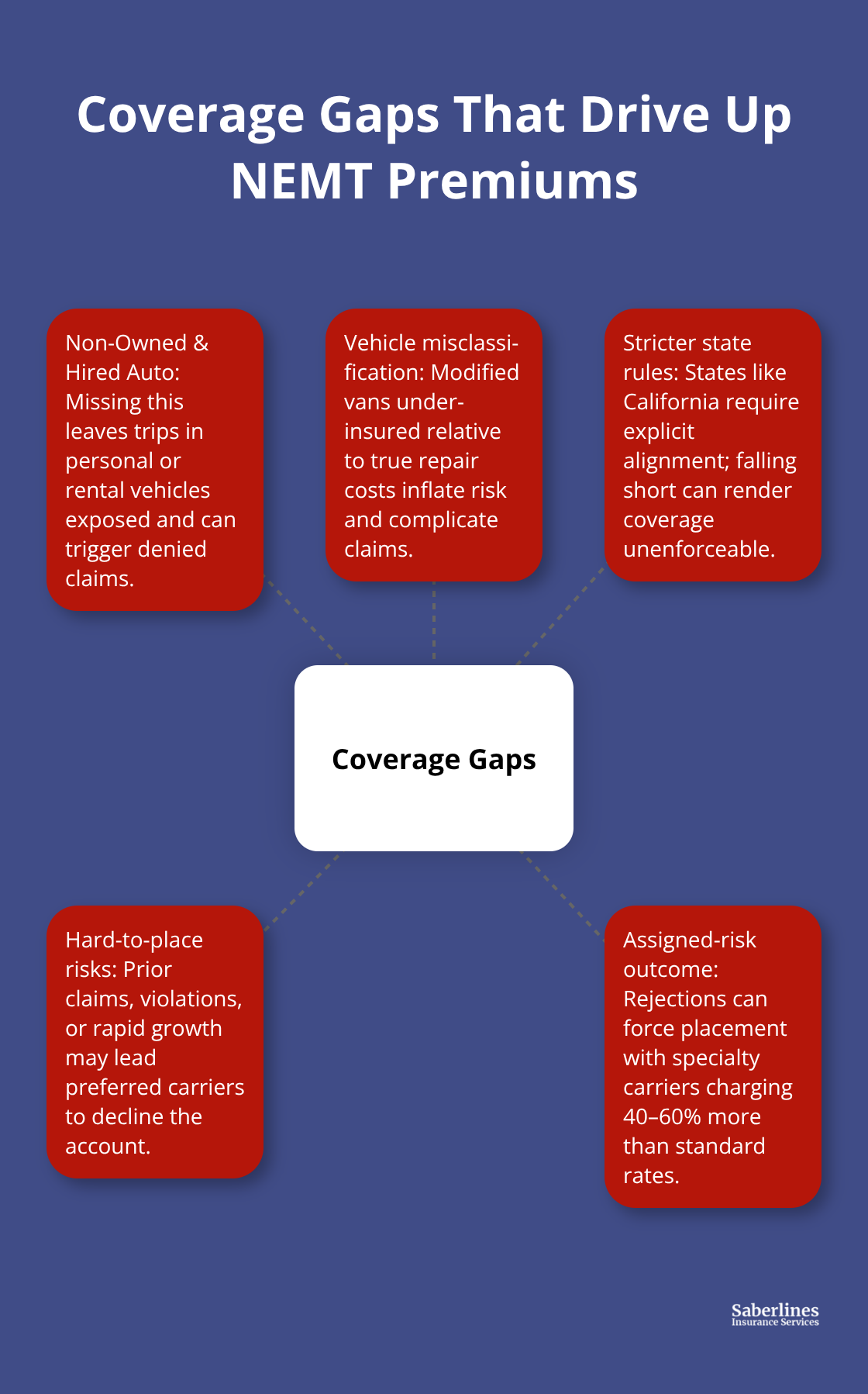
When this happens, you’re forced into assigned-risk pools or specialty carriers charging 40–60% premiums above standard rates.
Preparation Unlocks Better Pricing
The solution is not accepting the first quote or assuming your renewal will hold steady. Instead, audit your coverage structure 90–120 days before renewal, document every state requirement and contract obligation, and communicate those needs clearly to your broker in writing. Fleets that prepare early unlock preferred-risk pricing, access to lower-cost carriers, and the ability to negotiate deductibles and limits strategically. Those that wait until 30 days before expiration face carrier rejections and forced placement into expensive alternatives. Vehicle maintenance logs, driver training records, and incident reports are not administrative busywork-they are underwriting currency that transforms your operation from a liability into a managed-risk opportunity. Carriers want to see predictability and accountability, and documented processes deliver both.
Multi-State Operations and Contract Requirements
If you operate across multiple states or manage contracts with Medicaid networks, your broker must verify that your liability limits meet every jurisdiction’s minimum and every contract’s requirement. Missing this step is expensive: a claim in a state where your coverage falls short can be denied entirely, leaving you personally liable. Telematics installation also matters more for hard-to-place risks because clean data demonstrating safe driving behavior can shift an underwriter’s perception from decline to acceptance. The hardware costs $200–$500 per vehicle, but a single acceptance from a preferred carrier instead of an assigned-risk placement saves thousands annually.
Final Thoughts
Growing your NEMT fleet without the right insurance partner exposes you to renewal surprises, coverage gaps, and premiums that drain your margins. Specialist brokers deliver 10–20% renewal savings compared with generalist agencies because they understand which carriers actively write NEMT insurance for fleets and which documentation unlocks preferred pricing. They catch vehicle classification errors that inflate your entire fleet’s premiums and identify coverage gaps like Non-Owned and Hired Auto that surface only when you need them most.
The practical steps matter most when you operate across multiple states or manage hard-to-place risks. Install GPS telematics to unlock 8–15% discounts after six months of clean data, maintain detailed driver screening records and vehicle maintenance logs that signal accountability to underwriters, and pay annually instead of monthly to save 5–12% of your premium. Treat your broker as a strategic partner who understands your growth trajectory and adjusts your coverage proactively rather than reactively.
At Saberlines Insurance Services, we specialize in NEMT insurance for fleets and understand the specific underwriting landscape that shapes your costs and coverage options. We market your account to preferred carriers and hard-to-place specialists, combining deep industry expertise with fast quotes to keep your operation compliant and protected as you scale. Schedule your coverage review with Saberlines Insurance Services to prepare for renewal without surprises.
The information provided in this blog is for general informational purposes only and does not constitute legal, financial, or insurance advice. Coverage options, terms, and availability may vary. Please consult with a licensed professional for advice specific to your situation.