
Commercial General Liability Coverage: Clear Protection for Service Businesses
Service businesses operate in a high-risk environment where a single accident or injury claim can threaten your entire operation. Commercial general liability coverage protects you from the financial devastation of bodily injury claims, property damage lawsuits, and legal defense costs that can quickly drain your business.
At Saberlines Insurance Services, we’ve seen too many service business owners operate without adequate protection, only to face catastrophic losses when incidents occur. The right coverage isn’t optional-it’s the foundation of responsible business management.
What Commercial General Liability Coverage Actually Protects
Bodily Injury and Property Damage Protection
Commercial general liability coverage protects your service business from three major financial threats that emerge from everyday operations. First, it covers bodily injury claims when someone gets injured because of your work-a client slips at your location, a bystander gets hurt by your equipment, or medical expenses arise from an accident you caused. The Hartford reports that typical general liability premiums average around $810 per year, with a standard starting point of $1 million per-occurrence and $2 million general aggregate coverage. This means the policy pays up to $1 million for any single incident and up to $2 million total across all claims during the policy period.
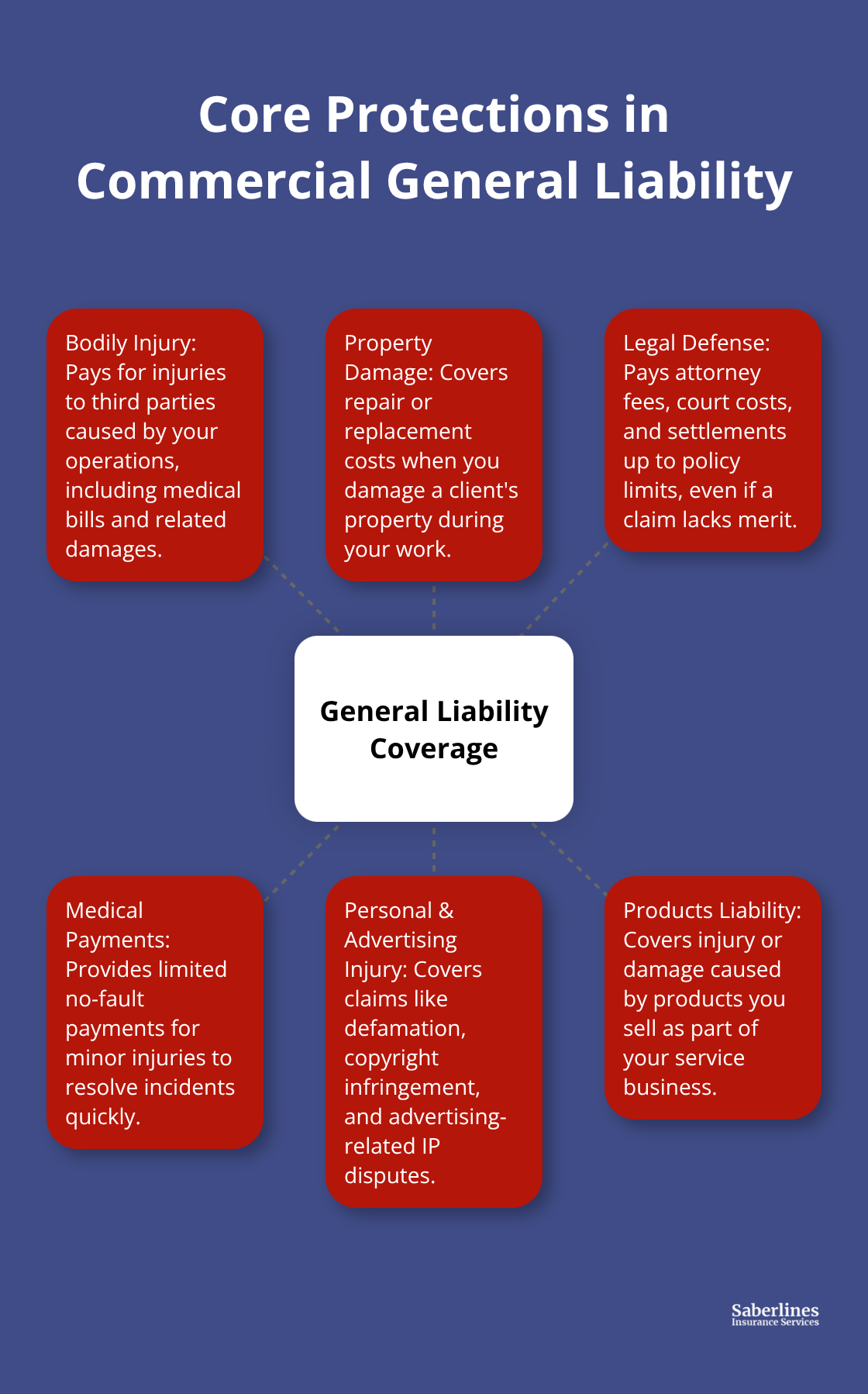
Second, the coverage handles property damage to others’ property caused by your business activities. If you accidentally damage a client’s flooring during a renovation project, break their equipment during installation, or cause structural damage while working on their premises, general liability pays for those repairs or replacements. Progressive’s 2025 data shows the national median general liability premium was $55 per month, though costs vary significantly based on your specific industry and employee count.
Legal Defense and Settlement Coverage
Third, the policy covers your legal defense costs and court settlements even when claims lack merit. Many service businesses underestimate how quickly legal fees accumulate-defense costs alone can reach tens of thousands of dollars before a case settles or goes to trial. The insurer pays these expenses up to your policy limits, protecting your cash flow when you face a lawsuit.
The policy also includes medical payments coverage for minor injuries, meaning you can pay someone’s emergency room visit or urgent care bill without admitting fault or waiting for a lawsuit. This component resolves small incidents quickly and prevents minor injuries from escalating into claims.
Additional Protections Within General Liability
Personal and advertising injury coverage protects against defamation claims, copyright infringement in your marketing, or intellectual property disputes arising from your advertising efforts. Additionally, if you sell products as part of your service business, general liability includes product liability protection for injuries or property damage caused by defects in those products.
The per-occurrence limit applies to individual claims while the general aggregate limit is the total the insurer will pay for all claims combined during the policy period. A $1.1 million claim would pay $1 million under the per-occurrence limit, with the remaining amount reducing your aggregate protection for the rest of the year.
What General Liability Does Not Cover
The policy does not cover theft of your own property, damage to your own business equipment, employee injuries (workers’ compensation handles those separately), or professional mistakes like a consultant providing bad advice. Understanding these boundaries matters because many service business owners discover gaps in their protection only after an incident occurs.
Now that you understand what general liability covers, the next step is recognizing why service businesses face such significant liability exposure in the first place.
Why Service Businesses Face Real Liability Risks
Constant Exposure in Daily Operations
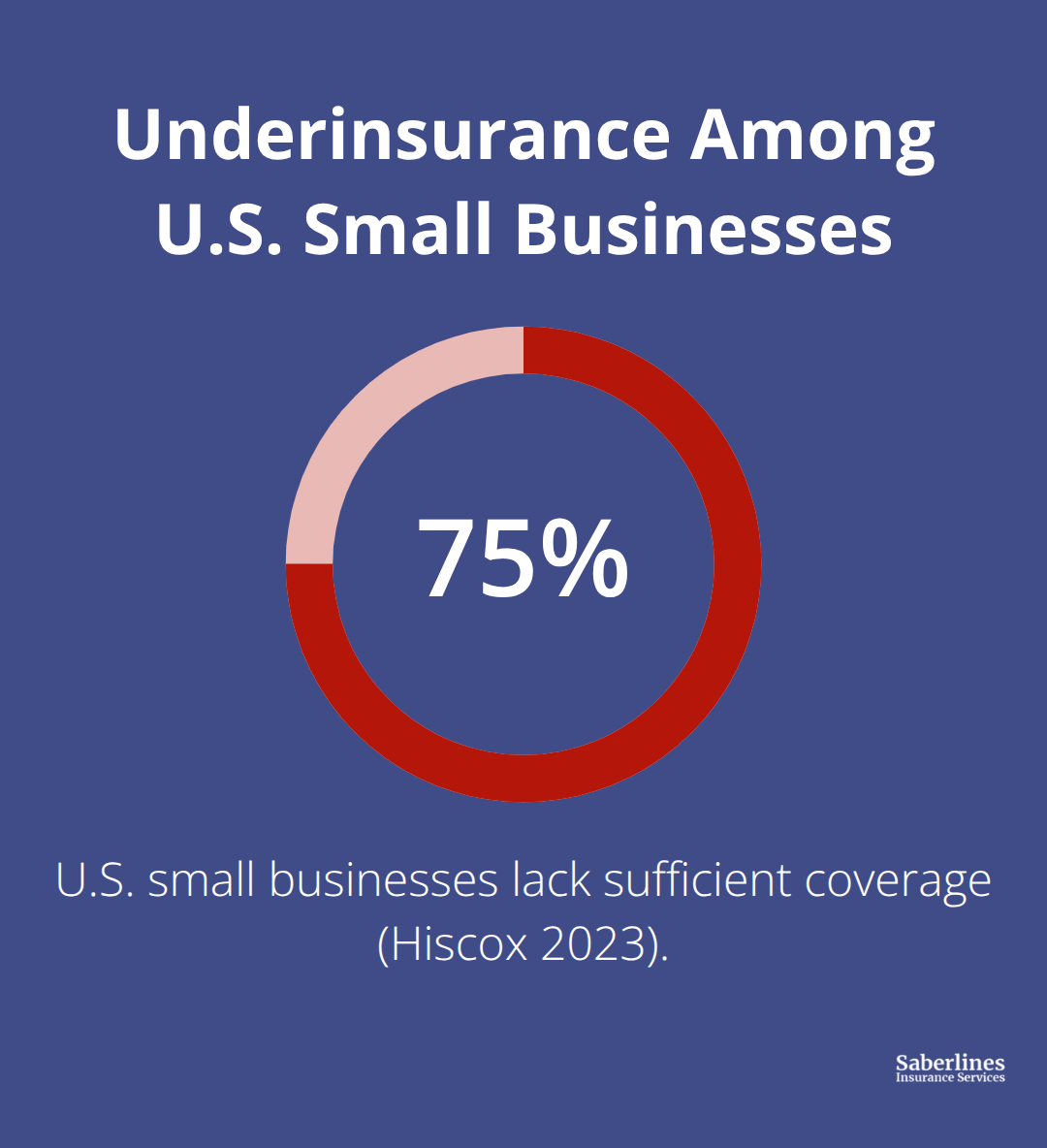
Service businesses operate in environments where liability exposure is unavoidable and constant. A plumber works in a client’s home, a landscaper operates equipment on residential property, a photographer shoots at a wedding venue, or a consultant advises a client-all face exposure to bodily injury claims, property damage incidents, and professional disputes. The 2023 Hiscox Underinsurance in Small Business Report found that approximately 75% of U.S. small businesses lack sufficient coverage, meaning most service operators are underprotected against the claims that actually occur in their industry.
Contractors face particularly high risk because they work on client premises, use equipment that can cause injury, and often handle valuable client property. A single incident-a client injured during service delivery, property damaged during installation, or a dispute over work quality-generates legal costs that exceed $50,000 before the claim even settles. Medical expenses from on-site injuries, property repair bills, and attorney fees combine to create financial exposure that most service businesses cannot absorb without devastating their cash flow and operations.
State Regulations and Contractual Demands
State regulations add another layer of liability risk that many service business owners overlook. Some states mandate workers’ compensation coverage if you have employees, while others require proof of general liability before issuing business licenses or permits. Clients increasingly demand certificates of insurance before signing contracts, and landlords require liability coverage as a condition of leasing commercial space.
Professional service providers in healthcare, legal, and accounting fields often face state-mandated professional liability requirements, though general liability alone falls short for these industries. Without understanding your state’s specific requirements and your clients’ contractual demands, you risk losing business opportunities, facing license suspension, or discovering mid-project that you cannot legally operate.
The Hidden Costs of Operating Uninsured
The financial impact of uninsured incidents extends far beyond the immediate claim payout. Lawsuits damage reputation, consume management time, drain legal resources, and can force temporary business closure during litigation. These secondary costs often exceed the actual settlement amount, affecting your ability to attract new clients and retain existing ones.
Understanding these liability risks makes it clear that selecting the right coverage limits becomes your next critical decision-one that directly determines whether your protection matches your actual exposure.
How to Choose the Right Coverage Limits for Your Business
Identify Your Contractual Requirements First
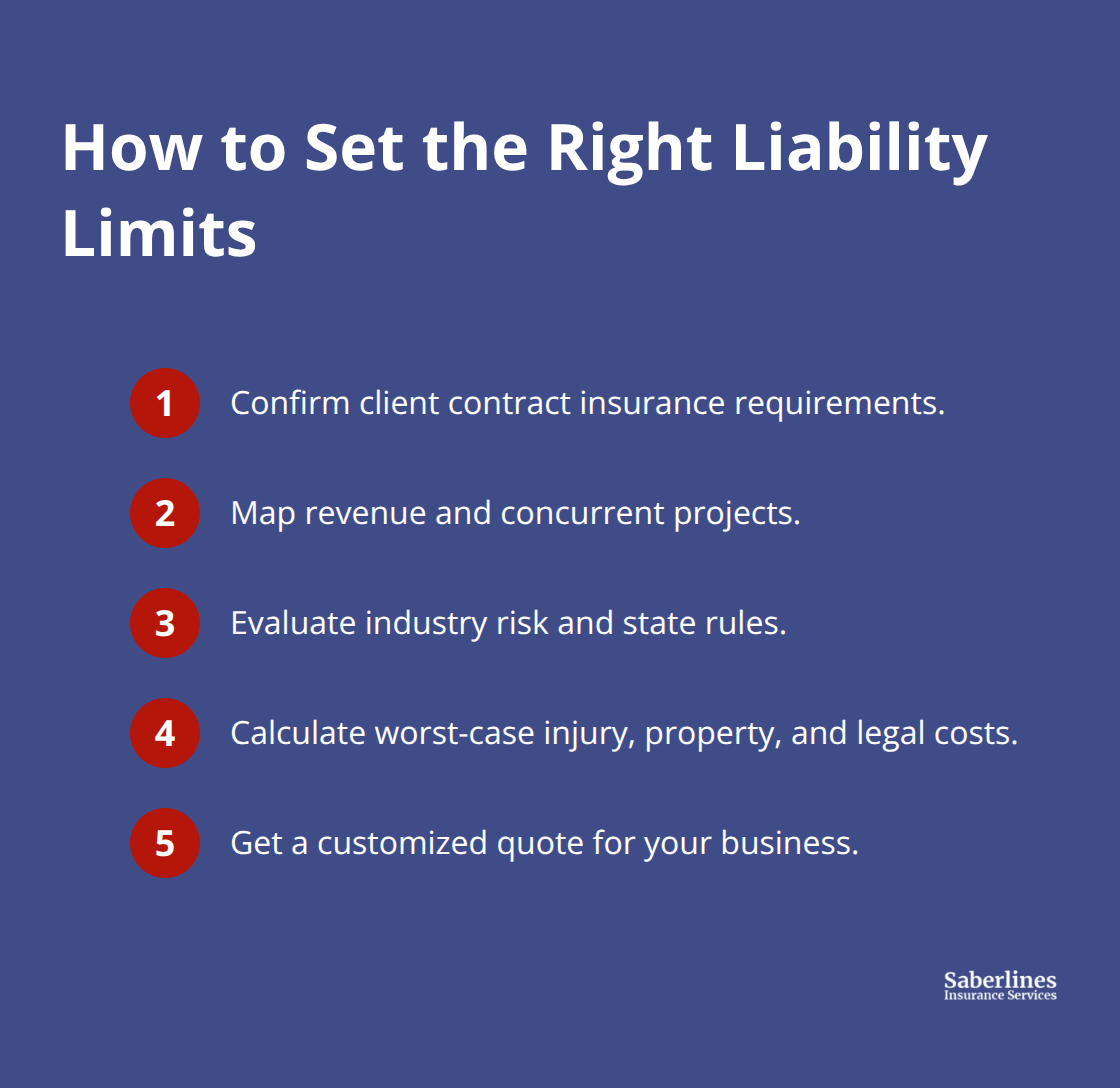
Your coverage limits determine whether general liability actually protects your business or leaves you exposed when a serious claim occurs. The standard starting point of $1 million per-occurrence and $2 million general aggregate works for many service businesses, but your actual needs depend on three concrete factors that you can assess right now. First, identify what your clients contractually demand before they sign work agreements with you. General contractors frequently require subcontractors to carry $2 million per-occurrence limits, while retail clients might accept $1 million. If you work across multiple client types, your coverage must meet the highest contractual requirement or you lose business opportunities.
Calculate Your Revenue and Project Exposure
Second, calculate your revenue exposure by examining what you charge clients and how many simultaneous projects you manage. A landscaping company earning $500,000 annually with five crews operating simultaneously faces different exposure than a solo consultant billing $150,000 per year. The Hartford data shows typical premiums around $810 yearly for $1 million/$2 million coverage, but higher coverage limits cost more-expect roughly $1,200 to $1,500 annually for $2 million/$4 million limits depending on your industry and location. Progressive’s 2025 median premium of $55 per month assumes standard risk; higher-risk industries pay significantly more.
Assess Your Industry’s Actual Risk Profile
Third, assess your industry’s actual claim history and the severity of potential injuries or property damage in your specific work. Contractors working at heights or with heavy equipment face greater exposure than interior designers. Service businesses in construction, plumbing, electrical work, and HVAC should strongly consider $2 million per-occurrence minimums because single incidents in these trades routinely exceed $1 million when property damage or catastrophic injuries occur. Your state may also set minimum requirements-some states mandate specific coverage levels before issuing licenses or permits, so verify your state’s regulations before selecting limits.
Calculate Your Worst-Case Scenario Costs
Once you understand your contractual obligations and industry risk, calculate your actual coverage needs by examining your worst-case scenario. Ask yourself: if you caused severe property damage to a client’s building, injured multiple people on a jobsite, or faced a major liability lawsuit, what would the total cost reach? Medical costs for serious injuries start at $50,000 and escalate rapidly for permanent disability or multiple injured parties. Property damage claims for construction defects or equipment damage frequently reach $100,000 to $500,000. Legal defense costs alone can consume $50,000 before a case settles. Adding these together reveals whether $1 million covers your actual exposure or whether you need $2 million or higher limits.
Get a Customized Quote for Your Situation
The cost difference between adequate and inadequate coverage is minimal-perhaps $30 to $50 monthly-but the protection difference is absolute when a serious claim occurs. Obtain a customized quote based on your specific industry, location, revenue, and employee count rather than assuming standard limits apply to your situation.
Final Thoughts
Commercial general liability coverage separates service businesses that survive claims from those that collapse under financial pressure. The protection addresses bodily injury claims, property damage incidents, and legal costs that accumulate faster than most service owners anticipate. Your next step is straightforward: review your client contracts to identify required coverage limits, calculate your worst-case scenario costs, and obtain a customized quote that reflects your actual business exposure.
We at Saberlines Insurance Services help service business owners secure the coverage they actually need without unnecessary complexity. Contact Saberlines Insurance Services to discuss your liability exposure and receive a quote tailored to your revenue, location, employee count, and industry risk profile. The difference between adequate and inadequate commercial general liability coverage costs only $30 to $50 monthly-but the protection difference becomes absolute when a serious claim occurs.
The information provided in this blog is for general informational purposes only and does not constitute legal, financial, or insurance advice. Coverage options, terms, and availability may vary. Please consult with a licensed professional for advice specific to your situation.