
NEMT Insurance Requirements: A Practical Compliance Guide
NEMT providers operate in a heavily regulated environment where insurance gaps can trigger fines, license suspensions, or worse-liability exposure that destroys a business. Getting your NEMT insurance requirements right isn’t optional; it’s the foundation of staying operational.
At Saberlines Insurance Services, we’ve seen too many operators scramble after an audit reveals missing coverage or inadequate limits. This guide walks you through the specific federal and state requirements, the coverage types you actually need, and the mistakes that cost providers thousands in penalties.
What Insurance Minimums Does Your State Actually Require?
Federal regulations from the U.S. Department of Transportation set a baseline, but state requirements for NEMT operators vary significantly and often exceed federal minimums. The DOT does not impose a single national commercial auto liability floor for NEMT; instead, individual states establish their own minimums, and many states require NEMT providers to carry coverage that protects both the operator and passengers. This means your policy limits in California differ from those in Texas or Florida, and operating across state lines without understanding each jurisdiction’s rules exposes you to penalties, contract termination, and uninsured liability.
State-Specific Requirements and Broker Demands
Contact your state’s Department of Insurance or review your Medicaid agency’s NEMT provider manual to find exact liability minimums, medical payment coverage requirements, and any additional endorsements your state demands. Some states require hired and non-owned auto coverage if you contract with independent drivers, while others mandate passenger liability limits that exceed standard commercial auto policies. Many NEMT brokers and Medicaid networks layer their own insurance requirements on top of state law, so your contract with a specific broker may demand higher limits or additional coverages like cyber liability for electronic visit verification systems.
Request a detailed coverage review from your insurance agent and cross-reference it against both your state’s regulations and every broker contract you’ve signed. Several states, including California, Texas, Florida, Minnesota, New York, and Ohio, have introduced or expanded electronic visit verification mandates, which means your cyber liability exposure has grown. Breaches involving patient health information can trigger HIPAA penalties reaching tens of thousands of dollars, yet many NEMT operators still carry inadequate or no cyber coverage.
Medical Payment Coverage Protects Passengers Immediately
Medical payment coverage protects your passengers if they sustain injuries during transport, regardless of fault, and it operates separately from passenger liability limits on your commercial auto policy. Many NEMT operators confuse these two coverages and end up with gaps that leave them vulnerable to lawsuits from injured patients or their families. Medical payments typically cover reasonable medical expenses up to a stated limit-often $1,000 to $5,000 per person-and this coverage pays quickly without requiring a lawsuit, which reduces friction with healthcare networks and Medicaid agencies.
Passenger Liability Limits Must Match Your Risk Exposure
Passenger liability is the portion of your auto liability policy that covers bodily injury claims from passengers; if a patient sues you for injuries sustained during transport, passenger liability is what defends and pays the claim. Standard commercial auto policies sometimes cap passenger liability at lower limits than third-party liability, so a patient with significant medical bills may exhaust your coverage and pursue personal assets. Higher limits-$250,000 to $500,000 per person for passenger liability-are increasingly expected by larger Medicaid networks and healthcare systems, especially if you transport high-acuity patients or operate a larger fleet.
Request a quote that separates passenger liability from third-party liability and ask your broker whether your Medicaid contracts or healthcare facility agreements specify minimum passenger limits. General liability policies typically do not cover passengers, and that gap can be catastrophic. Understanding the difference between medical payments and passenger liability determines whether you survive a serious injury claim or face personal financial exposure that destroys your business.
What Coverage Do NEMT Operators Actually Need
Commercial Auto Insurance Forms Your Foundation
Commercial auto insurance is non-negotiable for NEMT operations, but too many operators purchase the minimum and stop there. Your commercial auto policy must cover bodily injury and property damage liability for passengers and third parties, medical payments for injured passengers, and uninsured/underinsured motorist protection. Most NEMT providers operate minivans or passenger vans, and insurers rate these vehicles based on seating capacity, age, and whether they include wheelchair lifts or securement systems. A 2015 minivan with a wheelchair lift costs significantly more to insure than a 2022 SUV without accessibility equipment, so fleet age and equipment choices directly impact your premium. Request separate quotes for different vehicle configurations to understand your actual cost exposure before expanding your fleet.
Medical Payments and Passenger Liability Require Separate Attention
Medical payment coverage protects your passengers if they sustain injuries during transport, regardless of fault, and it operates independently from passenger liability limits on your commercial auto policy. Many NEMT operators confuse these two coverages and end up with gaps that leave them vulnerable to lawsuits from injured patients or their families. Medical payments typically cover reasonable medical expenses up to a stated limit-often $1,000 to $5,000 per person-and this coverage pays quickly without requiring a lawsuit, which reduces friction with healthcare networks and Medicaid agencies.
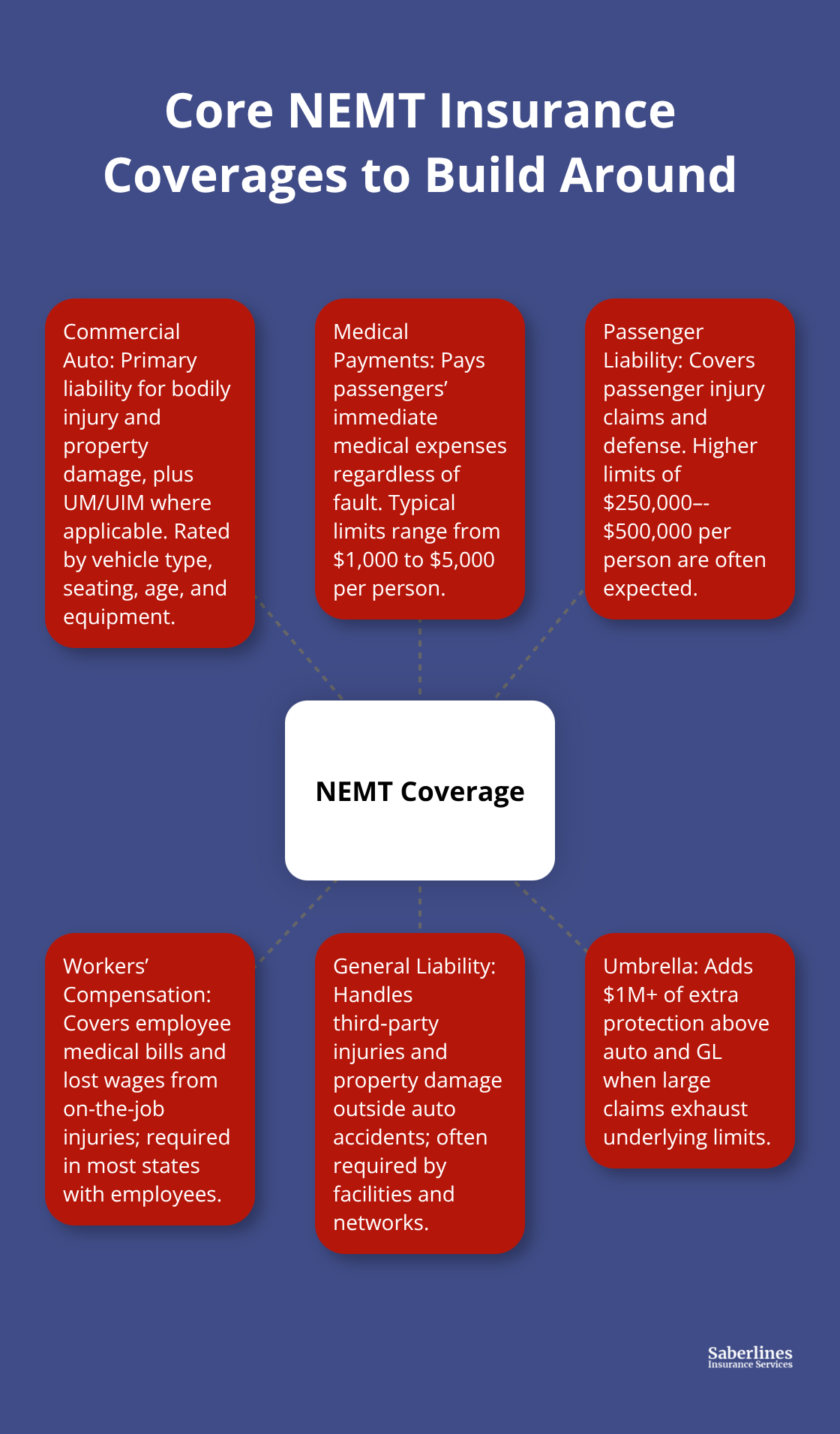
Passenger liability is the portion of your auto liability policy that covers bodily injury claims from passengers; if a patient sues you for injuries sustained during transport, passenger liability defends and pays the claim. Standard commercial auto policies sometimes cap passenger liability at lower limits than third-party liability, so a patient with significant medical bills may exhaust your coverage and pursue personal assets. Higher limits ($250,000 to $500,000 per person for passenger liability) are increasingly expected by larger Medicaid networks and healthcare systems, especially if you transport high-acuity patients or operate a larger fleet. Request a quote that separates passenger liability from third-party liability and ask your broker whether your Medicaid contracts or healthcare facility agreements specify minimum passenger limits.
Workers’ Compensation Protects Your Team
Workers’ compensation insurance covers medical expenses and lost wages for drivers and staff injured on the job, and it’s mandatory in virtually every state if you have employees. A driver injured during a patient transfer, a dispatcher injured at your facility, or an administrative staff member hurt during operations all fall under workers’ compensation. Many NEMT operators mistakenly assume their commercial auto policy covers employee injuries, but it doesn’t-that’s workers’ compensation’s job. Your premium depends on your payroll, claims history, and job classifications; a driver role costs more to insure than a dispatcher role because the risk is higher. Review your workers’ compensation policy annually as your payroll grows, because underreporting payroll to save premium money exposes you to audit penalties and leaves injured employees underprotected.
General Liability and Umbrella Coverage Close Critical Gaps
General liability insurance covers third-party bodily injury and property damage claims that fall outside auto accidents-a patient falls in your facility, a staff member damages a healthcare facility’s property, or a patient’s service animal is injured during transport. This coverage is separate from your commercial auto policy and is often required by Medicaid networks and healthcare facility contracts. Umbrella policies sit on top of your general liability and commercial auto policies and provide additional coverage limits when claims exhaust your underlying policies. If a serious accident causes $750,000 in damages but your commercial auto limit is only $500,000, your umbrella policy covers the $250,000 gap. Umbrella policies are relatively inexpensive-often $300 to $600 annually for $1 million in additional coverage-and they’re increasingly demanded by larger healthcare systems and Medicaid agencies.
Bundle Policies and Shop Multiple Carriers
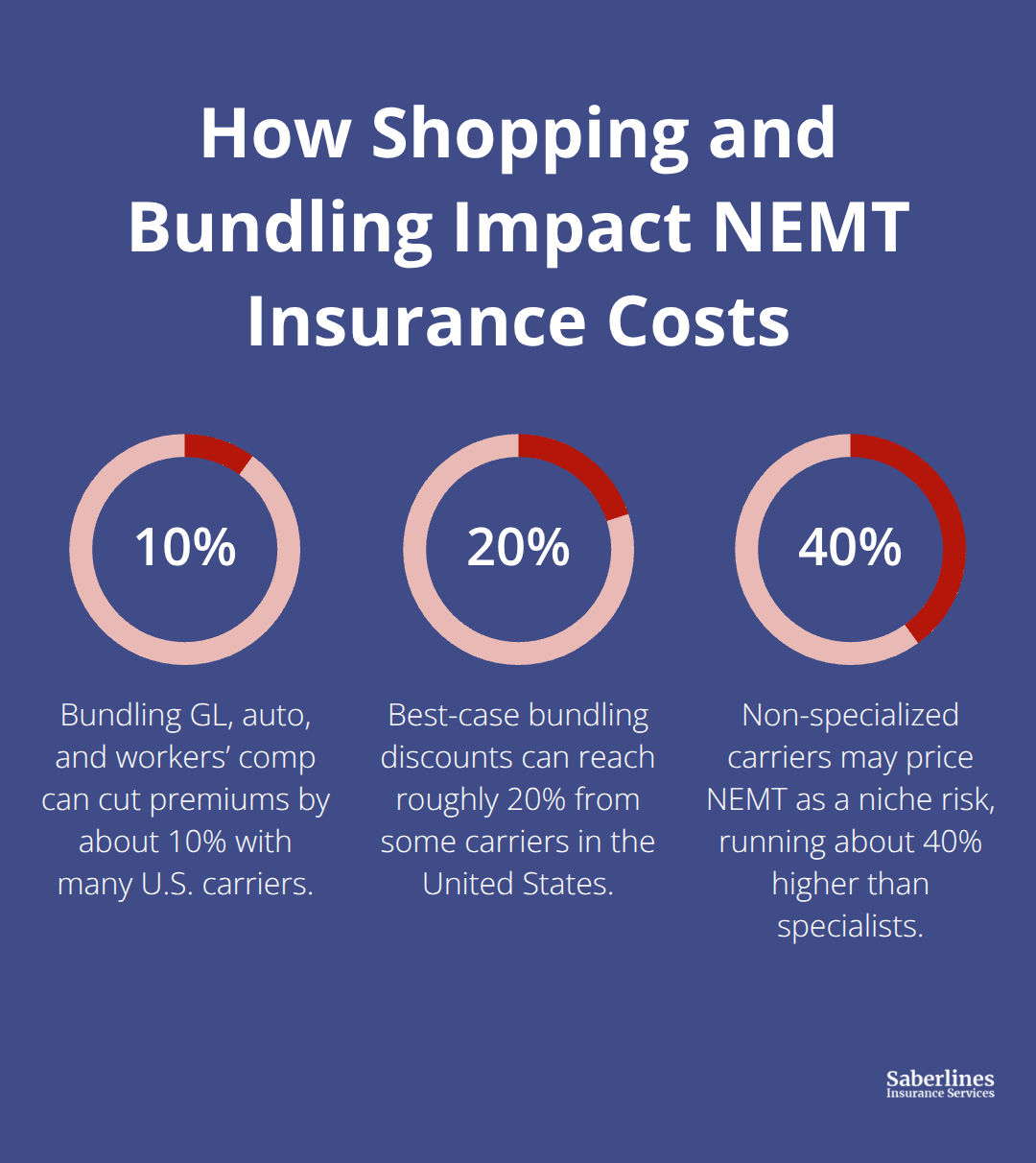
Bundling your general liability, commercial auto, and workers’ compensation policies together yields 10% to 20% discounts from most carriers. Shop quotes from at least three carriers because NEMT rates vary wildly based on how individual insurers underwrite medical transport risk. Some carriers specialize in NEMT and price competitively; others treat it as a niche risk and charge premiums 40% higher than specialized competitors.
Request a detailed coverage summary from each quote that lists policy limits, deductibles, and any exclusions specific to NEMT operations, because hidden restrictions on passenger liability or wheelchair lift coverage can create gaps you won’t discover until you file a claim. Your choice of carrier directly affects both your cost and your protection, so comparing options across multiple underwriters is essential before you commit to coverage.
Common Compliance Mistakes NEMT Providers Make
Fleet Expansion Without Policy Updates
Most NEMT operators make one critical mistake: they purchase insurance based on their current fleet size and never revisit it. A provider with three vans buys a policy rated for three vehicles, then adds a fourth van six months later without updating coverage. The new vehicle operates uninsured or underinsured because the policy never changed. When an accident happens, the claim gets denied and the operator discovers the gap during the worst possible moment.
Your insurance needs shift every time you add a vehicle, hire a new driver, expand into a different service area, or increase your Medicaid reimbursement volume. Failing to update your policy creates immediate exposure that no amount of scrambling can fix retroactively. A quarterly review process prevents this pattern entirely. Set a calendar reminder to contact your insurance agent every three months and report any changes to your fleet, payroll, or service territory. This simple habit costs nothing and protects your entire operation.
Underinsuring Passenger Liability Limits
Many operators copy their state’s minimum requirements and stop there, assuming that’s sufficient protection. If your state requires $100,000 in passenger liability but you transport patients with complex medical needs in a five-vehicle fleet generating $500,000 annually in revenue, that $100,000 limit evaporates in a single serious injury claim. A patient paralyzed during transport could pursue damages exceeding $1 million, and once your policy limit is exhausted, personal assets become the target.
Medicaid networks and healthcare facilities increasingly demand $250,000 to $500,000 in passenger liability before they’ll contract with you, so meeting the minimum actually disqualifies you from higher-revenue partnerships. The cost difference between $100,000 and $250,000 in passenger liability is typically $100 to $300 annually per vehicle, yet operators refuse to pay it. Higher limits protect both your business and your patients’ legitimate claims.
Neglecting Documentation and Certificate Maintenance
Brokers require current certificates of insurance with your agency listed as additional insured, and audits demand proof that your coverage was active on specific service dates. If your certificate expired last month but you continued billing Medicaid, regulators treat those claims as submitted without valid insurance. This triggers recoupment demands and false claims penalties ranging from $14,000 to $29,000 per claim according to federal guidelines.
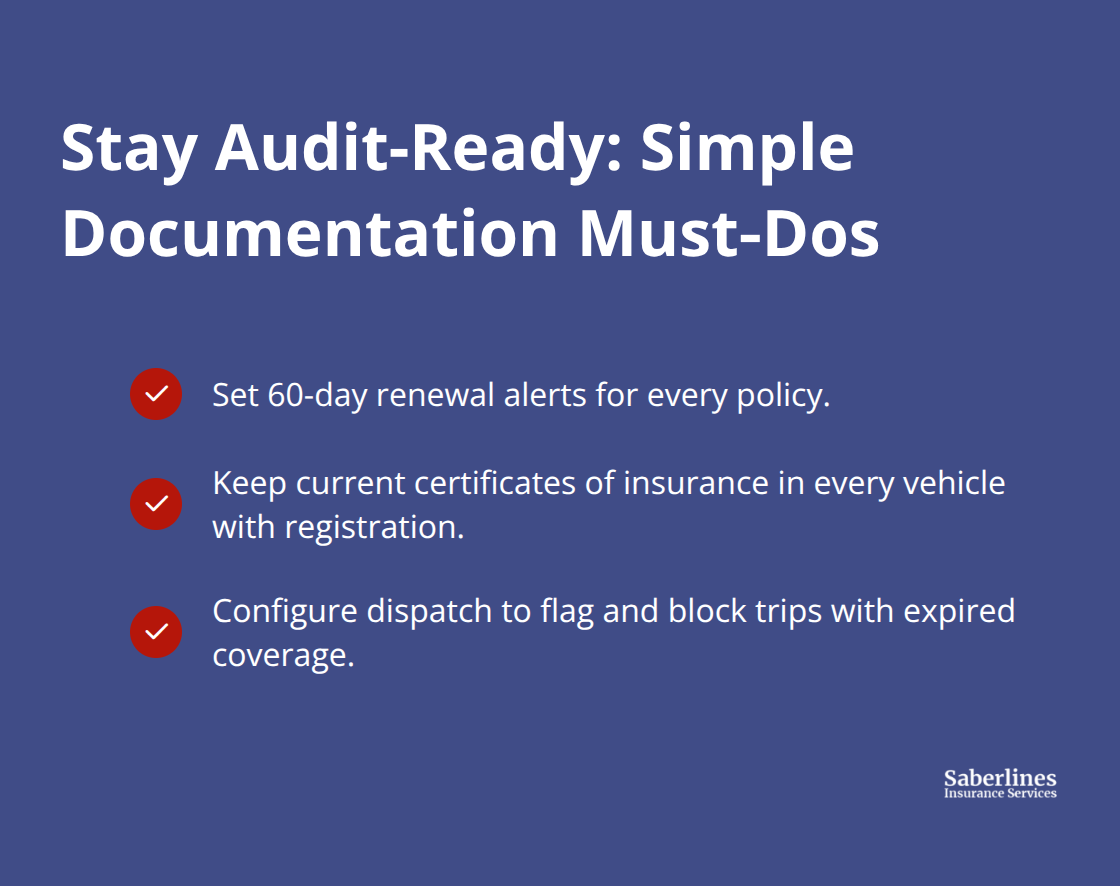
Maintain a 60-day renewal alert system and a master calendar tracking every policy’s expiration date. Your certificate of insurance must be physically present in every vehicle alongside current vehicle registration. Your dispatch system should flag expired coverage before you accept new trips. This documentation discipline prevents the costliest mistakes in NEMT operations.
Final Thoughts
NEMT insurance requirements protect your patients, your business, and your revenue stream. You must understand your state’s minimums, recognize that broker contracts often demand more than state law requires, and build coverage that matches your actual risk exposure rather than just meeting the bare minimum. Start by pulling together every broker agreement, Medicaid provider manual, and healthcare facility contract you’ve signed, then list the exact coverage limits and endorsements each one demands.
Set up a quarterly review process and stick to it. Add a calendar reminder for every three months to contact your insurance agent and report any changes to your fleet, payroll, service territory, or contracts. Maintain a master renewal calendar with 60-day alerts for every policy expiration, and keep current certificates of insurance in every vehicle alongside your registration (this prevents the costly mistake of operating uninsured vehicles after you expand).
We at Saberlines Insurance Services specialize in helping NEMT operators navigate these requirements and secure coverage that actually protects your business. Whether you’re verifying your current coverage or building a complete insurance program from scratch, we can help you get compliant and stay protected.
The information provided in this blog is for general informational purposes only and does not constitute legal, financial, or insurance advice. Coverage options, terms, and availability may vary. Please consult with a licensed professional for advice specific to your situation.